The Kotlin community is expanding. Google acknowledged Kotlin this year, making it Android’s second official language. Android developers finally have the pragmatic and intuitive language they have been waiting for.
But the big problem for developers is whether they should learn Kotlin only or Java as well.
Android development has evolved significantly, with Java and Kotlin emerging as the two most popular programming languages. Choosing between them depends on project requirements, scalability, and developer expertise. With professional support from mobile app development services, businesses can build high-performance Android applications tailored to their needs.
Key Takeaways:
There is no denying that Java has its place to compete, but with time, we all need some advancement, so if we can find it, we always look for a better option. Each language has its pros and cons, with which you have to decide which language you can utilize well.
Sun Microsystems developed Java, an object-oriented programming language. It is currently owned by Oracle. It was launched in 1991, and as an old language, it has much more to offer to you. Even Java can offer you more job opportunities, as you don’t want to develop Android applications all the time. It can let you open your wings and fly to another field. Because Android itself is Java-based, mobile app development firms have always preferred Java over any other language. It becomes essential to see why Java is considered the first official language for Android app development.
Kotlin launched in 2016, and at that time, all developers needed a modern language for Android development that could contribute to Java’s features and help in mobile development. JetBrains developed Kotlin, an open-source language based on the JVM. It can be compiled and interpreted with Java due to its statically typed, Java-based language. Developing Android Apps with Kotlin allows developers to update old Java applications readily, and you can effortlessly carry their work from Java to Kotlin.
After the brief introduction of both languages, now let’s take a look at what merits and demerits Java and Kotlin have in store for you.
Java is a reputable programming language with extensive open-source tools and libraries to benefit developers. With that said, there is no language without fault, and even Java is subject to complications that can render a developer’s job tedious. If anything, Kotlin will introduce solutions to prevalent headaches in programming and strengthen the Java ecosystem as a whole.
Over time, Kotlin has become a much more stable and congruous development alternative for Android Studio. Some developers also seem to believe that in the coming years, it will oust Java for Android development. Other specialists see that Kotlin and Java coexist without one outweighing the other. For most, the strengths of Kotlin outweigh the setbacks of the language. There are definite constraints within Java that impede the design of the Android API. Kotlin is inherently lightweight, neat, and far less verbose, particularly when it comes to writing callbacks, data classes, and getters/setters.
In other words, it is specifically designed to improve existing Java models by providing solutions to deficiencies in the design of the API, as Android programming is based on the Java programming language. Therefore, addresses numerous weaknesses of Java.
Adopting a new development language requires careful consideration. Kotlin delivers two concrete business advantages that justify the switch.
Reduced Project Timelines – Kotlin’s concise syntax means developers write less code to accomplish the same tasks. This readability makes code reviews and updates faster, accelerating time-to-market and reducing overall project duration.
Fewer App Crashes – Less code translates directly to fewer bugs. With a smaller codebase, there is less surface area for errors to hide. Kotlin’s clean syntax also makes bugs easier to spot and fix during development, resulting in more stable applications and lower maintenance costs.
One of the reasons is the trust built up around Kotlin owing to Google officially supporting the language. This support will expand the Android app development ecosystem, which will provide companies with improved technical support and other capabilities. Within the Android app development ecosystem, Kotlin is all set for a promising future. The reduced development and maintenance costs of Kotlin projects are a major advantage for any business, offering strong language features and concise code that guarantees greater performance with quicker turnaround time.
Major technology companies across multiple industries have already adopted Kotlin in their development environments. Their decisions reflect the language’s proven reliability and performance benefits:
These organizations range from streaming platforms to productivity tools to infrastructure providers, demonstrating Kotlin’s versatility across different business domains.
Kotlin was designed to address Java’s limitations while maintaining compatibility. Here’s how it simplifies development:
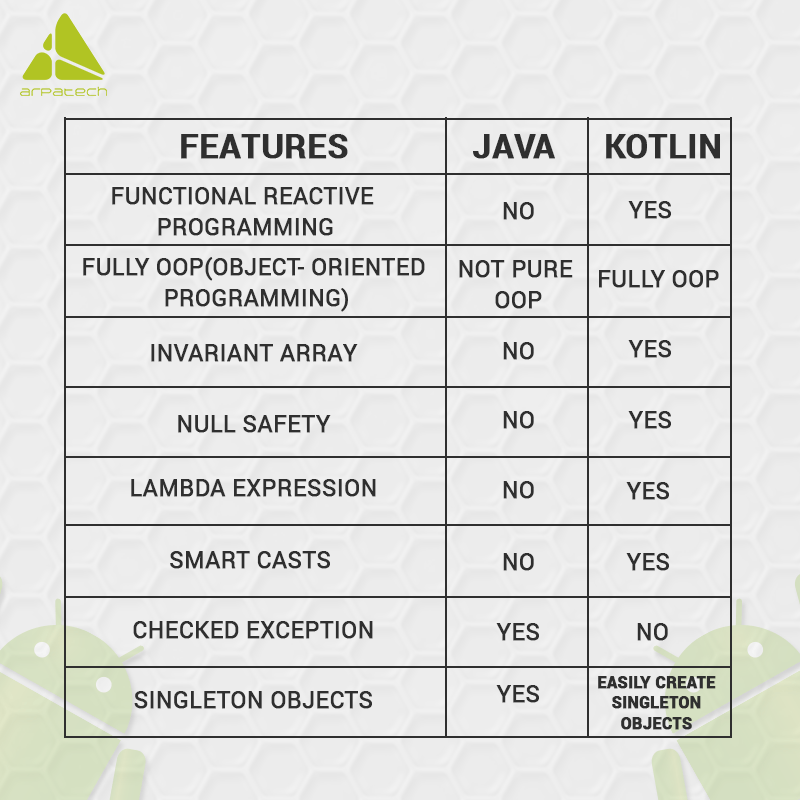
Comparing programming languages is inherently subjective. The factors that matter most depend on project needs, team expertise, and long-term strategy. Kotlin is built on Java, and the two languages are deeply connected; direct comparison misses the nuance of when each works best.
Many development teams have already made the switch to Kotlin and report measurable improvements. Others continue using Java for Android development. The difference comes down to what each project requires.
Two realities stand out:
The choice between them is not about one replacing the other; it is about matching the right tool to your project’s needs and timeline.
Both Java and Kotlin continue to shape the future of Android app development, each offering unique strengths for developers and businesses. While Java remains stable, your project goals will ultimately determine the best choice and long-term vision.
Arpatech has the Android expertise to build powerful applications that users love and businesses rely on. Let’s talk.

Before we begin, please solve this quick math check to confirm you're human, and you'll be all set to start chatting with our AI assistant.
Stay connected with us to receive the latest information, updates, and insights from our world of innovation.
By entering your email address you will receive promotional updates.


© 2026 ARPATECH (ADVANCED RESEARCH PROJECTS & TECHNOLOGY)