The Short Version:
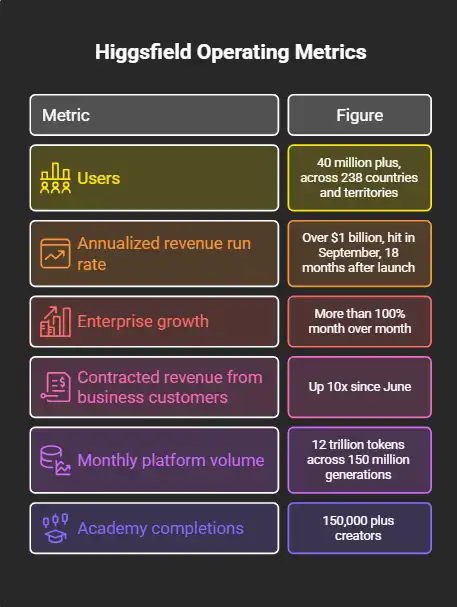
The Higgsfield Series B extension added TCV and NVIDIA as new investors on October 23, 2026, building on a round DST Global led in August. Higgsfield reports more than 40 million users across 238 countries, over $1 billion in annualized revenue run rate reached in September, and enterprise growth above 100% month over month. The announcement came out of San Francisco and Astana, timed with Jensen Huang’s first visit to Kazakhstan. The money goes to product, global infrastructure, hiring, and go-to-market. The bigger story sitting underneath it is that brands now need more visual content than traditional production can deliver, and investors are pricing that gap.
The Higgsfield Series B extension was announced on October 23, 2026, with TCV and NVIDIA coming in as new investors. It extends the Series B that DST Global led in August, a round that also included Goldman Sachs Alternatives, Tribe Capital, AI Capital Partners, Smash Capital, GFT Ventures, and Valor Capital.
Higgsfield did not disclose the extension amount. It did disclose the operating numbers, all self-reported:
* The US is its largest single market. Europe is its largest region by usage.
TCV has backed Netflix, Spotify, Facebook, ByteDance, and Electronic Arts. Founding General Partner Jay Hoag framed the investment as part of that same line of media platforms. General Partner Neil Tolaney pointed to product velocity and adoption speed as the reason, describing the platform as an AI-native route for creators, brand marketers, and agencies to turn ideas into images and video.
NVIDIA’s position is different. It is both investor and supplier. Higgsfield has scaled on NVIDIA hardware since L40 and A40 GPUs, moved through Hopper and Blackwell, and is now expanding to Vera Rubin. It uses NVIDIA Dynamo to deploy custom inference workloads on its own GPU infrastructure. Its 15-minute animated short, Kök Börü, ran on Blackwell Ultra and was open-sourced as a free Academy course.
Rev Lebaredian, NVIDIA’s VP of physical AI simulation, described AI factories as producing tokens and the application layer as the place where those tokens become useful work.
This is the part worth slowing down on, because it explains the valuation logic more than the user count does.
Industry benchmarks cited in the announcement put generative video’s effective yield at $30 to $150 per million equivalent tokens. Text sits at $0.15 to $0.60. A single commercial campaign does not produce one asset. It produces multiple generations, test variants, and adaptations for different markets and languages. Higgsfield says it can generate up to 100 ad variants from one campaign concept.
So the same compute, pointed at video instead of text, returns a far higher value per token. That is the bet.
The market data backs the direction. WPP Media forecasts global advertising revenue of $1.3 trillion in 2026 and names AI as a primary driver. The IAB expects US digital video ad spending to pass $80 billion this year, with close to two in three buyers already using generative AI for digital video creative, up from half in 2025.
Strip away the funding headline and the pattern is clear. The winners in this cycle are not the ones with the best model. They are the ones who built a production layer around models: workflow tooling, controls, automation, and systems that turn raw output into something a client can actually sign off on.
That gap is where most enterprise AI projects stall. A team gets access to a strong model, runs a pilot, produces something impressive once, and then cannot repeat it reliably across campaigns, departments, or regions. The model was never the bottleneck. The workflow around it was.
This applies well beyond creative work. The same structure shows up in support automation, claims processing, document review, and scheduling. Agentic AI is already handling clinic scheduling, referrals, and routine communication with far less manual effort, which is the same shift Higgsfield is riding in media: compute becomes useful only when something orchestrates it.
Arpatech has been building that orchestration layer since 2003, with teams across the US, UK, UAE, and Pakistan. Our AI practice covers model integration, agentic workflow design, and the cloud and DevOps infrastructure underneath it, so the pilot that worked once keeps working at volume.
The financing supports product development, global infrastructure, hiring, and go-to-market expansion. Higgsfield is headquartered in San Francisco with roots in Kazakhstan through Astana Hub, and is described as the country’s first AI unicorn. Co-founder and CEO Alex Mashrabov previously co-founded AI Factory, the computer vision company behind Snapchat’s Cameos, acquired by Snap in 2019.
Expect more capital to flow toward the application layer through 2027. The compute is available. The models are commoditizing. The value is moving to whoever builds the system that makes them produce consistent, usable work.
If your team has run AI pilots that looked good in a demo and stalled before production, that is the exact problem we work on. Book a 30-minute AI readiness call with Arpatech and we will walk through your current stack, where it breaks under volume, and what it would take to fix it.

Before we begin, please solve this quick math check to confirm you're human, and you'll be all set to start chatting with our AI assistant.
Stay connected with us to receive the latest information, updates, and insights from our world of innovation.
By entering your email address you will receive promotional updates.


© 2026 ARPATECH (ADVANCED RESEARCH PROJECTS & TECHNOLOGY)