The Short Version:
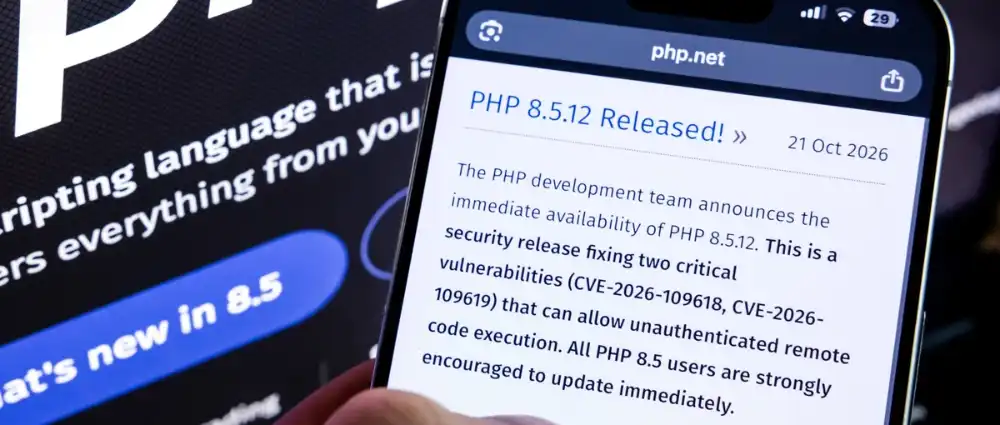
Two critical PHP security vulnerabilities, CVE-2026-109618 and CVE-2026-109619, let an attacker run code on a PHP website with one crafted web request and no login. Five days after the emergency PHP patch, here is where it stands:
The schedule was decided by a leak. On 20 October 2026, details of two unpatched PHP security vulnerabilities surfaced online ahead of the coordinated disclosure date. The PHP security team posted an advance notice that evening and moved the release forward, saying it could ship even earlier if active exploitation appeared.
On 21 October at 14:00 UTC, PHP published the advisory and released 8.5.12, 8.4.27, 8.3.36 and 8.2.35. The GitHub advisories went live 26 minutes before the announced time. Fixed Windows builds appeared on downloads.php.net at 13:47 UTC.
None of this was new code. The PHP Foundation says a 2024 audit turned up the first signs of the weakness, and it sat there partly because nobody had shown it was exploitable. Ryan Austin at the security firm Calif found working paths on 1 August 2026 and reported the first bug to PHP between 11 and 14 August. Wiz Research ran into the same bug family on its own, finding its first bug on 19 August and reporting on 24 August. Sansec traces the vulnerable code back to PHP 5.4.0, released in 2012, so this is roughly fourteen years of exposure.
|
Date (2026) |
What Happened |
|---|---|
|
1 August |
Calif finds multiple RCE paths in the PHP engine |
|
11 to 14 August |
Calif reports the first bug and coordinated disclosure begins |
|
19 to 24 August |
Wiz Research independently finds and reports the same bug family |
|
21 September |
PHP starts work on the fix |
|
17 October |
Amazon’s MadPot honeypots record the first exploit attempt |
|
20 October |
Details leak, PHP announces an emergency release, CERT-EU issues advisory 2026-018 |
|
21 October, 07:43 UTC |
Cloudflare reports the first attacks, more than six hours before the fix |
|
21 October, 14:00 UTC |
PHP ships 8.5.12, 8.4.27, 8.3.36 and 8.2.35. CISA and the UK NCSC publish alerts |
|
21 to 22 October |
Governments pull sites offline. Cloudflare’s attempt count climbs into the millions |
|
23 October |
Mirai deployment attempts reported. About 34.4 million PHP services still assessed vulnerable |
|
25 October |
CYFIRMA reports a suspected North Korea-linked scanning campaign. Still no CISA KEV listing |
CVE-2026-109618 abuses PHP’s memory limit. While PHP sets up an incoming request, it marks some internal state as ready before every allocation it needs has succeeded. Send a request big enough to exhaust the memory limit and PHP gets interrupted partway through, leaving that state half built and never rolling it back. The cleanup routine then treats the leftover memory as valid, which is a use after free (CWE-416). From there an attacker can corrupt memory and run their own code. On top of that, the flaw can leak server memory back to the attacker.
CVE-2026-109619 works differently. Internal state tied to one request survives after its memory is freed, so a later request handled by the same worker picks up the stale data. Both end in the same place: remote code execution without credentials.
Severity ratings vary by setup. Red Hat rates CVE-2026-109618 Important rather than Critical for its own distributions, on the basis that standard Red Hat Enterprise Linux builds run PHP-FPM, whose workers exit on early initialization failures before reaching the corrupted structures. Red Hat says exploitation there is difficult in practice and usually needs non-default behaviour, such as parsing a second request body during script execution. That is a reason to check your own stack, not a reason to skip the PHP patch.
This is the part of the story that has nothing to do with patching and everything to do with what comes next. Calif found the first flaw with OpenAI’s GPT-5.6 Sol, during a PHP source audit funded under OpenAI’s Patch the Planet program. Wiz used Google’s Gemini 4 Argon, GPT-5.6 Sol and its own Wiz Atlas tool. PHP’s advisory credits Calif, Wiz and OpenAI together.
OpenAI calls the result a Defender’s Window: the models found the flaws before attackers did, which bought two months of coordinated fixing. Wiz put the severity next to Heartbleed and Log4Shell and said the models made the difference. Not everyone reads it that way. Calif’s own write-up points out that every ingredient was already public, including the C source on GitHub, Stefan Esser’s 2004 work on interrupting PHP through the memory limit, a 2019 bug report and the 2024 audit notes. The models searched public material faster than people had, which is still a change worth taking seriously.
The uncomfortable comparison came from commentary in The Guardian: The PHP Foundation maintains the language with 13 full and part time staff, while the AI research that helped find the bug runs on billions in funding. If AI-assisted discovery becomes routine, the gap between a flaw being found and a flaw being exploited keeps shrinking, and a quarterly patch cycle will not keep up.
If PHP serves web requests anywhere in your stack, assume yes until you have checked the version. PHP says every installation serving web requests is at risk, including PHP-FPM, Apache with mod_php, php-cgi, FrankenPHP and LiteSpeed.
|
PHP Branch |
Vulnerable |
Fixed in |
|---|---|---|
|
8.5.x |
Below 8.5.12 |
8.5.12 |
|
8.4.x |
Below 8.4.27 |
8.4.27 |
|
8.3.x |
Below 8.3.36 |
8.3.36 |
|
8.2.x |
Below 8.2.35 |
8.2.35 |
|
8.1 and older, back to 5.4 |
All versions |
No official PHP release. Check vendor backports, or upgrade |
.
Because the flaws live in the engine, the application on top does not protect you. Sansec reports that an attacker without a login can run code against stock installs of Magento 2.4.9, WordPress 7.1.2, Drupal 11.4.3, Joomla 6.1.4, MediaWiki 1.46.2, Roundcube 1.7.4, phpMyAdmin 5.2.3 and Nextcloud 35.0.1.
Run php -v on each server, and remember the places PHP hides: container images, staging boxes, cron workers, CI pipelines and old client sites nobody has touched in two years.
The scanning started immediately and has not stopped. Cloudflare saw tens of thousands of exploit attempts within 45 minutes of the announcement, hundreds of thousands within two hours, and millions by early on 22 October. Amazon, whose MadPot honeypots caught the first attempt on 17 October, now describes PHP2Shell as broadly exploited in the wild and says it does not know how that attacker got the details early. watchTowr reports exploitation of both CVEs through its Attacker Eye honeypot network. Hadrian logged exploitation at scale from 11:35 UTC on 21 October, mostly through PHP’s session upload progress path. Check Point Research puts the share of organisations worldwide that have seen exploitation attempts at 10%, with Europe taking the brunt and attempts peaking around midnight when fewer people are watching.
The tooling is public and improving. Proof of concept code circulated before the patch and several working exploits are now on GitHub. SOCRadar found an exposed attacker server at 206.188.197[.]105:9999 holding a one-click Python exploit for PHP 8.4.26 under Apache mod_php, plus screening scripts that check live sites for the conditions the chain needs, spread across ten open directories. VulnCheck reports a working exploit for CVE-2026-109618 that defeats ASLR on x86-64 with standard production settings against unpatched PHP 8.4. Some attempts are trying to install Mirai botnet malware. CYFIRMA says a suspected North Korea-linked campaign is probing PHP infrastructure globally from 21 compromised nodes.
What nobody has shown yet is a confirmed break-in. As of 25 October, no victim organization has been publicly named, and neither CVE is in CISA’s Known Exploited Vulnerabilities catalog. One widely shared report did not hold up: Unit 42 described attackers reaching MFA secrets and password hashes at a European government body, with agentic AI platforms used for the post-exploitation work, then retracted the link, telling The Hacker News it could not confirm that initial access came from the PHP2Shell CVEs. NCSC-NL said on 23 October that it knows of one report of possible misuse abroad, unconfirmed, and that large scale misuse now looks less likely than it first estimated. Sansec, which had predicted mass attacks within fifteen minutes of the release, has also softened its view: a working attack needs specific knowledge of the target server, and the public exploits do not fire against every build.
That is not an all clear. It means attempts are universal and success takes targeting. watchTowr’s advice is to start any investigation from 17 October, not from the disclosure date.
The clearest signal of how seriously this was taken came from the organisations that went dark. Reuters reported public bodies in the Netherlands, Finland, France and Denmark taking websites and services offline as a precaution while they patched. The Dutch national cyber agency took down its own site, followed by the Tweede Kamer, Overheid.nl, DigiD, the Dutch Data Protection Authority, the Port of Rotterdam, the football association KNVB and NotuBiz, which runs council information for more than 100 local governments. Finland’s state IT centre Valtori shut down public central government web services, and the National Land Survey went offline too. France’s Interior Ministry pulled local government administrative sites while it waited for the fix. Universities followed: Vienna switched off its websites, webmail and Moodle, with Freiburg and Haaga-Helia doing the same.
In the UK, tech minister Baroness Lloyd of Effra told the House of Lords that 32 government services were unavailable and four partially unavailable, with no confirmed compromise. Australia’s own cyber security agency website went offline as well. The FBI and CISA both advised taking systems offline where an immediate update was not possible.
There is a lesson in the pattern. Organisations with an accurate inventory switched off only what was exposed. Organisations without one switched off everything, which is how a university’s webmail ends up down alongside its brochure site. Knowing where PHP runs in your estate is the difference between a two hour patch window and a two day outage.
Older branches are messier than the headlines suggest. PHP’s own fixed releases cover the supported branches, 8.2 through 8.5. Beyond that, some reporting points to PHP source backports for 7.4, 8.0 and 8.1, and third parties have moved on their own: GetPageSpeed has published patched EL7 builds covering 5.6 through 8.4. Check what your distribution or vendor has actually shipped rather than assuming either way. Anything older with no patched build available is a migration job, and CISA’s advice in the meantime is to take the system offline.
Patching stops the next attempt, not one from last week. Attempts ran for four days before the fix existed, so a clean php -v today proves nothing about 18 October. What to look for:
If anything looks off, treat the patch as step one. Rotate application credentials, session secrets and any API keys the web server could read, then go through the server properly.
PHP’s advisory is clear that no configuration change fully mitigates either flaw. The settings below narrow the attack paths and each one costs you something. Set them in php.ini, the PHP-FPM pool config or the web server config, then still patch as soon as you can.
|
Setting |
What It Blocks |
What It Costs |
|---|---|---|
|
memory_limit = -1 |
Removes the memory limit that CVE-2026-109618 relies on |
A single request can consume all memory on the instance |
|
session.upload_progress.enabled = 0 |
The session path used in the demonstrated attack on CVE-2026-109619 |
Session based upload progress stops working |
|
fatal_error_backtraces = 0 |
The backtraces CVE-2026-109619 uses on PHP 8.5 |
Fatal errors no longer include a backtrace |
A WAF buys hours, not safety. Cloudflare deployed rules for the known exploit vectors within hours and public Nginx and Apache rules are circulating, but they filter the paths researchers have demonstrated, and PHP’s advisories say the bug class is wider than those paths. If a server is internet facing, unsupported and unpatchable, CISA’s advice is to take it offline until it can be replaced.
Nobody has a firm number and the published counts disagree. Unit 42 reported more than 22.6 million exposed instances. A 23 October assessment put 34.4 million PHP services still vulnerable. Other trackers counted around 2.24 million internet facing hosts. They measure different things. The practical answer is that PHP runs most of the web and you should check your own servers rather than trust a headline figure.
Slowly. A free public checker ran 40,849 times across 30,027 sites between 21 and 25 October, and 59% of them still showed a pre-fix PHP version.
Wiz compares the reach to Heartbleed and Log4Shell. Exploitation is proving harder than those, because a working attack needs specific knowledge of the target server. Reach is comparable, ease of exploitation is not.
Yes. The flaw is in the PHP engine underneath WordPress, so your plugins, themes and hardening make no difference. Your host controls the PHP version, so ask them what you are running.
No. It closes the confirmed session path for CVE-2026-109619 and nothing else.
On a server you control, usually under an hour: package update, restart, verify. The time sink is finding every place PHP runs.
Patching one site is an afternoon. Patching forty, across hosts, containers and client environments, with a few stuck on PHP 7.x and nobody quite sure which agency built what, is a different problem. The governments that pulled everything offline last week were solving an inventory problem, not a patching one.
Arpatech has been building and running PHP websites since 2003. Our web development, managed hosting and support teams can check which PHP version each of your sites is actually running, apply the patch, restart services properly, and map out a migration for anything left on an end of life branch.

Before we begin, please solve this quick math check to confirm you're human, and you'll be all set to start chatting with our AI assistant.
Stay connected with us to receive the latest information, updates, and insights from our world of innovation.
By entering your email address you will receive promotional updates.


© 2026 ARPATECH (ADVANCED RESEARCH PROJECTS & TECHNOLOGY)