Latest Blogs
Software Development
Ramsha Khan
Jun 30, 2026
SOC 2 vs HIPAA: What Healthcare Technology Companies Need to Know
Read More...

How Deep Learning and Machine Learning are Different
Machine Learning and deep learning have gained a lot of popularity in recent years. Both are the subsets of artificial intelligence. Often, both the terms have been seen using interchangeably but both have a lot of differences. Examples of machine learning and deep learning are all around. It’s how Netflix understands which show you’re going to watch next, how Facebook recognizes whose face is in a picture, what makes self-driving cars a reality and a lot more.
So, let us start with the basic enlightenment of both the terms
So, AI is an all-encompassing term that originally erupted, followed by ML that thrived later, and finally, DL that is promising to scale AI’s progress to another level.
Machine learning is the best tool to analyze, comprehend and recognize data patterns so far. The main idea behind ML is that a computer is trained in a way to automate duties that are exhausting or complex to humans. It takes decisions with minimal human interference. Machine learning incorporates data to deliver an algorithm which can comprehend the connection between input and output. When the machine has fulfilled the learning, the value or class of the new data point can be predicted.
On the other hand, deep learning uses different layers to learn from data. It is also often called machine learning as it copies the network of neurons in a brain. The learning phase in deep learning is completed through a neural network which is an architecture in which layers are piled on top of each other.
Since you have understood the basic definition of machine learning and deep learning, let us now dig deep into the differences between both of them.
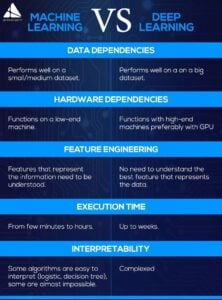
We will start off with the major difference between the two algorithms which is the ‘performance’. Deep learning algorithms require a huge amount of data to understand completely hence if the data is small DL algorithms do not work rightly. While in machine learning their handcrafted rules prevail in this setting.
Among both the algorithms, deep learning severely depends on high-end machines as compared to traditional machine learning which can swiftly work on low-end machines. Consequently, deep learning requirement comprises GPUs which is a fundamental part of its working. Comparatively, Deep learning algorithms do a large amount of matrix multiplication operations. All of these operations can be proficiently optimized by means of a GPU because it is made for this purpose.
Feature Engineering is a method of placing domain knowledge into the development of feature extractors to lessen data complexity and make patterns more visible for learning algorithms to function. This method is tricky and costly in terms of time and expertise. In machine learning, most of the characteristics used need to be recognized by the specialist and then hand-coded as per domain and data type. While deep learning algorithms try to learn high-level features from data. This is a very unique component of deep learning and a significant step forward in traditional machine learning. Deep learning thus minimizes the task of developing a new feature extractor for every problem.
The traditional machine learning algorithm is generally needed to break a problem into different parts to solve them individually and combine them to get the result. In contrast, deep learning backs to solve the problem end-to-end, such as logistic issues. Let’s further explain it with an example.
You are asked to detect multiple objects. In this task, we need to specify what the object is and where it is present in the picture. So, in the machine learning algorithm, this problem gets to divide into object detection and object recognition. First of all, we use the grabcut algorithm to skim through the picture and discover all possible items. Then, of all recognized objects, you would use an object recognition algorithm such as SVM with HOG to identify applicable objects. On the contrary, deep learning algorithm would perform the whole process end-to-end.
Deep Learning usually requires more time to train compared to machine learning. Because of the fact that there are so many parameters in a deep learning algorithm. On the other side, machine learning requires a lot less time to train, from a few seconds to a few hours.
But if we talk about testing time, the turn is completely opposite. The deep learning algorithm requires a lot less time to operate. Whereas, if you compare it with the nearest neighbors (a type of machine learning algorithm), the test time improves by increasing the size of the data.
Interpretability is the main factor deep learning is still thought 10 times before its use in industry. For instance, an automated marking of a test is done. The scoring done is accurate and quite human-like. But it does not explain why such marks or score were given. You can find out later which nodes of the neural network were activated, but we don’t understand what the neurons were intended to model and what these layers of neurons were doing together anyway. So, we fail to interpret the results.
While in machine learning algorithms such as decision trees offer us all the details we look for as to why it chose what has been marked. so, it is particularly simple to interpret the reasoning behind them. Therefore, algorithms such as decision trees and linear/logistic regression are mainly used for interpretability in the industry.
Saima Naz
Aug 21, 2019
Apple Allegedly Boosts TV Outlay by $5 Billion
A new report by the Financial Times alleges that tech giant Apple has committed a staggering $5 billion dollars more to its original video content budget in an effort to effectively vie with Amazon, Disney, HBO, Netflix, and Hulu.
The company had initially earmarked $1 billion for former Sony Pictures Television officials Jamie Erlicht and Zack Van Amburg to invite renowned creators and Hollywood stars to its platform. According to the publication, that number has risen to $6 billion as more shows have moved through production and budgets have swollen.
The FT says that one production has cost Apple hundreds of millions of dollars, while separately Apple is reported to be spending $300 million on just the first two seasons of the show.
Apple’s inclination to instantly match what Netflix was spending yearly on original content only a few years ago shows how intense the streaming wars are set to become in the coming months and years.
Apple’s TV Plus service mounts this autumn, secured by a set of other programming with big names like Oprah Winfrey and Steven Spielberg. The company’s services chief Eddy Cue has said the tech behemoth plans to add new content at a slower pace than its soon-to-be competitors, with a prioritization on quality over quantity.
Nevertheless, Apple will be going up against not just current streaming titans, but also novices like Disney. In 2020, there will also be WarnerMedia’s new HBO Max to deal with, a new streaming service that is likely to mix live TV, including news and sports, and a wider variety of content from across every WarnerMedia property with all of HBO’s current offerings.
In the meantime, Amazon, Disney, and Netflix are spending staggering amounts of money to vie with one another.
Saima Naz
Aug 20, 2019

Podcast mobile app usage surges to 60% since January 20...
As per the study done by Adobe Analytics, usage of podcast mobile app has increased 60% since January 2018.
The study says that the usage of the app is likely to grow even further as 45% of listeners plan to tune into more podcasts in the future.
The study, which consisted of 193 million monthly exclusive visitors to U.S. mobile apps, discovered that 41% of podcast finding happens through online sources such as blogs and articles.
According to the report, almost 72% of respondents notice podcast quality to be on the increase, with just 6% think that quality is declining. Nearly 52% of respondents said they listen to podcasts while working or traveling.
According to the study, education, history, and documentary were found to be the four most popular genres, while video games were among the least popular.
The majority—60%—of listeners said that only after hearing it on a podcast did they look up a service or product, with 25% reporting that they ended up making the purchase. Nevertheless, 58% of respondents said they avoided podcast ads.
The podcast sector’s impetus raises the feasibility of podcast advertising to reach a mounting audience. And, since more data is on hand from diverse platforms like Spotify, advertisers have more targeting skills to help them get closer to the listeners that are almost certain to be interested in their products or services.
Saima Naz
Aug 16, 2019
Top 10 Machine Learning Tools in 2019
Machine Learning which leads all other jobs among technology world. Data Science and Machine Learning are playing a boss role for all other technologies. Be it restorative or building it is adaptable to serve all sort of fields. To deal with Data Science, we should have the top Machine Learning tools, software, and frameworks to work on. These tools should give the outcomes which lead to 100% accuracy as we have an immense measure of training data which may be totally messy (in most cases). What’s more? These tools give the best results when we build well-defined software for them. However today, a machine can act by itself and is working well in this environment. This fruitful change is only achievable by making machine learning tools much effective. There are a lot of machine learning tools for beginners. The absolute best machine learning software and tools to learn in 2019 are mentioned below irrespective of any ranking:
Data, if look closely it has detailing in it and if talking about individual’s data all around the world then you have millions and billions of training data. Your PC will not be able to execute this much long listing or even your algorithm doesn’t work here. What will you do now? Here comes a tool named as Google Cloud ML Engine. This tool can let your data train the way you want. Data scientists run their high-quality machine learning models using this tool.
A cloud-based machine learning software which is strong and easy to use by the developers working on different levels. To generate predictions and building high-quality machine learning models, developers are using this tool. Data integration is done by coordinating different sources like Amazon S3 and more.
A simple framework works on linear algebra and expressed in Scala DSL. A free and open source undertaking of the Apache Software Foundation. This system works on the objective of implementing the algorithm rapidly for information researchers, mathematicians, and analysts.
Another machine learning framework which work on both audio and image processing libraries written in C# is Accord.NET. It comprises of different libraries having a wide scope of utilization incorporating linear algebra, pattern recognition, and statistical data processing.
Accord.Math, Accord.Statistics, and Accord.MachineLearning are the libraries working for Acoord.NET.
Shogun, an open source machine learning library created in 1999 by Soeren Sonnenburg and Gunnar Raetsch. A C++ written tool which solves machine learning problems by the algorithms and data structures it provides. It bolsters numerous languages like Python, R, Octave, Java, C#, Ruby, Lua, and so on.
An acknowledgment of the lambda engineering. Oryx 2 is based on Apache Spark and Apache Kafka. It is utilized for ongoing enormous machine learning works. Oryx 2 works for developing applications like end-to-end applications for filtering, classification, regression, and clustering. Oryx 2.8.0 is the latest version running in the market.
Tiers:
Layers:
Also a data transport layer is there for transferring the data among layers to receive the input from external sources.
In 2014, Apache Singa came into existence by DB System Group at the National University of Singapore in a joint effort with the database group of Zhejiang University. This software used for Natural Language Processing (NLP) and image recognition and bolster a wide scope of mainstream deep learning models. This software comprises three fundamental parts: Core, IO, and Model.
It is safe to say that you are a versatile developer? No worries. Google’s Android Team brings an ML KIT for you which bundles up the machine learning aptitude and innovation to grow progressively robust, customized, and advanced applications to keep running on a gadget. You can utilize this instrument for face and image recognition, image labelling, locating places and standardized identification examining applications.
To integrate machine learning models into your app another machine learning framework is playing a role known as Apple’s Core ML. Use your ML model by dropping it’s file into your project and the Objective-C or Swift wrapper class consequently is formed by the Xcode.
This software provides maximum execution and extreme performance on every processor you are using (CPU and GPU).
TensorFlow is another big name known by every machine learning expert. Created by Google for building ML models on its open-source platform. It has an adaptable plan of libraries and assets that enable developers to create applications.
Saima Naz
Aug 15, 2019

Indexing issues keep Google Search from Showing New Con...
Some new content through the Web is not appearing in search results as Google is confronting problems related to index today. For instance, a quick glance at the Top Stories in Google News reveals that some of the stories are from the last few hours, but many are from yesterday. The issues were first reported by Search Engine Land.
On Thursday, the company established that it was reviewing reports of indexing problems, later adding that it was seeing “issues in the URL Inspection tool within Search Console.”
According to Google, the URL problem was rectified as of 11:41AM ET, but no update has been provided on indexing. Google announced that it is working to fix the issue.
To find new text to display users, Google is continually crawling the internet. When Google undergoes issues with indexing, like it does today, search results won’t be as accurate as users expect from tech behemoth.
Of late, Google has faced a slew of indexing issues, including problems that lasted for a week in April and more than three days in May.
Saima Naz
Aug 9, 2019

How the Augmented Analytics tools leverage Business Int...
Augmented analytics is one of the recent developments for business intelligence tools. We are living in a digital age. Not only data, but big data: datasets have become so enormous, complex, and fast-moving that traditional BI solutions simply cannot handle them. Either they fail to get the data, to handle the data, to prepare the data, or simply to understand the data… but we must handle it! Data is everywhere and more of it is being produced all the time.
If your organization is going to thrive, it requires uncovering the insights hidden in your data. Digging through this data is hard, but with the correct tools, it can be done. But how will you identify the solution to your changing data needs? And what does all this have to do with augmented analytics?
Here we are going to answer what is augmented analytics and can it add value to the business.
Augmented analytics solutions have gained traction in the business intelligence world. Augmented analytics is intended in practical terms to facilitate more development and help create more revenue.
“Augmented Analytics Is the Future of Data and Analytics”
“Augmented analytics uses machine learning/ artificial intelligence (ML/AI) techniques to automate data preparation, insight discovery, and sharing. It also automates data science and ML model development, management and deployment.”
In simpler terms, everything related to the process of analytics and business intelligence will be changed by artificial intelligence analytics by simplifying or eliminating some steps and thoroughly changing and improving the others.
If you compare augmented analytics with a usual business model, data analysts reach data through testing their hypotheses and theories while operating on a principle of knowledge. Although, we cannot doubt the knowledge of data analysts, but their viewpoints will always limit people in some capacity. It is quite difficult to show a thorough, unbiased and entirely correct conclusion without being aware of every factor that might influence the results. This implicates a lot of business are potentially working with limited views of their data landscapes, leaving money on the table.
But if we talk about augmented analytics, it invokes the power of machine learning to process way faster than humans can. As machine learning has a very little human interference which makes algorithms uninclined to the biases.
Augmented analytics, therefore, empowers business users to perform on the insights they receive, allowing data scientists to concentrate on much more complicated queries.
Augmented analytics approach to business intelligence has countless advantages and, with the right self-serve analytics and data discovery tool, the average enterprise can expand these benefits and add even more value. We are listing some of the benefits to augmented analytics approach to business intelligence. Or in other words, here are just a variety of ways that self-serve augmented analytics can add value to business intelligence.
Augmented Analytics solution helps analysts, data scientists, and inner IT staff to center on crucial projects as well as offer support to strategic problems which results in releasing them from centering on the business community’s day-to-day analytical requirements.
As augmented analytics provide critical information itself, it enables business users to put a focus on their goals. Also, it provides objective metrics and allows data sharing which advance business interests.
In an easy-to-use interface, it offers complex, advanced techniques and tools to collect data from disparate data sources and enable confident, precise and accurate decisions to be made.
With augmented analytics simplified tools you can improve user adoption, data sharing, data popularity advancement, the integration of social BI within the organization and data and metrics literacy.
Augmented Analytics delivers immediate, objective results and enhances ROI and TCO.
Another business benefit of this approach is perfect business forecasting and predictions. Augmented analytics offers metrics so that one can be sure that the right decisions are made and that the business takes suitable action with regard to products and services, pricing, competition, and other key business factors.
In order to automate the operations of data, augmented analytics uses the power of machine learning which helps find insights as well as share the insights for business users, operational staff and data scientists.
Augmented data discovery, augmented data science and machine learning, and augmented data preparation are counted among the key capabilities of augmented analytics tools. Augmented data preparation has its focus on automating data intake into analytics systems in a system that involves data modelling, metadata adding, data profiling, data quality assurance, and catalogue storage. With augmented data discovery, relevant data is provided to users via automating, visualizing and narrating relevant findings. The skill-gap needed for model building to test new hypotheses or write algorithms can also be attained with the help of machine learning. Startups and big vendors have the potential to disrupt data integration, leading BI and analytics, data science and embedded data analytics vendors.
In their interaction with top BI vendors, an analytics manager must consider supporting the following five augmented analytics capabilities:
Saima Naz
Aug 6, 2019


Before we begin, please solve this quick math check to confirm you're human, and you'll be all set to start chatting with our AI assistant.
Stay connected with us to receive the latest information, updates, and insights from our world of innovation.
By entering your email address you will receive promotional updates.


© 2026 ARPATECH (ADVANCED RESEARCH PROJECTS & TECHNOLOGY)