Businesses across every industry continue to invest in mobile applications to improve customer experiences, simplify business operations, and create new revenue opportunities. Whether you’re launching a startup, expanding an enterprise platform, or digitizing internal processes, understanding app development cost is one of the first steps toward making informed decisions.
App development cost in 2026 varies significantly because no two apps are the same. A scheduling tool for a local clinic looks nothing like an AI-powered fintech platform serving thousands of concurrent users. These two differ greatly in both scope and budget. The cost to develop an app in 2026 can extend from $15,000 for a simple app to over $500,000 for a complex AI-powered platform, according to a Goodfirms survey based on insights from 267 mobile app development companies. Pricing depends on what you want to build, how you want to build it, and who builds it for you.
Technology is changing how apps are built and priced. AI is now included in many applications, and cross-platform frameworks have simplified how teams build for multiple apps for both iOS and Android. Businesses also need to invest more in security and compliance before launching their products.
If you’re planning a new application, working with experienced mobile app development services helps ensure your project is scalable, secure, and built for long-term success.
Key Takeaways:
Understanding what drives pricing helps you make smarter decisions from day one. Here are the major factors that affect app development cost:
It is one of the biggest factors that affect app development cost. A simple app takes less time and effort to build, while applications with AI, real-time features, or enterprise integrations require more planning, development, and testing.
The features you choose also have a direct impact on the overall cost of app development. Functions like user authentication, payment gateways, GPS tracking, in-app chat, notifications, dashboards, analytics, and AI require extra time to design, build, and test.
The platform you choose also plays a significant role in app development cost. When you develop separate apps for iOS and Android, it usually requires more time, while cross-platform frameworks allow developers to use a single set of code for both platforms.
Most apps today don’t work alone. They often connect with payment systems, CRM software, mapping tools, and cloud services. Each connection needs to be set up, tested, and monitored. This process can increase both the time and cost of the project.
Not all applications require the same level of security. Applications that manage personal or financial data require additional protection. This involves measures such as encryption, secure login methods, access controls, and continuous monitoring.
Some industries also have strict compliance requirements. For example, healthcare and finance apps must follow specific rules for handling customer data. Building those requirements into the app takes extra planning, development, and testing.
Your choice of development team can also affect the project budget. Development rates vary from one country to another, but cost should not be the only consideration. A team with strong technical expertise, clear communication, and reliable support can provide better value over the life of the project.
Applications designed to support thousands or millions of users require scalable architecture, cloud infrastructure, database optimization, and performance engineering, all of which increase app development cost.
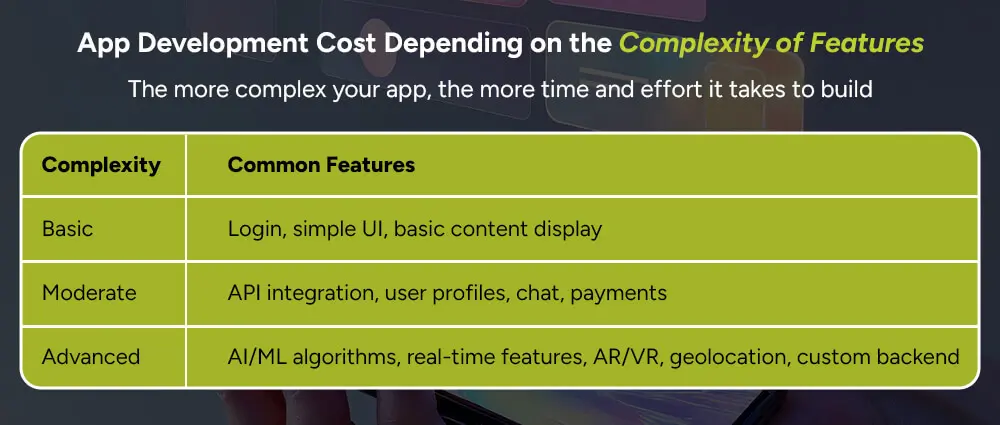
Even features that seem simple, like push notifications or login with Google/Facebook, can add time and cost.
App development is completed in several phases, from planning to ongoing maintenance. Understanding each stage makes it easier to see where your budget is allocated:
Every successful application begins with a strategy. Market research, competitor analysis, business requirements, user personas, and feature prioritization help reduce risks before development starts.
Proper planning often reduces future app development cost by minimizing scope changes.
Design focuses on creating intuitive user journeys, wireframes, prototypes, accessibility, and visual identity.
A strong design phase improves usability while reducing expensive revisions later.
Most of the app development cost lands here, simply because of the volume and complexity of work involved. There is a lot happening under the hood of any functioning app. Developers build:
Complex apps require specialists in both areas, often simultaneously.
Third-party integrations are often underestimated in both time and cost. Each service needs to be connected, tested across scenarios, and revisited whenever the provider changes something on their end. Modern applications rely on services like:
Each integration contributes to the overall Cost of app development.
Testing is what stands between a working app and a broken user experience. QA teams verify:
Quality assurance gives developers the opportunity to identify and fix issues before users encounter them. This makes the app more stable and reduces the need for urgent fixes after launch.
Publishing your app is only one part of the process. Before users can start using it, you need to complete app store submissions, set up your cloud environment, and make sure everything runs smoothly. After the release, you will need to focus on regular updates, bug fixes, new features, and compatibility with the latest operating systems. All of this ongoing work should be included in your long-term budget.
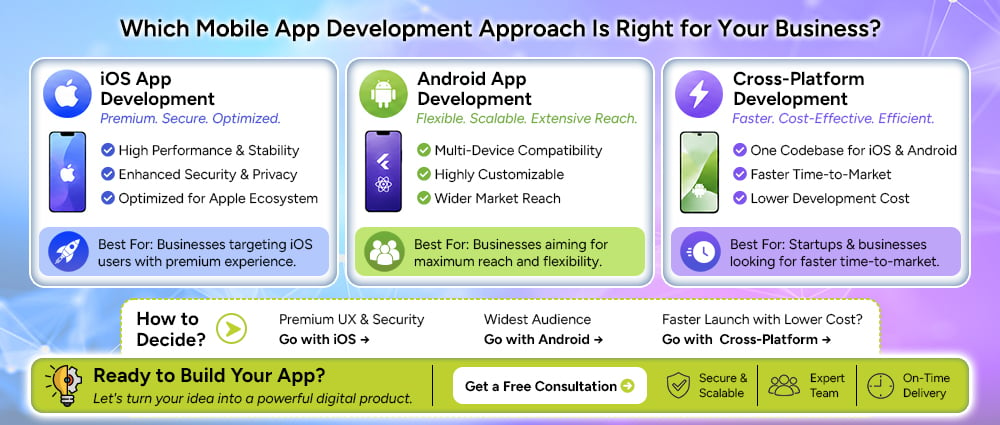
The iOS app development cost can differ based on the project. Simple apps with a few basic features usually take less time to create than more complex apps with advanced integrations or custom functions. Testing is often easier because Apple has a smaller range of devices, but developers still need to follow the App Store’s design and review rules before launching the app.
The Android app development cost may increase because the app needs to perform well across different devices, operating systems, and screen sizes. More device variables mean more testing cycles, which adds time and budget.
Cross-platform frameworks like Flutter and React Native simplify the development process by allowing one application to run on both iOS and Android. This method minimizes the need for duplicate development work, which can help lower the overall app development cost. Additionally, it can help to reduce the time required for development.
Applications in the financial sector require strong authentication, fraud prevention, regulatory compliance, secure payment processing, and real-time transactions. These requirements drive costs higher than most other categories. KYC/AML integrations and multi-currency support all add significant development layers that directly impact the overall app development cost.
Businesses interested in fintech app development should also consider future scalability and compliance requirements, as these significantly influence app development cost.
Healthcare apps handle highly sensitive patient information, so security and compliance become a major part of the development process. In US, healthcare providers must follow HIPAA requirements, while other countries have their own data protection regulations. Features including secure data storage, encrypted communication, audit logs, and integration with healthcare systems often need to be built into the application.
Applications supporting telemedicine, remote patient monitoring, and electronic health records add further complexity on top of that foundation. Meeting those standards across all functions is what makes healthcare mobile app development services consistently more demanding to build for.
Building an AI-powered app involves more than adding AI features. Developers also need to set up the right infrastructure to support them, such as:
Each of these capabilities requires additional development work, testing, and infrastructure, which can increase the overall app development cost.
Building the app is only part of the investment. Several costs sit outside the development scope but have a direct impact on the total app development cost.
Common hidden costs include:
Keeping development costs under control starts with making the right decisions early in the project. Instead of trying to build everything at once, focus on what delivers the most value first. Here are a few practical ways to keep your budget on track:
App development is constantly changing as new technologies reshape how applications are designed, built, and maintained. Here are some of the trends shaping app development:
AI-assisted development tools are accelerating how code is written, reviewed, and tested. This is beginning to reduce timelines for straightforward development tasks.
Low-code platforms are handling simple app requirements faster than ever, freeing development teams to focus on complex, custom functionality.
Cloud-native architecture is now the default starting point for scalable apps. Building on cloud infrastructure from day one avoids expensive migrations later.
Embedded AI features like smart search, personalized recommendations, and predictive analytics are being integrated into apps across all industries, not just tech-first businesses.
Cross-platform dominance is growing. Flutter and React Native continue to mature, and more businesses are choosing them as their primary development approach.
Cybersecurity-first development is no longer a niche consideration. Security is being designed in from the architecture stage rather than bolted on at the end. Our software development services reflect this shift.
Teams that have adopted these technologies are seeing shorter development cycles and products that are easier to maintain and grow over time.
The team you choose can have a lasting impact on your project’s success. Beyond technical skills, it’s important to choose a partner who understands what you’re building toward and can support that growth long-term. Here are a few qualities to look for:
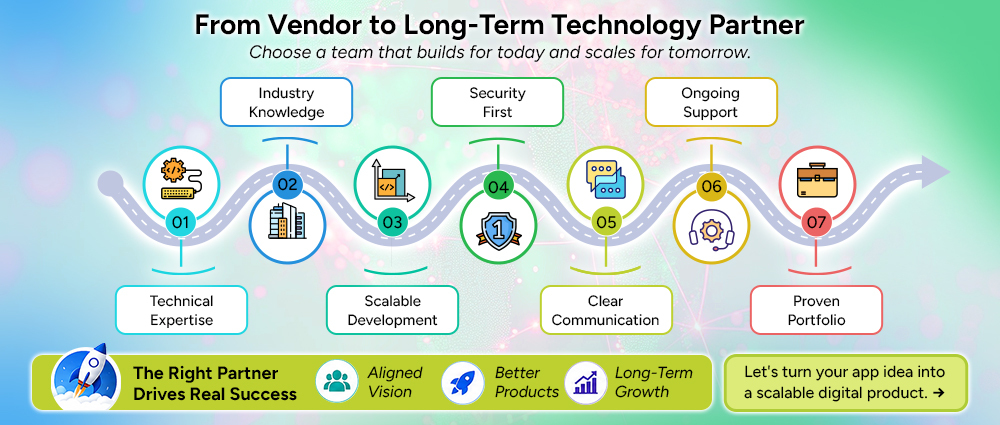
Large organizations may also benefit from partnering with an enterprise mobile app development company, while startups often prioritize flexibility and rapid delivery. If you’re targeting North America, choosing a reputable mobile app development company in usa with global delivery capabilities can also provide strong project outcomes.
The way an app is planned and developed has a direct impact on its performance, scalability, and long-term maintenance. Projects that focus on solving real user problems with the right set of features are often easier to manage and expand over time.
For example, an Electric Vehicle Service App shows how features such as service discovery, appointment scheduling, and vehicle management can be combined into a single application without making the experience difficult for users. The application was built to keep everyday tasks simple without compromising important functionality.
Another good example is an Eco-Friendly Driving App that encourages greener driving habits. Instead of trying to include every possible feature, the application focuses on driving insights, user engagement, and environmental awareness. Rather than adding unnecessary complexity, the app focuses on delivering a simple and effective experience.
Successful applications focus on the right features, future growth, and a simple user experience, which usually leads to better long-term results.
Every app project is different, and so is its cost. Business objectives, technical requirements, and scalability needs all pull the budget in different directions. A simple app and an enterprise platform live in completely different budget categories, and that gap is justified by the complexity involved.
Starting with an MVP helps reduce financial risk while validating market demand. Once your app gains users and your business grows, you can gradually invest in stronger security, AI capabilities, scalable infrastructure, and new features.
A scalable architecture helps prepare your application for future growth. As your business expands, adding new features and supporting more users becomes much easier.
Have an app idea? Talk to the team at Arpatech to discuss your goals and create a development strategy that fits your business.
1- How much does it cost to build an app in 2026?
App development cost are influenced by the type of application you’re building and the functionality it requires. More advanced projects often involve additional development, testing, and security measures, which increase the overall effort. Discussing your goals in detail will lead to a more accurate estimate.
2- What factors affect app development cost?
Several factors influence the overall cost of an app. The size of the project, the features you need, the app’s design, backend development, integrations, security, and testing all play a part. Your choice of development team can also affect the budget, as rates are based on location and experience. It’s also important to plan for ongoing expenses such as maintenance, cloud hosting, and future updates.
3- How long does it take to develop a mobile app?
Every app follows a different timeline. Simpler applications are usually completed faster, while products with advanced features, third-party integrations, or compliance requirements need more time. Teams often divide the work into smaller development cycles, making it easier to review progress and make improvements throughout the project.
4- What is the cost difference between iOS and Android development?
The iOS app development cost and Android App development cost differ primarily because Android applications must work smoothly across different devices and operating system versions.
Businesses targeting both platforms often choose cross-platform development using Flutter or React Native as the most cost-efficient approach without meaningful sacrifice in quality.
5- How can startups reduce app development cost?
Developing an MVP first can help lower your initial app development cost. Cross-platform development reduces costs compared to building separate native apps.
Outsourcing to a skilled team in a cost-competitive market can also significantly reduce the budget. Phased development, where functionality is added in planned increments, keeps initial spending manageable while allowing the product to grow.
6- What is the cost of fintech app development?
Fintech applications require secure authentication, payment processing, fraud detection, compliance, and real-time transaction capabilities.
Because of these advanced requirements, fintech platforms generally involve higher development investments than standard business applications.
7- What hidden costs should businesses consider when building an app?
Cloud hosting, maintenance, monitoring, third-party subscriptions, security updates, infrastructure scaling, and app store fees all sit outside the development budget but are just as real. Many businesses account for none of these until they are already live and scrambling. If you want the app to perform reliably and grow over time, these costs need a line in the budget from day one.
8- What are affordable mobile app development options for startups in the US?
Many startups manage mobile app development cost by building cross-platform applications, launching MVPs, and working with experienced global development teams. Choosing the right mobile app development company in the US, like Arpatech, gives startups access to enterprise-level expertise without the overhead of a large onshore team.
9- How do you choose a mobile app development company for enterprise projects?
Look for companies with proven enterprise experience, in your industry’s compliance landscape, a clear process for security testing, and references from clients who have built on a similar scale. Evaluate their post-launch support model carefully; enterprise apps require ongoing maintenance and a partner who remains engaged after delivery
10- What are the essential steps to launch a mobile application?
A successful launch follows a clear sequence: define your goals and target users, validate the concept before full investment, plan your architecture for scalability, design with the user experience as a priority, build the app in smaller stages and test it regularly, conduct thorough QA across all target devices, submit to app stores with advance planning time, prepare to introduce your app to users before it goes live.
After your app goes live, monitoring and rapid response to issues in the first weeks are as important as anything that happens before release.

Before we begin, please solve this quick math check to confirm you're human, and you'll be all set to start chatting with our AI assistant.
Stay connected with us to receive the latest information, updates, and insights from our world of innovation.
By entering your email address you will receive promotional updates.


© 2026 ARPATECH (ADVANCED RESEARCH PROJECTS & TECHNOLOGY)