Running a hospital, clinic, or healthcare organization involves complicated financial tasks, not just clinical challenges. Every time a patient interacts with staff, it starts a series of administrative and billing processes. If these processes are not handled well, the organization can lose revenue, face delays in getting paid, and experience cash flow issues. According to the American Hospital Association, hospitals used $43 billion in 2025, trying to collect payments from insurers for care already provided, with nearly $18 billion spent on fighting denied claims.
Automating healthcare revenue cycle management is essential for providers today. They face many challenges, such as changing payer requirements, new compliance regulations, rising claim denials, and labor shortages. At the same time, there is pressure to cut administrative costs while still delivering quality care. Without an efficient revenue cycle in place, even the best healthcare organizations may struggle financially. And without automating processes, they are collapsing under pressure.
Every time a patient visits, there is a financial process behind it, and healthcare revenue cycle management keeps this process running smoothly. It involves how healthcare providers collect patient information, check insurance, submit claims, and collect payments. According to Experian Health’s State of Claims 2025, 41% of providers say that at least one in ten of their claims gets denied.
This shows that having a strong revenue cycle is important, and automating the healthcare system is even more important, not only for daily operations but also as a financial safety measure. Automating healthcare revenue cycle management helps providers reduce administrative burdens, improve cash flow, minimize denials, and deliver a better financial experience for patients.
When the system works well, organizations have healthy profits and can invest more in patient care. However, when it fails, staff become overwhelmed, revenue slows down, and leaders lose track of their finances.
Whether you are exploring healthcare revenue cycle automation solutions for the first time or looking to optimize existing workflows, understanding how each stage of the revenue cycle can be streamlined through automation is the first step toward improving financial performance and operational efficiency.
In this blog, we cover:
If we talk about what is revenue cycle management in healthcare, it refers to the end-to-end process of managing the financial lifecycle of a patient encounter from the moment an appointment is scheduled to the moment payment is fully collected and reconciled.
It encompasses clinical, administrative, and financial functions that work together to ensure that healthcare services are accurately billed and appropriately reimbursed.
Healthcare revenue cycle management ensures providers get paid the right amount, at the right time, for the care they deliver. This involves verifying patient eligibility, assigning the correct medical codes, submitting clean claims to payers, following up on unpaid or denied claims, and collecting patient balances.
It also involves financial reporting and analytics that give leadership insight into where revenue is being lost and how performance can be improved.
Healthcare RCM is complicated because it brings together so many different parties under one process: patients, providers, payers, and government programs like Medicare and Medicaid, each playing by its own rules and timelines. One coding error, a missing document, or a submission mistake can be enough to trigger a denied claim, delay a payment, or create a compliance issue. It is no surprise then that healthcare revenue cycle management has grown into a specialized field that requires deep industry knowledge and the right technology to get it right.
Today, automation in healthcare is transforming how providers manage these complexities. Through healthcare workflow automation, business process automation, and AI-driven tools, organizations can streamline repetitive administrative tasks, improve coding accuracy, and accelerate reimbursements.
Technologies such as automated claims processing, predictive analytics, and AI agents in healthcare are helping providers reduce manual workloads, minimize claim denials, and create a more efficient and financially sustainable revenue cycle.
Understanding how the healthcare revenue cycle works requires looking at each stage as an interconnected workflow. A breakdown at any point can affect everything downstream.
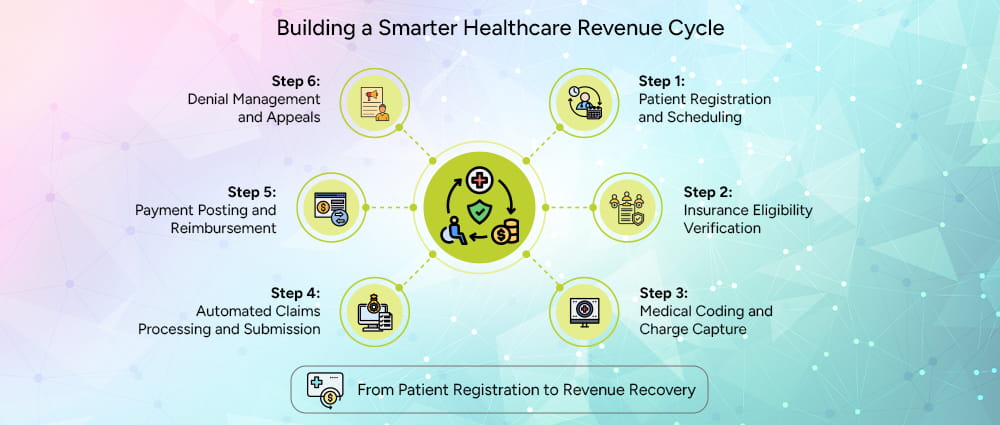
Today, automation in healthcare helps providers streamline these processes, improve accuracy, and reduce administrative burdens.
The revenue cycle starts at scheduling, long before a patient sees a medical professional. Demographic and insurance details are collected and entered into the system, and accuracy here is critical. A simple error in a name, date of birth, or insurance ID can trigger claim rejections weeks later. Any prior authorizations required by the payer are also secured at this stage.
Many healthcare enterprises use healthcare workflow automation and business process automation tools to simplify scheduling and reduce manual data entry.
Patient calls or visits → appointment scheduled → demographic and insurance details collected → prior authorizations obtained where applicable.
After registration, providers must confirm that the patient’s plan is active and the planned services fall within their coverage. This step, known as eligibility verification, determines what the payer will cover, which deductibles apply, and what the patient owes.
Rushing through it is one of the fastest ways to invite claim denials. Efficient healthcare organizations have built real-time eligibility checks and automated workflows into their scheduling process as a matter of course.
Insurance details submitted → real-time eligibility check run → coverage confirmed → deductibles and patient responsibility identified → authorization gaps flagged.
After a patient visit, healthcare providers record the services provided, diagnoses made, and procedures performed. Medical coders then turn that information into standard codes, using ICD-10 for diagnoses and CPT for procedures. Getting the coding right is important because if the billing is too low, the practice loses money, and if it’s too high, there might be compliance issues.
Charge capture ensures that every service offered is included before the claim is sent to the insurance company. Increasingly, AI agents in healthcare are assisting with coding accuracy and identifying missing documentation.
Patient visit ends → provider records services, diagnoses, and procedures → medical coder assigns the right codes → charge capture checks that nothing is missed → claim is prepared and sent for submission.
Once coding is completed, the billing team sends the bill to the right payer. Before it gets there, the claim is reviewed for formatting and coding errors. The payer then looks at the provider’s contract, the patient’s coverage, and the claim itself to decide how much to pay.
A clean claim gets processed quickly, while one with errors gets sent back, costing the organization both time and money. Automated claims processing and business process automation help providers validate claims and accelerate reimbursements.
Bill prepared → sent for error review → formatting checked → clean claim forwarded to payer → payer reviews and decides payment amount.
When a payer processes a claim, they send a payment summary that explains what was paid, what was adjusted, and what was denied. Payment posting is the process of recording these payments in the provider’s accounting system and checking them against expected amounts.
This step is essential for keeping finances accurate and for spotting issues with underpayments or contractual adjustments that may need attention. Healthcare workflow automation helps organizations improve efficiency and maintain accurate financial records.
Payer sends payment summary → payment amount reviewed → payments recorded in accounting system → compared to expected amounts → any underpayments or adjustments marked for follow-up.
Claims do not always get paid on the first submission. Missing information, coding errors, medical necessity disputes, coverage limitations, and other issues can lead to denials. Managing them effectively comes down to monitoring rejections by type and payer, understanding why they happened, fixing the issue, and resubmitting without delay.
Appeals are filed when the situation calls for it. Organizations that leverage automation in healthcare, predictive analytics, and AI agents in healthcare can identify denial patterns earlier and recover more revenue than those that write denials off.
Claim denied → reason identified → issue fixed or extra documents gathered → claim resubmitted or appeal filed → payment recovered or written off.
Modern healthcare revenue cycle management depends on more than billing systems alone. Today, automation in healthcare is driven by intelligent technologies that streamline repetitive processes, reduce manual errors, and improve financial performance. From business process automation to AI-driven analytics, these technologies are transforming how providers manage the revenue cycle.
In Healthcare revenue management cycle, business process automation platforms help healthcare organizations standardize repetitive tasks such as patient registration, eligibility verification, prior authorizations, payment posting, and denial management.
By automating these workflows, providers can improve efficiency while minimizing manual errors and administrative burdens. As healthcare organizations scale, business process automation enables teams to maintain consistent workflows while accelerating reimbursements and reducing operational costs.
Automated claims processing has become one of the most valuable technologies in modern revenue cycle management. These solutions perform claim scrubbing, error detection, and electronic submission to ensure claims are complete before reaching payers.
Automated systems can identify coding inconsistencies, flag missing information, and streamline remittance posting after payments are received. By reducing manual intervention and preventing avoidable errors, automated claims processing helps organizations improve first-pass claim acceptance rates and shorten reimbursement cycles.
AI agents in healthcare are bringing a new level of intelligence to revenue cycle operations. Powered by generative AI, natural language processing (NLP), and predictive analytics, these systems can automate repetitive tasks, uncover hidden patterns, and improve financial performance.
By reducing administrative workloads, AI agents allow staff to focus on higher-value activities while enhancing efficiency across the revenue cycle.
Key applications of AI agents in healthcare include:
Healthcare workflow automation platforms connect clinical, administrative, and financial processes across the organization. Through workflow orchestration, EHR integration, and billing system integration, these platforms enable data to move seamlessly between departments without manual intervention.
Healthcare workflow automation eliminates duplicate data entry, improves collaboration, and ensures that information flows efficiently throughout the revenue cycle. By creating a connected ecosystem, healthcare organizations can improve productivity, enhance accuracy, and deliver a more efficient experience for both staff and patients.
As healthcare organizations continue to modernize, automation in healthcare is helping providers improve financial performance while reducing administrative complexity. Through healthcare workflow automation, business process automation, and healthcare revenue cycle management software, organizations can streamline operations, reduce errors, and create better experiences for both staff and patients.
Many healthcare revenue cycle management companies and healthcare revenue cycle management services now leverage these technologies to deliver more efficient and scalable solutions.
Healthcare workflow automation helps organizations connect clinical, administrative, and financial processes, leading to smoother operations and improved coordination.
Healthcare automation reduces the need for manual data entry and repetitive tasks, allowing staff to focus on higher-value work.
Automated claims processing helps providers identify errors before submission, improving first-pass claim acceptance rates and reducing lost revenue.
Business process automation enables healthcare organizations to standardize workflows and eliminate bottlenecks. AI agents in healthcare can further support coding, claims review, and denial management.
Modern healthcare revenue cycle management solutions accelerate claims processing and payment posting, resulting in healthier cash flow.
An efficient revenue cycle benefits patients as much as providers. AI agents in healthcare and automated communication tools help create a more transparent billing experience.
Ultimately, what is revenue cycle management in healthcare is evolving beyond traditional billing. With the help of healthcare revenue cycle management software and intelligent automation, providers are creating more efficient, scalable, and patient-centered financial operations.
Many providers are now adopting healthcare revenue cycle management solutions that combine automation in healthcare, AI, and intelligent workflows to improve efficiency and financial performance.
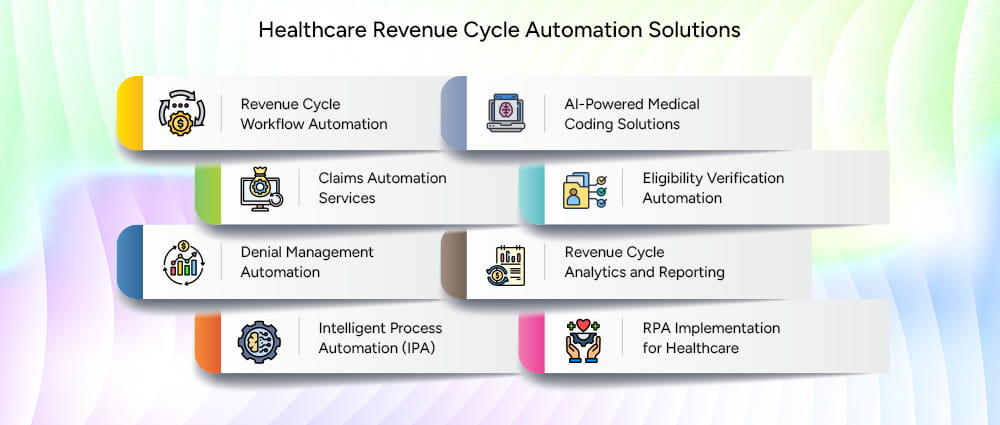
Whether delivered through healthcare revenue cycle management software or specialized healthcare revenue cycle management services, these technologies help organizations streamline operations while reducing administrative burdens.
Healthcare workflow automation connects clinical, administrative, and financial processes to eliminate bottlenecks and improve coordination across the revenue cycle.
From patient registration to payment posting, automated workflows help providers increase efficiency and reduce manual errors.
AI agents in healthcare are transforming medical coding through natural language processing (NLP) and intelligent automation.
These solutions help coders improve accuracy, accelerate claim preparation, and reduce compliance risks while minimizing the need for manual intervention.
Automated claims processing enables providers to streamline claim scrubbing, electronic submission, error detection, and remittance posting.
By identifying issues before claims reach payers, organizations can improve first-pass acceptance rates and accelerate reimbursements.
Insurance verification is one of the most repetitive stages of revenue cycle management healthcare operations.
Through business process automation, providers can perform real-time eligibility checks, identify authorization gaps, and reduce the risk of denied claims before treatment begins.
Advanced healthcare revenue cycle management companies are using predictive analytics and AI agents in healthcare to identify denial patterns and prioritize claims that require immediate attention.
Automated workflows help organizations recover revenue faster and improve collections.
Analytics and reporting automation testing tools provide real-time visibility into key performance indicators such as denial rates, collection rates, and days in accounts receivable.
These insights help leadership identify inefficiencies and optimize financial outcomes.
Intelligent Process Automation (IPA) combines artificial intelligence, machine learning, and business process automation to manage complex workflows that traditionally required human intervention.
By integrating data and decision-making capabilities, IPA enables healthcare organizations to scale operations while maintaining accuracy and compliance.
Robotic Process Automation (RPA) allows healthcare organizations to automate repetitive administrative tasks such as appointment scheduling, eligibility verification, claims processing, and payment posting.
As healthcare automation continues to evolve, RPA is becoming an essential component of modern healthcare revenue cycle management software and digital transformation initiatives.
Choosing the right healthcare revenue cycle management service provider has lasting financial consequences. Here is what to look for:
The cost of healthcare revenue cycle management depends on the technologies and resources used to support the process. As organizations adopt healthcare revenue cycle management solutions, understanding the main cost drivers can help maximize long-term value.
Labor remains one of the largest expenses in revenue cycle management healthcare operations. Salaries for billing specialists, coders, denial management teams, and revenue cycle leaders, along with ongoing training, can significantly impact operating costs.
Healthcare revenue cycle management software requires investment in:
Denied claims create hidden expenses through:
Healthcare automation technologies may require upfront investment, including:
Healthcare revenue cycle management services and healthcare revenue cycle management companies typically charge 3% to 8% of collections, depending on the provider’s size and specialty.
Although automation in healthcare requires initial investment, organizations often achieve long-term savings through:
By leveraging business process automation and AI agents in healthcare, providers can build more efficient and scalable revenue cycle operations.
Even well-resourced healthcare organizations face persistent challenges in managing their revenue cycles effectively.
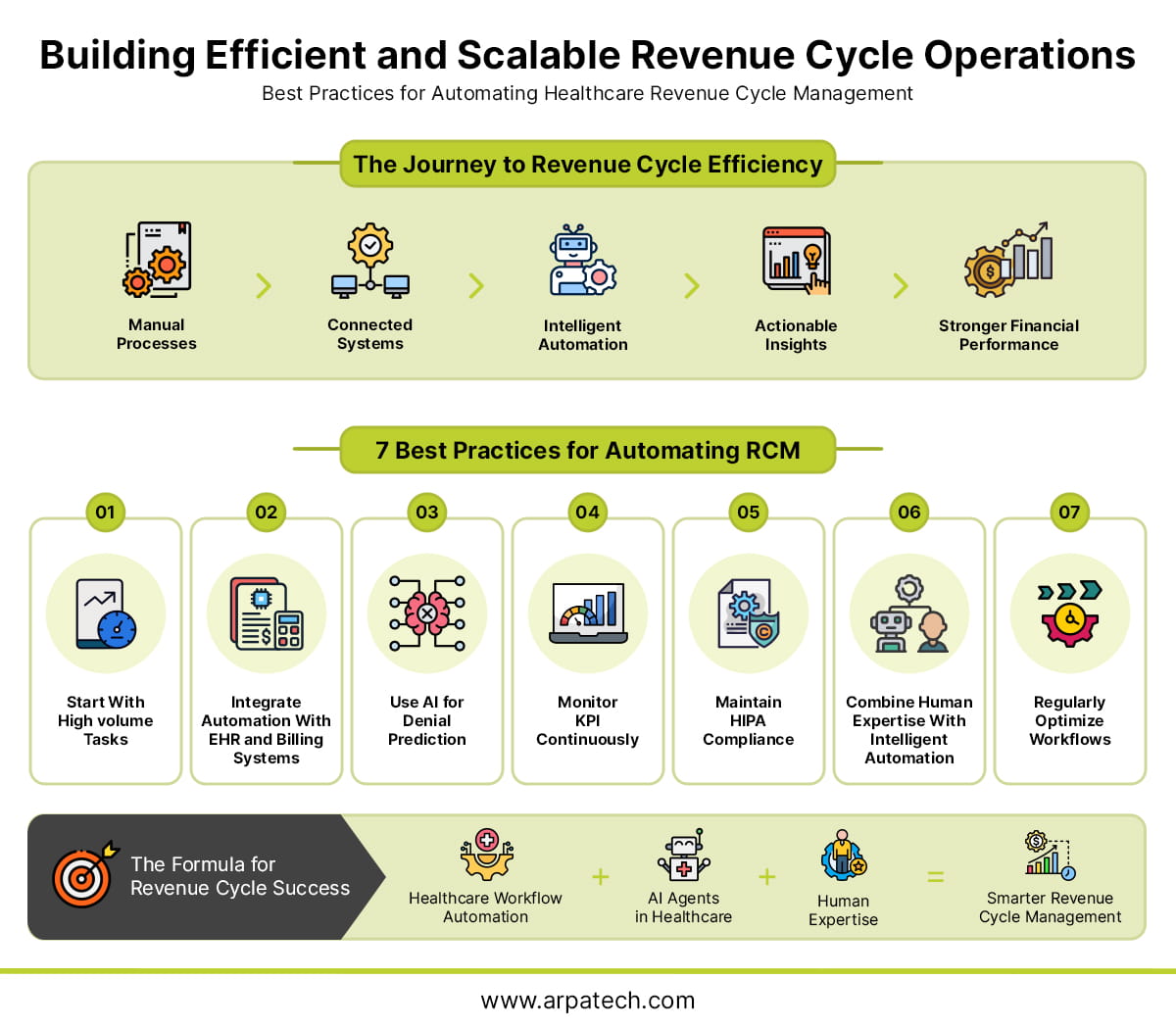
Organizations that achieve the greatest success with healthcare revenue cycle management solutions take a strategic approach to healthcare automation. The following best practices can help providers improve efficiency, reduce denials, and maximize financial performance.
Automation in healthcare delivers the most value when applied to routine processes that consume significant time and resources.
Focus on automating:
Healthcare workflow automation works best when clinical and financial systems are connected. Seamless EHR and billing system integration reduces duplicate data entry, improves accuracy, and accelerates reimbursement cycles.
AI agents in healthcare and predictive analytics can identify high-risk claims before submission, allowing organizations to address issues proactively rather than recovering revenue after denials occur.
Successful healthcare revenue cycle management companies rely on data-driven decision-making. Key metrics to monitor include:
As healthcare revenue cycle management software becomes increasingly automated, organizations must ensure that workflows, data storage, and system integrations remain secure and compliant with HIPAA requirements.
Business process automation and automated claims processing are most effective when paired with skilled staff. Intelligent technologies should enhance human decision-making, not replace it entirely.
Healthcare automation is an ongoing process. Organizations should continuously evaluate performance, refine workflows, and adopt new technologies to keep pace with changing payer requirements and industry demands.
By combining healthcare workflow automation, AI agents in healthcare, and business process automation with experienced teams, providers can build more efficient, scalable, and financially resilient revenue cycle operations.
Healthcare revenue cycle management ranks among the most vital operational functions in any provider organization. When it runs well, it supports financial stability, keeps operations efficient, automates workflows, and allows providers to focus on delivering quality care without constant financial pressure. When it breaks down, the effects show up across the entire organization, in staffing decisions, technology investments, and the ability to serve patients effectively.
Organizations that combine strong processes with modern healthcare revenue cycle management solutions, automated claims processing, and AI agents in healthcare are building more efficient and resilient revenue cycle operations. As automation in healthcare continues to advance, providers who embrace intelligent workflows today will be better positioned for long-term success.
Ready to modernize your revenue cycle? Connect with Arpatech to discover how our healthcare revenue cycle management services and automation solutions can help streamline operations and accelerate growth.
The healthcare revenue cycle management software market offers options for all organizational sizes, from large companies like Epic and Cerner to mid-size solutions like Kareo and Athenahealth.
When selecting software, consider how well it integrates with EHR systems, how it handles denial management, and the support from the vendor. No platform delivers results on its own. The organizations that get the most out of their software are the ones that back it up with experienced outsourced RCM expertise.
Identify your biggest challenge first: coding accuracy, denial rates, or eligibility gaps. Find a provider whose strengths match your challenge. Ask for first-submission acceptance rates and denial resolution timelines from the start so you have a clear basis for comparison. Next, look at how they communicate and handle performance reporting. Good partners are transparent, proactive, and easy to work with. Confirm HIPAA compliance, data security, and payer experience, and ask for references from organizations of a similar size and specialty before making a final decision.
Building a strong medical billing team from scratch takes time and money, most healthcare organizations do not have. Outsourcing gives them immediate access to trained coders, established payer relationships, and proven workflows that deliver cleaner claims, faster reimbursements, and fewer denials.
On top of that, it eases the burden on internal staff, reduces the disruption of team changes, and keeps pace with organizational growth. Clinical teams stay where they are needed most while experienced partners handle the revenue cycle day to day.
Go beyond marketing claims when evaluating healthcare revenue cycle management companies. Case studies, client testimonials, and directories from organizations like the Healthcare Financial Management Association are good starting points, keeping in mind that hospital systems, outpatient clinics, and specialty practices each have different RCM needs.
Ask for proposals that include performance guarantees, reporting methods, and pricing structures. Good providers have no problem showing how they measure success and pointing to real improvements in days in AR, net collection rates, and denial rates across their client portfolio.
By removing manual steps from error-prone processes, automation makes healthcare revenue cycle management faster and more reliable. Real-time eligibility verification, automated claim validation, and remittance posting each take a layer of human error out of the equation before it becomes a problem.
Advanced analytics and AI bring an added layer of intelligence to the process, helping organizations predict which claims may face rejection, catch documentation gaps early, and better understand payer behavior to build stronger appeals. Organizations that invest here pull ahead of peers across every major RCM metric while reducing administrative costs and letting staff concentrate on work that needs their attention most.
The healthcare revenue cycle moves through six stages: patient registration, eligibility verification, medical coding and charge capture, claims submission, payment posting, and denial management. They are deeply connected, and when one breaks down, the rest feel it. That interconnection is what makes investing in the right healthcare revenue cycle management solutions so important for any healthcare organization.

Before we begin, please solve this quick math check to confirm you're human, and you'll be all set to start chatting with our AI assistant.
Stay connected with us to receive the latest information, updates, and insights from our world of innovation.
By entering your email address you will receive promotional updates.


© 2026 ARPATECH (ADVANCED RESEARCH PROJECTS & TECHNOLOGY)