Have you searched for one item for hours and gone back and forth browsing between products endlessly? But in the end, even if you decided on a product, you weren’t satisfied with the price or the quality.
There were too many missing factors in order to determine the best product that would have lasted you years. In the end, you’re left with the fatigue of having twenty browser tabs open just to buy a pair of running shoes.
If only there were AI tools for ecommerce that would help you select the best product among thousands.
Well, today AI is starting to change that process, and Google is at the center of it. Instead of handing back a list of blue links, AI can now understand what a shopper actually needs in plain language.
We’re calling it “Agentic Shopping.”
An AI assistant can research products, compare options, spot better deals, track price drops, and even help finish the purchase. This is the idea behind agentic shopping, and it is quickly becoming one of the biggest shifts in ecommerce since mobile shopping took off.
Google is not treating this as just another chatbot experiment bolted onto Search. Its strategy pulls together Search, Gemini, Merchant Center, Google Ads, Google Pay, Google Wallet, product data, payment infrastructure, and a set of open protocols meant to connect retailers and AI agents. At the center of it all sits Google’s Universal Commerce Protocol, an open standard designed to create a shared language for agentic commerce across discovery, purchasing, and post-purchase support.
For a software company like Arpatech, this shift matters. It is not just a Google feature update. It signals a broader change in how ecommerce infrastructure needs to work. Google’s latest AI tools for ecommerce suggest that the future of online shopping will not simply involve people using AI to find products faster. AI agents themselves may become active participants in the shopping journey, and that creates real opportunities and real challenges for retailers, developers, and marketers alike.
Before diving into what Google has built, it helps to define the term everyone is suddenly using.
Agentic shopping refers to a shopping experience where AI can take actions on a consumer’s behalf, rather than just answering questions. It is the difference between an AI that talks and an AI that does.
For example, instead of asking a generic question like “what are the best running shoes,” a shopper using agentic AI tools for ecommerce shopping could say something closer to: “Find me a pair of running shoes under $150 that work for long-distance running, come in my size, and can arrive before Friday.”
From there, an AI agent could potentially:
It helps to see the difference side by side.
|
AI Shopping Assistant |
Agentic Shopping AI |
|
|
|
|
|
|
|
|
|
|
It is worth being honest here: true autonomy is still developing. Agentic commerce will likely exist on a spectrum for a while. Some experiences will require a shopper to approve a purchase before it happens, while others may become increasingly automated over time.
Google already sits at the beginning of a huge number of shopping journeys in the US. It has played a major role in product discovery for years through Search, Google Shopping, product listings, Google Ads, YouTube, Maps, and Merchant Center.
Google says people shop across its services more than a billion times a day, powered by its Shopping Graph, which now contains more than 60 billion product listings. That is the kind of stat that puts the scale of this shift into perspective. Very few companies have that kind of reach into everyday buying decisions.
The opportunity for Google is to move past simply helping people find products, and start connecting more of the full journey: intent, discovery, research, comparison, decision, purchase, and post-purchase support.
A good way to frame this is “from search engine to shopping agent.” Traditional search largely sends people away to other websites. Google agentic commerce flips that model. Instead of just pointing shoppers toward a retailer’s site, more of the decision-making and transaction process can now happen inside AI-powered interfaces like Gemini and AI Mode in Search.
This does not mean retailer websites disappear. In Google’s model, retailers stay the seller of record, while AI-powered surfaces help remove friction between discovery and checkout. It is less about replacing retailers and more about inserting a smarter layer between the shopper and the store.
This is arguably the most important piece of Google’s entire strategy, so it deserves a closer look.
The Universal Commerce Protocol, or UCP, is an open standard built to help AI agents, ecommerce businesses, consumer platforms, and payment systems talk to each other. Without a shared standard like this, every AI platform and every retailer would need separate, custom integrations, which quickly becomes unmanageable at scale.
Think of UCP as an attempt to create a common language for AI-driven commerce. Google says UCP is designed to support the entire journey, including discovery, buying, and post-purchase interactions, and it is built to work alongside existing technologies like Agent2Agent (A2A), the Agent Payments Protocol (AP2), and the Model Context Protocol (MCP).
Why does interoperability matter so much here? Picture an AI agent trying to check whether a product is in stock, verify its specifications, find alternatives, check loyalty benefits, apply a promotion, calculate delivery timing, complete a payment, and then track the order afterward. If every retailer and platform uses a completely different system for each of those steps, scaling this kind of experience becomes nearly impossible. That is the exact problem UCP is trying to solve.
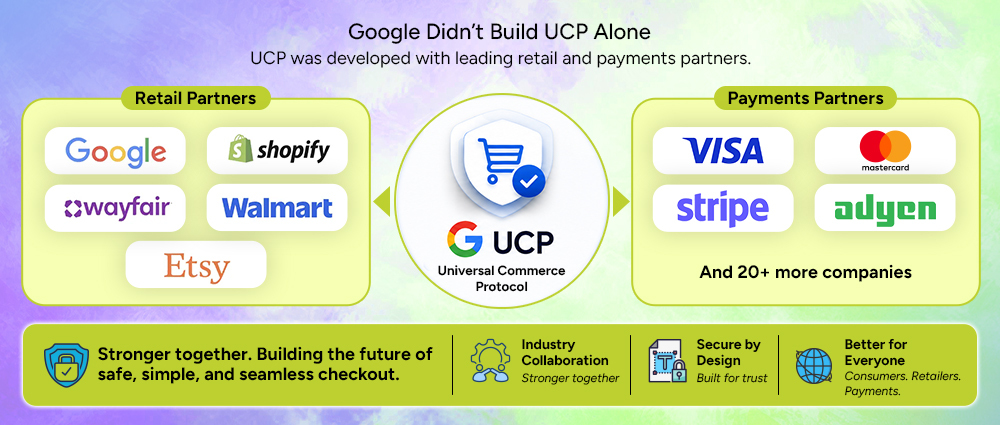
The bigger takeaway is not just that Google built a protocol. It is that Google is trying to build an entire ecosystem around Google agentic AI and agentic commerce, one where competitors, payment processors, and retailers all have a reason to participate rather than compete against it.
Google’s push into agentic shopping is not one single feature. It is a collection of AI tools for ecommerce that work together, and it helps to break them down individually.
Conversational interfaces are changing how people search in the first place. Instead of typing something short like “best office chair,” a shopper can now type or say something closer to: “I work from home eight hours a day, have lower back pain, need adjustable armrests, and don’t want to spend more than $500.”
AI can interpret that entire context instead of relying purely on isolated keywords. Google is positioning AI Mode and Gemini as places where product discovery and shopping interactions increasingly happen, rather than simple side features attached to Search.
The key implication for ecommerce businesses is that optimization is starting to shift. It may increasingly involve optimizing for questions, context, and product attributes, not just keywords, which is a real change from how ecommerce SEO has worked for the last two decades.
Google’s Business Agent is a branded AI experience that lets shoppers interact directly with participating retailers through Search. It works something like a digital sales associate. It can help customers ask product questions, get recommendations, understand product details, explore related products, and get help in the retailer’s own brand voice rather than a generic AI tone.
Google has also signaled plans to expand these capabilities with retailer data, insights, offers, and purchasing functionality. For ecommerce businesses, this raises a bigger question than “how does my website chatbot work.” The real question becomes: how does my brand and product knowledge show up inside AI-powered shopping environments that I don’t fully control?
This part matters a lot for anyone working on ecommerce SEO or product data strategy. Google is rolling out additional Merchant Center data attributes built specifically for conversational discovery. These go beyond standard product titles and keywords to include things like:
This is a real shift in how retailers need to think about product data. In traditional ecommerce SEO, the goal was often matching the right keyword. In conversational commerce, businesses need product data that actually helps AI understand the product in context.
For example, instead of only optimizing for a phrase like “wireless headphones,” a retailer may need product data that explains who the headphones are suitable for, whether they work well for travel, how strong the noise cancellation is, battery life, device compatibility, alternatives, and common use cases. This is also where the best AI tools for ecommerce search analytics come into play, since retailers need visibility into how AI systems are actually representing their products before they can fix any gaps.
Google is also experimenting with Direct Offers, a way for advertisers to present relevant offers to shoppers who are close to making a purchase decision inside AI-powered experiences. Google may use AI to determine when a specific offer fits a user’s needs and shopping context.
This matters because advertising inside AI experiences is starting to look less like simply winning a keyword auction. It increasingly involves context, user intent, product relevance, purchase readiness, the offer itself, and value beyond just price. That is a meaningful shift for anyone running paid ecommerce campaigns in the US market.
Google has kept building on this strategy well past its initial announcement, most notably with Universal Cart, which is designed to make shopping across multiple retailers feel seamless.
Google’s vision here includes helping shoppers manage products from different merchants in one place and using AI to support tasks like monitoring shopping opportunities in the background. The broader idea is that traditionally, every retailer controls its own separate shopping journey. Agentic commerce introduces a more unified experience, where an AI layer helps coordinate the process across multiple merchants at once.
Historically, ecommerce companies have spent years fine-tuning product pages, add-to-cart buttons, checkout forms, and payment flows. In an agentic future, some of those steps may happen inside an AI interface instead of on a retailer’s own site.
That does not eliminate the importance of ecommerce websites. It does shift part of the competitive advantage toward things that live behind the scenes, including:
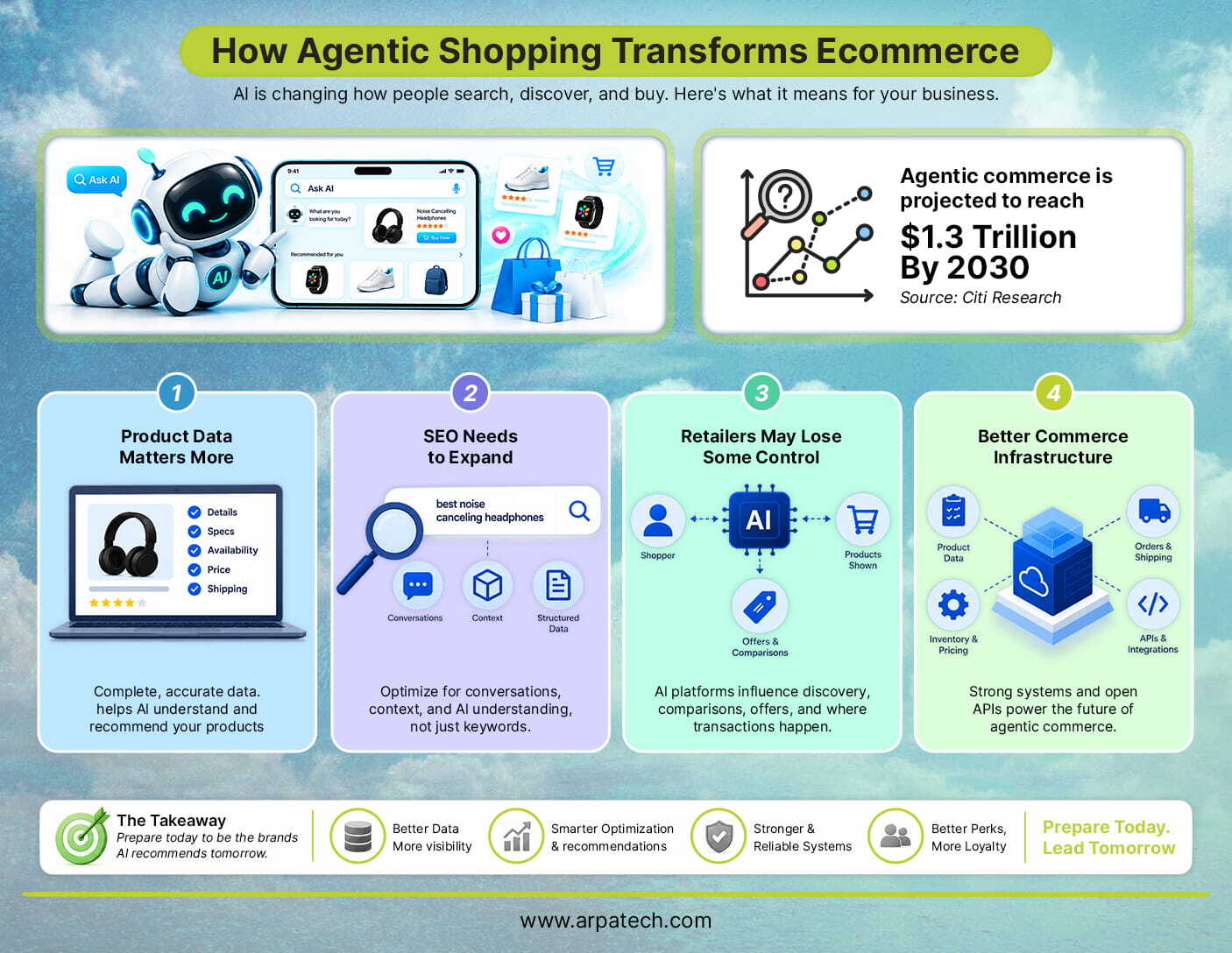
If AI is the one recommending products, incomplete or inaccurate data makes those products harder to understand and harder to recommend in the first place. Google has repeatedly emphasized how important strong product data is for AI-driven shopping experiences. Retailers need to think seriously about accurate titles, detailed descriptions, product specifications, availability, pricing, shipping information, compatibility, alternatives, and frequently asked questions.
SEO is not dead, but the field it covers is expanding. Businesses may need to optimize for conversational queries, product context, natural language questions, AI-generated comparisons, structured product data, and merchant feeds. Ranking for a keyword may no longer be the only goal. Being understandable and recommendable to an AI system could become just as important as ranking on a results page.
This is an important counterpoint that businesses should not ignore. When a shopper interacts through Google, Gemini, or another AI platform, the retailer does not control every step of the experience anymore.
The AI platform can influence which products get shown, how products are compared, which alternatives appear, when offers pop up, and where the actual transaction happens. That creates real tension between convenience for the shopper and control for the brand.
Agentic commerce is not only an AI problem. It is an infrastructure problem too. Retailers need systems that can reliably expose product data, inventory, pricing, order information, shipping options, loyalty benefits, and customer permissions to outside systems.
This is exactly where opportunities open up for ecommerce web development, API integration, cloud infrastructure, and AI implementation work, which is a space Arpatech and companies like it are well positioned to help with.
It is worth balancing the business perspective with the consumer side of this story.
On the upside, agentic shopping could mean less time spent researching products, more personalized recommendations, easier comparison shopping, faster checkout, better deal discovery, and help with repetitive shopping tasks that nobody actually enjoys doing. Instead of checking ten different websites for one specific laptop, a shopper could define their requirements once and let AI compare the suitable options for them.
But consumers will likely have real concerns too, including:
These concerns are exactly why trust and permission systems will matter so much as agentic AI shopping matures.
It would be misleading to suggest agentic commerce is already fully mature. It is not, and there are a handful of real challenges still ahead.
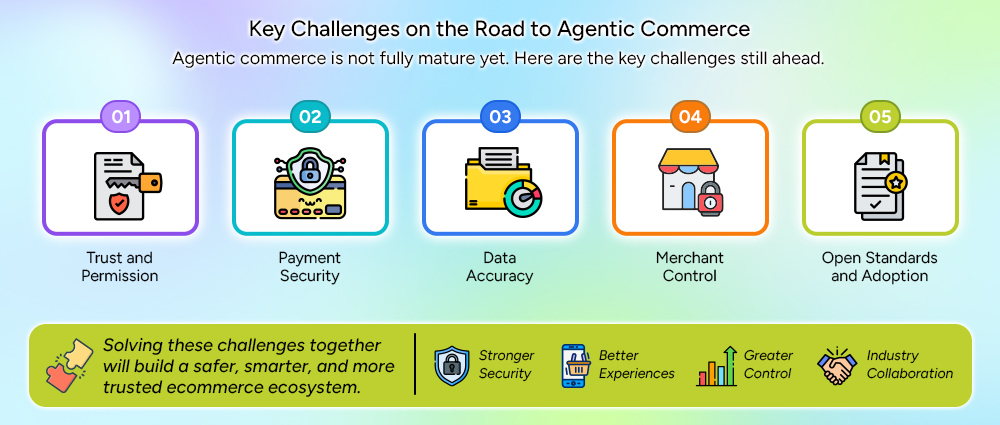
Trust and Permission: How much autonomy should an AI actually have? Should it be allowed to recommend, add items to a cart, apply a discount, or complete a purchase on its own? Where does the system need to stop and ask for human approval?
Payment Security: An AI agent spending money on someone’s behalf raises real questions about authorization and accountability. Google’s broader agentic commerce infrastructure includes work on payment protocols like AP2, while the wider industry is increasingly focused on making sure agents are properly authorized to act for the people they represent.
Data Accuracy: AI is only as useful as the information it can actually access. Incorrect prices or outdated inventory numbers could create serious customer experience problems, and possibly some very awkward customer service conversations.
Merchant Control: Retailers will need to decide how much control they are comfortable handing over to outside AI systems that they don’t fully own or manage.
Open Standards and Adoption: UCP’s long-term success depends entirely on adoption. An open standard only becomes powerful once retailers, payment providers, ecommerce platforms, and AI companies actually put it to use, rather than treating it as a nice idea on paper.
This is the part that matters most for anyone running or building for an online store right now.
A useful way to think about it: the businesses best prepared for agentic commerce may not be the ones that adopt the most AI tools for ecommerce business needs right away. They may simply be the ones with the cleanest data and the most connected commerce infrastructure underneath everything else.
This is worth sitting with for a moment. Google may be moving toward becoming a more active layer between consumers and retailers, not just a directory that points people elsewhere.
Traditionally, the path looked like this: consumer, then Google Search, then retailer website. The emerging model looks more like: consumer, then an AI interface, then an AI agent, then the retailer or commerce system on the back end. The key difference is that this middle layer can now understand intent, compare products, recommend choices, and potentially assist with the actual transaction, not just point in a general direction.
This does not necessarily mean Google replaces ecommerce businesses outright. It could instead become an increasingly important commerce orchestration layer sitting between shoppers and stores.
There are two sides worth weighing here. On the opportunity side, Google can send high-intent customers directly to retailers and reduce friction along the way. On the risk side, retailers may become more dependent on AI platforms for both discovery and transactions, which shifts some leverage away from the brand itself.
Agentic shopping is still in its early stages, and plenty of questions around trust, payments, privacy, retailer control, and interoperability remain unresolved. That is a fair and honest place to land.
That said, Google’s recent moves show the company is investing in far more than AI-generated product recommendations. Through UCP, AI-powered shopping experiences, Business Agent, Merchant Center updates, Direct Offers, and Universal Cart, Google is building the pieces of an ecosystem where AI can play a much larger role throughout the entire shopping journey, not just at the search step.
The biggest shift may not be that people start shopping with AI. Plenty of people already do that today. The bigger shift arrives when AI moves from helping people make decisions to actively helping them complete decisions they’ve already made.
For ecommerce businesses, the real question is no longer whether AI will affect online shopping. It already has. The question now is whether a business’s product data, technology, and customer experience are ready for a world where the next shopper might not be a person browsing a website at all, but an AI agent acting on that person’s behalf. That is exactly the kind of infrastructure and integration challenge Arpatech works with ecommerce brands to solve, from cleaning up product data to building the connected systems that agentic commerce will depend on.

Before we begin, please solve this quick math check to confirm you're human, and you'll be all set to start chatting with our AI assistant.
Stay connected with us to receive the latest information, updates, and insights from our world of innovation.
By entering your email address you will receive promotional updates.


© 2026 ARPATECH (ADVANCED RESEARCH PROJECTS & TECHNOLOGY)