Managing an online store requires more than just handling sales. Businesses must constantly update inventory, track orders, process payments securely, and maintain organized customer information. Ecommerce website development services integrate these functions into a single platform, simplifying everyday operations.
More people are shopping online than ever before, and that momentum continues to build. Industry forecasts suggest Global ecommerce sales will pass $7.4 trillion in 2026 and continue growing in 2027. For businesses, this creates a clear opportunity to invest in ecommerce platforms that can support future growth.
Today’s ecommerce websites do much more than showcase products and accept payments. Many businesses use AI to recommend relevant products, answer common customer questions, and better understand shopping behavior. At the same time, connecting the website with payment gateways, ERP systems, and CRM software helps keep inventory, orders, and customer information organized in one place. These capabilities make daily operations easier to manage while giving customers a faster and more convenient shopping experience.
This is also where the right development partner matters. Web app development services like these are built for businesses that need more than a pre-built solution, whether that means a fully custom shop or a platform that ties into existing inventory and payment systems.
Key Insights:
Here’s what you’ll learn:
Ecommerce website development services help businesses build, launch, and manage online stores where customers can browse products, place orders, and complete purchases securely. These services cover every stage of an ecommerce project, from planning the user experience to integrating payment systems, inventory management, customer accounts, and analytics tools.
A standard business website is mainly built to share information, but an ecommerce website supports the daily operations of an online store. Along with displaying products, it needs to process payments securely, manage inventory, calculate shipping costs, handle customer orders, and help shoppers complete purchases without unnecessary steps.
Professional ecommerce website design & development services usually include:
While these features meet the needs of many online stores, businesses with more complex requirements often turn to ecommerce software development services for additional customization, automation, and system integrations.
People have become less patient with slow or outdated online stores. They expect websites to load quickly, offer convenient payment options, and work just as well on a phone as they do on a desktop. If shopping feels difficult, many customers simply leave and buy elsewhere.
It’s common for businesses to outgrow their original ecommerce website. What once handled daily operations without any issues can become harder to manage as product ranges, customer numbers, and business processes expand. Upgrading the platform gives businesses more room to grow and simplifies many routine tasks.
Some of the benefits include:
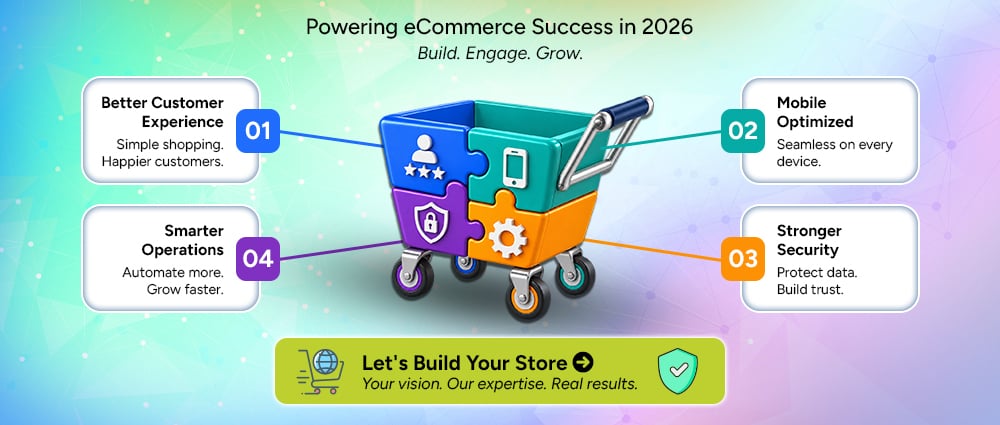
One of the first decisions during any ecommerce project is selecting the platform that best supports your business objectives. Different platforms offer different levels of flexibility, customization, and scalability.
Shopify: Many startups and small businesses choose Shopify because it makes launching and managing an online store easier. With hosted infrastructure and a broad selection of apps, businesses can spend more time selling and less time maintaining the platform.
WooCommerce: Built specifically for WordPress, with thousands of plugins and themes to choose from, this platform gives businesses a lot of flexibility to shape their store. It’s a strong option for businesses that combine ecommerce with content-driven marketing.
Magento (Adobe Commerce): Growing businesses often move to this platform because it can take on advanced customization, large catalogs, several storefronts, and complicated pricing structures without slowing down. Businesses still running older versions should also look into upgrading Magento 1 to Magento 2, since the older version no longer receives support.
Custom Ecommerce Platforms: Some businesses move to a custom build because it can manage custom features, smoother integration with existing systems, and growth without hitting platform restrictions.
The right platform depends less on what a business needs today and more on where it wants to be in a few years, whether that means Shopify, WooCommerce, Magento, or a custom solution.
The features that worked a few years ago are no longer enough for many online stores. Businesses now need ecommerce websites that can support higher traffic, larger product catalogs, faster transactions, and changing customer preferences. Professional ecommerce website development services help businesses build platforms that can meet these requirements without sacrificing performance or usability.
Some of the key features to consider in 2026 include:
AI is becoming a key part of how ecommerce businesses improve the shopping experience. Instead of showing every visitor the same products, AI uses browsing history, previous purchases, and customer preferences to offer product suggestions relevant to each visitor.
This also helps businesses highlight products that customers are more likely to be interested in, improve product discovery, and make searching through large catalogs faster and more efficient.
Customers now use different devices when shopping online. They might look at products on their smartphones, compare options on tablets, and make purchases on desktops. It is important for an ecommerce website to deliver a consistent experience throughout this process, which is why many businesses turn to ecommerce app development services to support this kind of cross-device experience.
To help customers browse products and complete purchases easily on various screen sizes, the website should have responsive layouts, mobile-friendly navigation, and fast-loading pages.
A checkout that takes too long or feels complicated often pushes customers to leave before buying. Modern ecommerce websites make buying easier with faster checkout, guest checkout options, multiple payment methods, and digital wallets. They also use secure payment gateways and encrypted transactions to protect customer information during every purchase.
As a business grows, keeping track of inventory by hand can be difficult. Automatic inventory updates ensure stock levels remain accurate across different sales channels, reducing stock issues and helping orders run more smoothly.
Businesses that use ecommerce software often connect their warehouse systems, shipping providers, and order management platforms to make the fulfillment process easier.
To understand how customers use an ecommerce website, we can see what is working well and what needs to be fixed. Reports and dashboards help track sales, monitor product performance, and find out where customers leave without completing their orders.
This information helps businesses adjust inventory levels, evaluate marketing campaigns, and make practical improvements based on customer behavior rather than assumptions.
Customers frequently move between websites, mobile apps, marketplaces, and social media before making a purchase. Modern ecommerce platforms integrate these channels, giving customers a familiar and reliable shopping experience across every sales channel.
Launching a successful ecommerce website involves much more than selecting a theme and uploading products. Effective ecommerce website development services follow a structured development process that aligns technology with business objectives.
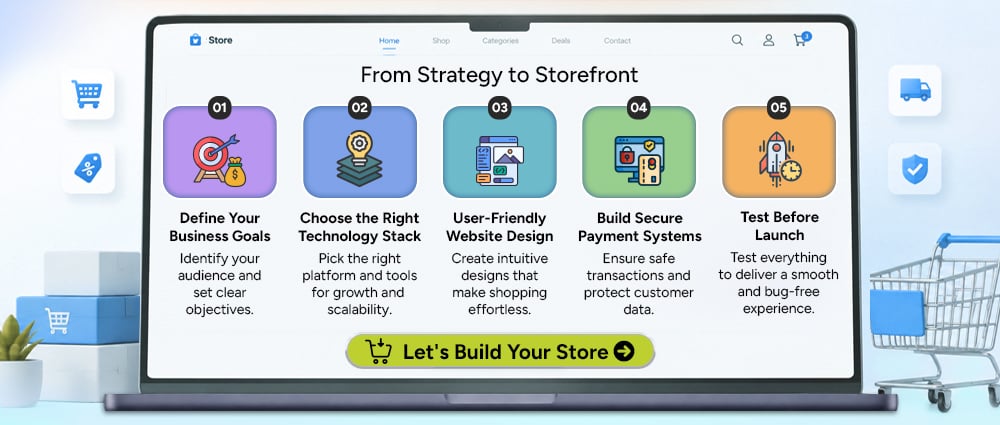
Every ecommerce project should start by defining business needs. First, understand your target audience. Then, clearly outline your products or services. Next, look at your competitors and identify the features your customers want. Having clear goals helps developers choose the best platform and setup for your project.
The technology behind your online store determines how easily it can grow in the future. Built-in platforms such as Shopify and WooCommerce meet the needs of many businesses. As their requirements become more complex, they often move to custom ecommerce website development services that can accommodate their existing systems and daily operations.
Customers stay longer on sites where shopping feels quick and effortless. Well-organized product pages, simple navigation, and a hassle-free checkout make shopping smoother- features an experienced ecommerce web design company knows how to build well. Combined with responsive design and quick page loading, these features make the experience smooth whether customers are shopping on a desktop, tablet, or smartphone.
Customers expect every transaction to be secure, making strong payment protection an important part of any website. Payment gateways, SSL certificates, fraud prevention tools, and secure authentication help safeguard both businesses and customers from cyber threats.
Small technical issues can build up and cost sales quickly after launch. Going through payment systems, mobile responsiveness, loading speed, search functions, account creation, product filtering, and checkout workflows before launch helps keep the shopping experience smooth for customers.
As more manufacturers, wholesalers, and distributors sell online, B2B Ecommerce websites are expected to handle far more than simple product listings. B2B ecommerce website development services are built to support complex purchasing processes, customer-specific pricing, bulk ordering, and long-term business relationships.
These requirements come from the way businesses purchase goods. A single order may involve contract pricing, internal approvals, or a quotation before it is confirmed, making the buying process very different from a typical retail transaction.
Enterprise platforms also integrate with ERP systems, CRM software, accounting platforms, warehouse management systems, and logistics providers to automate operations across the organization.
Custom dashboards, often built through an ecommerce web development service, allow corporate customers to track orders, download invoices, manage multiple users, and monitor purchasing history from a single portal. These capabilities improve operational efficiency while reducing manual administrative work for both buyers and sellers.
As business operations become more complex, these features help organizations manage growing customer accounts and purchasing activity without adding unnecessary administrative effort. A well-planned platform can continue supporting day-to-day operations as businesses grow.
Standard ecommerce platforms work well for many businesses, but they aren’t always the right fit for companies with specialized processes. Custom ecommerce development services allow businesses to build features that align with the way they already operate.
For example, Arpatech has also built a payment platform that combines fiat and cryptocurrency payment processing in one secure environment. Businesses can manage different payment methods through a single system, reducing operational complexity and providing customers with greater payment flexibility.
In another project, Arpatech developed a web application that replaced a manual license renewal process with a digital workflow. Automating approvals and centralizing records reduced manual work while making the process easier to manage.
Good custom development, whether it’s for payment systems or internal operations, always starts with a clear problem. The technology should be the tool, not the point.
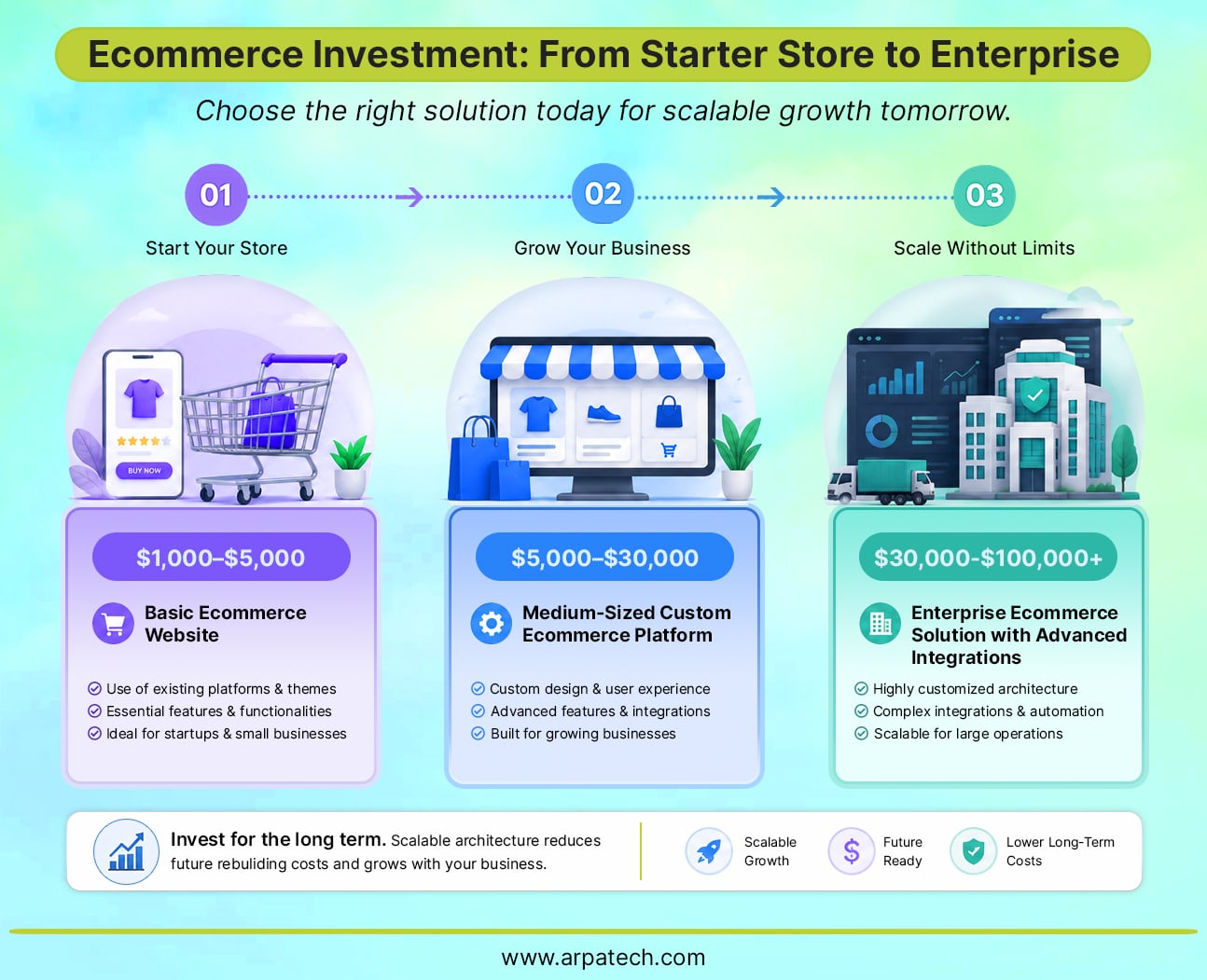
The overall cost of an ecommerce website depends on the type of platform you need, the features you want to include, and the level of customization involved.
A basic online store built using an existing platform generally costs less than a fully customized enterprise solution.
A properly built ecommerce website does more than showcase products. It turns into a central place for sales, customer engagement, marketing, and operations. Ecommerce website development services help businesses perform better today and grow down the road.
As your business expands, your ecommerce platform should be able to grow with it. A scalable solution makes it easier to add products, support higher traffic, introduce new features, and enter new markets without rebuilding the website from scratch.
An intuitive interface, fast-loading pages, advanced search, and simplified navigation encourage customers to stay longer and complete purchases. Positive shopping experiences also increase customer loyalty and repeat business.
Automation takes over repetitive manual work like syncing inventory, processing orders, updating stock, and connecting business systems. This saves time and helps avoid mistakes.
Small improvements on an ecommerce website can boost sales. Providing clear product information, making navigation easy, offering convenient payment options, and ensuring a faster checkout help customers place orders more easily.
Customers provide personal and payment information each time they place an order. Security measures like SSL encryption, fraud detection, secure authentication, and protected payment gateways help protect these transactions.
Technology will continue to change, but these practices can help businesses build an ecommerce website that performs well over time.
A well-maintained ecommerce website is easier to manage, performs more consistently, and gives customers a better shopping experience.
Customer expectations have raised the standard for ecommerce websites, and this is exactly why ecommerce website development services have become so important. Fast performance, smooth navigation, secure payments, and convenient purchasing experiences are no longer optional features; they are part of what customers expect when shopping online.
As online stores become more established, many businesses discover that a standard ecommerce platform no longer supports the way they work. Professional ecommerce website development services make it possible to add the features, integrations, and functionality that fit existing business processes instead of forcing teams to adapt to software limitations.
Customers see the shopping interface, but much of the work happens in the background. Connecting the website with inventory management, payment systems, ERP software, CRM platforms, and automation tools keeps information moving between systems, reduces repetitive manual tasks, and helps day-to-day operations run more smoothly.
Ready to build an ecommerce platform that fits your business? Contact Arpatech today to discuss our ecommerce website development services.
What are ecommerce website development services?
An ecommerce website development service helps businesses create an online store that works for both customers and internal teams. Along with the storefront, developers can build features for secure payments, inventory management, order processing, shipping, and other day-to-day business operations.
Depending on the project, this may involve a ready-made ecommerce platform or a custom solution developed around the company’s existing processes.
How much do ecommerce website development services cost?
The price of ecommerce website development services varies from one business to another. A small online store with standard features will usually cost less than a custom platform with advanced integrations, B2B functionality, or automation tools.
Looking beyond the initial development cost can also be worthwhile. A platform that fits your business from the start is less likely to require major changes as product ranges, order volumes, and operational requirements increase.
What features should an ecommerce website include in 2026?
The features an ecommerce website needs will vary by business, but most platforms include secure payment processing, mobile-friendly layouts, inventory management, customer accounts, search functionality, and a straightforward checkout. Many businesses also use AI to recommend products and analytics tools to see how customers actually shop and browse.
Many businesses also integrate automation tools, CRM systems, ERP software, shipping providers, and marketing platforms to improve operational efficiency while delivering better customer experiences.
How do businesses choose an ecommerce website development company?
Finding the right ecommerce development partner takes more than comparing quotes. Experience with similar projects, technical knowledge, custom development capabilities, communication, and long-term support all play an important role in the decision.
Reviewing case studies, client testimonials, and long-term support services can also help businesses select a partner capable of delivering a scalable ecommerce solution that aligns with their goals.
What is the difference between custom ecommerce development and template-based platforms?
Many businesses start with a template-based platform because it reduces development time and upfront costs. These platforms work well when the required features are already available.
When standard functionality is no longer enough, custom development gives businesses more freedom to shape the platform around their own processes, software, and operational requirements.
What platforms are commonly used for ecommerce website development?
Many businesses start by comparing platforms such as Shopify, WooCommerce, Magento (Adobe Commerce), and BigCommerce. Each takes a different approach to setup, customization, and management, while some organizations decide that a custom-built platform is a better fit for their operations.
Choosing the right platform depends on scalability, budget, customization needs, and integration requirements rather than popularity alone.
What are B2B ecommerce website development services?
B2B ecommerce website development services focus on building online commerce platforms for wholesalers, distributors, manufacturers, and enterprise businesses. These platforms support complex purchasing workflows that differ from consumer-focused online stores.
Typical features include custom pricing, quotation management, ERP integration, customer-specific catalogs, approval workflows, bulk ordering, and account management for multiple business users.
How long does ecommerce website development take?
Some ecommerce websites can be launched fairly quickly, while others require several months of development. The difference usually comes down to the number of custom features, integrations, and the overall scope of the project.
Planning, design reviews, development, testing, and deployment each take time, particularly when the platform connects with payment gateways, ERP systems, or other business software.

Before we begin, please solve this quick math check to confirm you're human, and you'll be all set to start chatting with our AI assistant.
Stay connected with us to receive the latest information, updates, and insights from our world of innovation.
By entering your email address you will receive promotional updates.


© 2026 ARPATECH (ADVANCED RESEARCH PROJECTS & TECHNOLOGY)