If you are a web developer or a website owner who relies on PHP-enabled platforms like WordPress, Drupal, Joomla, or Magento, we have some exciting news for you. According to the official PHP timetable, released on 3 December 2015, PHP 7 is a powerful platform that covers everything from cloud to enterprise applications and from mobile to web applications. Teams offering reliable Web App Development Services are already making the most of PHP 7, and here is everything you need to know about it.
Yes, you heard it right! PHP 7 is out for use. We are going to tell you all the great things you need to know about PHP 7.
Key Takeaways:
PHP 7 is a platform built to power strong and reliable apps, all from cloud to enterprise applications and from mobile to web applications. PHP 7 covers almost everything you need. What makes it stand out the most is how it reduces memory consumption while delivering major performance improvements.
Let’s take a look at what PHP 7 covers:
The version PHP 5.6 was renamed to PHP 7. As PHP 6 already existed, developers tended to do some experimental projects, but this version of PHP never reached the production phase. After some dispute, the official PHP development team came to a conclusion, and they decided that they would name this new version PHP 7 and would omit the name PHP 6 completely.
The decision helped users stay away from mixing up the previously attempted experiment with the latest development.

After the release of PHP 4 in 1999, the platform was powered by the Zend engine till now.
Zend, the Zend Framework, which supports PHP 7, is an open-source execution engine and is written in the C language. It is used to interpret the PHP language. PHP 5. X uses the Zend Engine II, which was used to enhance the functionality of the previous engine.
Whereas PHP 7 uses the Zend Engine with a code name of PHPNG (Next Generation).

There are many improvements that can be seen when it comes to the new PHPNG Engine, but the most significant feature is the improvement in performance. The PHPNG is the new structure of the Zend Engine; thus, we can see optimized memory usage.
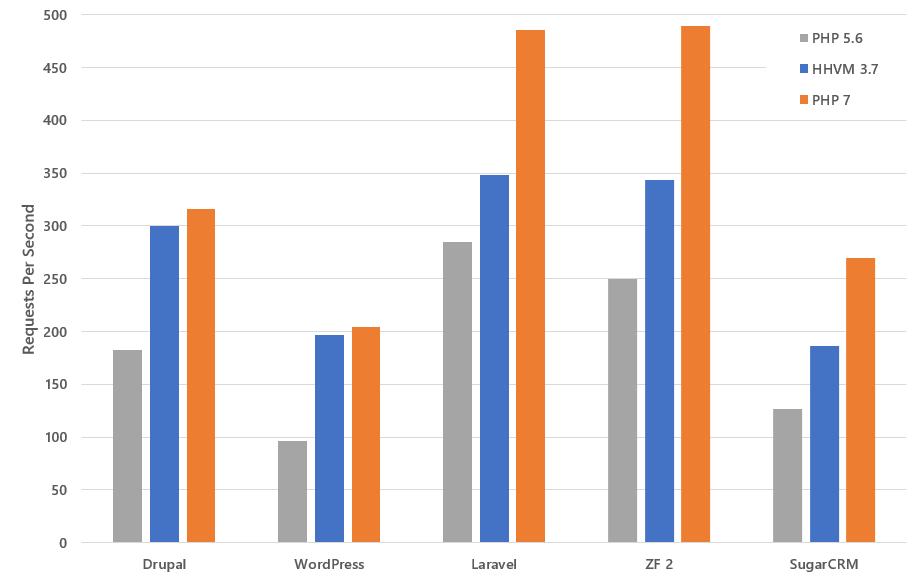
By using PHP7, you will need fewer servers to serve the same number of users with the increased execution time of code. The graph below is the performance benchmark that the Zend Performance Team provides.
Handling catchable fatal errors is not an easy task for PHP coders and never has been. The only solution to handle these fatal errors is to use Exceptions. This new Zend Engine provides the facility for PHP developers to handle errors easily without system failure at runtime, which is quite unprofessional.
The new EngineException objects in the new Zend Engine don’t extend the Exception Base Class of previous versions. This object shows that the new system is using the interfaces and data from earlier versions but producing different kinds of exceptions in error handling: the Traditional and the Engine Exceptions.
PHP 7 enables PHP programmers to catch both types of exceptions by introducing the new Parent Class Called BaseException.
The code and the result that emerged because of the fatal errors in previous versions are shown below:


The new changes are:

The native environment of PHP is Linux because PHP is a prominent member of the LAMP stack. But it is not impossible to run PHP on a Windows system. There are two types of Windows systems: x86 and X64. PHP 5 does not provide support for the X64-bit version of Windows. So PHP 7 introduced support for the X64-bit Windows system.
PHP 7 now allows you to run the language on your 64-bit Windows system. Both 64-bit integers and large files are supported by PHP 7.
The official name for the spaceship operator is the Combined Comparison Operator. The notation of this operator is like a simplified spaceship, like this <=>.
This operator gives the result 0 if both the left-hand operand and the right-hand operand are equal, returns 1 if the left operand is greater than the right operand, and -1 if the left operand is less than the right operand. This three-way comparison operator not only exists in PHP but also in other programming languages like Perl and Ruby.

The Null Coalescing operator – denoted as (??), is used to check if the value exists or not. If the value does not exist, then it returns a default value, and if the value does exist, it will return the left operand. The right operand is returned if the value doesn’t exist or in any other case.
The code snippet below shows how this new operator reduces the time spent on basic declarations:

The new PHP 7 allows developers and programmers to improve the quality of their code by using the correct return type declarations so that unintended return values can be prevented.

The image shows a simple use case of the foo() function. This function is supposed to return an array. There are more complicated examples that show the return type declarations.
PHP 7 has introduced four new types of declarations for scalar values to increase the features even more. The types are int, float, string, and bool. These new scalar types allow PHP developers to denote the integers, floats, strings, or booleans to be returned.
PHP 7 enables developers to use the OOP concept and to use anonymous classes. The concept already exists and is used in many Object-oriented languages like C# and Java. The anonymous class – as defined by the name- is a class with no name. But the object that instantiates it has the same functionality as an object of a named class.
If we talk about the syntax, which is the same as what we were using in traditional PHP classes, the only difference is the name, which is missing. The advantage of using an anonymous class is that it can increase the speed of code and execution time as well, if and only if these classes are used in an excellent way. And in the case when a class doesn’t need to be documented.

The Group Use Declarations are indeed a blessed feature for developers who want to import many classes from the same namespace when required. This new syntax helped developers by cutting the babble of words, making the code neat and clean, easier, and saving typing time.
Using Group Use Declarations makes it easy and clean for you to read through and debug code, as it helps developers identify imports from the same namespace in a module.

PHP 7 was introduced with the goal of freeing up space and improving performance. To achieve this, it removed many deprecated functionalities, along with old and unsupported Server APIs and extensions.
This cleanup provides more security by removing items that have been deprecated for a while in PHP 5 and that have not been in use for a long time. Keep in mind that PHP 7 can break your code if your app is still running on an older version of PHP.
PHP 7 has come a long way, and there’s even more to look forward to in future versions for developers who love working with PHP. You might run into a few bugs along the way, but that’s all part of the process, and honestly, that’s how you grow and get better at it.
Arpatech turns PHP 7 into a competitive advantage: faster builds, cleaner code, better results. Let’s start building.

Before we begin, please solve this quick math check to confirm you're human, and you'll be all set to start chatting with our AI assistant.
Stay connected with us to receive the latest information, updates, and insights from our world of innovation.
By entering your email address you will receive promotional updates.


© 2026 ARPATECH (ADVANCED RESEARCH PROJECTS & TECHNOLOGY)