Latest Blogs
Software Development
Ramsha Khan
Jul 14, 2026

Top 7 SEO Tools to Support Your Website Ranking
With an almost endless number of websites nowadays, getting good traffic is extremely difficult unless you use suitable SEO tools. There are many such tools available on the market, but people sometimes feel confused when it comes to finding the most appropriate solution to their needs.
It can be hard to master SEO optimization, particularly if you’re just starting out. Optimization of search engines can be difficult, especially given the ever-changing algorithms of search engines. With the right set of SEO optimization tools, despite the frequent algorithm updates, you will be able to increase your site traffic.
When you implement the right SEO techniques, the website will be able to rank high in searches, gaining higher visibility and more targeted traffic—a higher ranking contributes directly to more visitors. These useful tools will help you boost your online presence, achieve a higher ROI, and gain more revenue in the long run.
You want to produce quality content focused on high rating keywords, but it would require time-consuming and extensive work to identify them. When it comes to keyword research, using the right SEO tools can save you a lot of valuable time.
They can also help you optimize your content, so you can gain credibility and authority on the web. In fact, SEO tools help you to research the competitors closely to ensure you’re still one step ahead of them.
We have compiled the best SEO tools to make things easier for you.

Ahrefs is among the most popular web SEO tools. After Google, it is the second-largest crawler of websites. Ahref’s Site Audit feature is known to be the best SEO analytics tool today. It lets you highlight the areas of your website that require changes and upgrades. It amazingly helps you achieve higher ranking in search engines.
You can also use Ahrefs to sneak into the backlinks of your competitor. It will give you a starting point for launching your own brand. Marketers use Ahrefs to identify the content that is most relevant to within a specific niche.

Google Search Console (GSC) offers novice webmasters an outstanding way to get started with SEO.
And if you’re not headstrong at SEO, whatever the size of your web or blog, the first port of call will be Google’s laudable Search Console (formerly Webmaster Central) and the countless user-friendly tools under its hood.
The tool suite provides you with valuable information about your site at a glimpse: it will assess the efficiency of your site and detect any potential problems to configure (such as harmful spam links). It helps ensure that your site is Google-friendly and track the indexing of your site by Google.
If your platform has incurred a penalty, you may also record spam and seek reconsideration. Furthermore, if you don’t consistently refer to their Webmaster Guidelines, well, you’ve just got to excuse yourself if you go wrong. Search Console is continuously being updated, and new updates are on the way, such as new URL inspection tool or new sitemaps reporting.

The SEO community enjoyed using the SEO tools of SEMRush marketing. SEMrush is fan’s favorite and experts, who have admired it for the impressive features.
You can quickly review the ranks, ranking improvements and potential opportunities for improved ranking captures. The Domain Vs Domain feature offers you an in-depth overview that helps you to equate your domain with competitors.
The On-Page SEO Checker tool helps you to monitor your rankings effectively, and provide recommendations about how to boost the performance of your website.

Moz Pro is a SEO tool kit that focuses on helping you improve traffic, rankings and visibility throughout search engine results.
Key tools include the ability to use the Moz Pro spider to audit your own site, which should highlight potential problems and recommend actionable insights. There is also the ability to track the rankings of your site over hundreds or even thousands of keywords per site.
There’s even a keyword research tool to help decide which keywords and keyword variations are better for targeting and there’s also a backlink analysis tool that combines a variety of metrics like anchor text in links as well as estimated domain authority.
Pricing for Moz Pro starts at $99 a month with the Premium package including the basic tools. The Medium package provides a wider variety of features for $179 a month, plus there is a free trial.
If you don’t sign up with Moz Pro, there are a variety of free tools available. There is also a huge community of support willing to offer assistance, advice and guidance around the spectrum of search marketing issues.

An SEO keyword tool such as KWFinder lets you find long-tail keywords that have lower competition levels. The professionals use this SEO tool to find the best keywords and run analysis on backlinks and SERP (Search Engine Results Page).
Their Rank Tracking tool helps you to quickly determine your ranking while measuring one key metric for your improvement. And, if that’s not enough, you’ll get a lot of new ideas for keywords to help you rank the site even higher.

Created by Neil Patel, it is a keyword-finding tool that lets you find keywords and the search intent behind them by showing them the top SERP ranks.
From short to long-tail phrases, with hundreds of recommendations from this free fantastic keyword tool, you can find the best keywords to use on your website. The keyword volume, competitiveness, CPC, and seasonal trends are the metrics that they include in their report. The tool will help PPC teams decide whether a keyword is worth promoting and how competitive it is for both organic, SEO and paid.

BuzzSumo helps you analyze which category of content works best for any topic and breaks down performance across blogs, keywords, etc. through various metrics. You begin by entering your keyword in the search box, and then find out what content is best for it.
You will also find key influencers to support your content and you can use email outreach to pitch to them. You just need to enter the topic you are working on to find a high-performing headline. It’ll send you a rundown of any topic’s most popular titles, sorted by the number of social shares.
Alerts can be created with any keyword related to your brand, which will keep you on top of new and trending content.
Saima Naz
Mar 12, 2020

Why You Should Use Cloudflare
Implementing Cloudflare is no doubt one of the simplest ways to optimize and add security to your website. Cloudflare is a CDN (Content Delivery Network), and Security Company aims to supercharge and secure online infrastructure for small to enterprise level businesses. It serves as a middle layer between your actual hosting provider and the user using the name of your domain, who browses your website.
It caches your website’s static resources, letting your website load faster and puts on less web hosting load. It’s the CDN that’s in the center of your domain name and web host.
One of Cloudflare’s significant benefits is the free CDN. Integration is easy and does not change the image URL or show URLs like cdn.domain.com. Cloudflare is absolutely free to start, while other CDN services cost money.
You do not need to do any code changes, or install any software. Just set up an account and choose which domains you would like to secure. You’ll experience superior performance of the website in as little as five minutes.
As the traffic on the website is filtered only valid traffic flows. Therefore, the hosting resources will be used by the actual customers with better speed. In addition, Cloudflare caches the static content and supports it by requesting it from the host each time. So, to serve the content the host needs less processing.
Google Analytics or any other analytics you will use in HTML are based on the fact that users have JavaScript enabled and the page loads to the point where the tracking code is accessible. With Cloudflare, analytics are much more precise than JavaScript-based stats as they catch all of the traffic stats that JavaScript may lose due to blocked JavaScript content or page not loaded fully.
The entire traffic does not head to host. So, one can save on the bandwidth of spammers and hackers that you would otherwise waste. In addition, the static content delivered as cached from Cloudflare would still be saved on the hosting bandwidth.
If you have multiple images on your website then Cloudflare Polish may dynamically adjust them for quick loading to a smaller size. You can choose either lossless or lossy compress.
Polish supports WebP compression as well and is accessible from the PRO package. Additionally, you should link to this for learning how to compress images for WordPress, Joomla or other website platforms.
DDoS and DoS are blocked by Cloudflare. DDoS is an attack on the website that sends out too many automated requests from various locations to render it down.
If the hacker knows your IP address, Cloudflare can’t fully protect the server from DDoS since the attacker targets IP that explicitly bypasses the Cloudflare. The workaround would be to change the IP address and only use the new IP address in Cloudflare.
If a platform receives too many DDoS attacks, then using Cloudflare makes sense.
Not only is it improving your website hosting experience, but you are accessing a growing international user community. An attack on any user is immediately identified and consequently blocked for the entire community. Cloudflare helps you protect against numerous threats, be it cross-site scripting, spam comment, SQL injection, excessive bot crawling, harvester emails, etc. It will deter most attacks automatically without the complicated configurations needed for other security plugins and tools.
Saima Naz
Mar 9, 2020

Uses of AI in the Health Sector
Artificial intelligence is transforming numerous fields of the healthcare industry. From robot-assisted surgeries to simulated nurse assistants or helping identify diseases, AI is providing improvements in general care, diagnosis and treatment.
A staggering 20% of healthcare spend is wasted globally, but AI is capable of improving treatment results by 30-40 percent, reducing costs by as much as 50%.
Here are some key uses of AI in health sector:

Saima Naz
Mar 6, 2020

Best Ecommerce Platform for Drop-shipping Business in 2...
Drop shipping is a process of order fulfillment where retailers do not house inventory explicitly but instead use wholesalers or manufacturers to distribute straight to the customers. This often comes with a range of benefits, including:
The main difference between dropshipping and conventional shipping is that the retailer excludes the use of additional space which can save money that is generally used to rent a warehouse. In return, they purchase products from a wholesaler or manufacturer on a ‘need’ basis. Moreover, they keep a track of the shipping process.
Let us dive deep into the details to look for the best ecommerce platform for any startup company who wishes to start with dropshipping business.
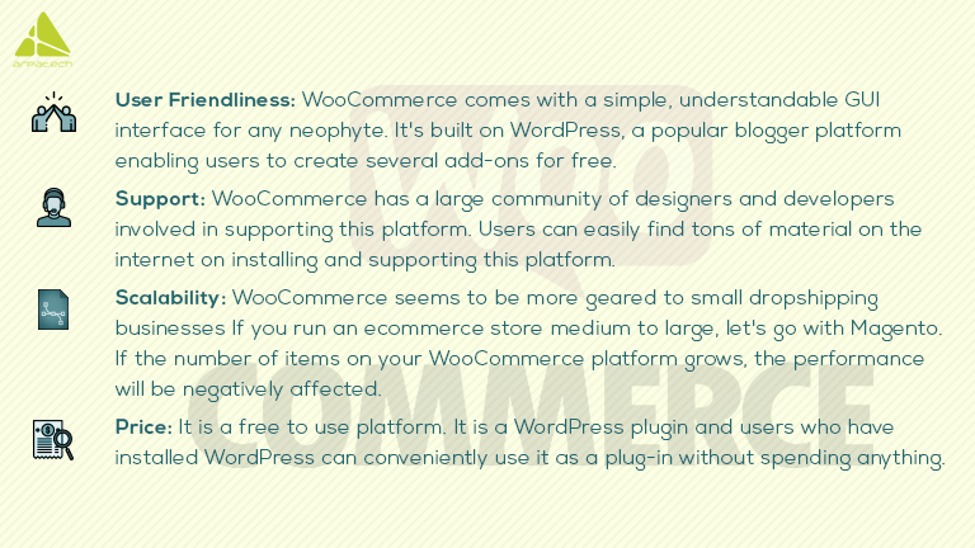
WooCommerce is the world’s most widely used ecommerce platform. It has a market penetration of more than 28 percent in overall ecommerce stores and this is undoubtedly due to the free and simple install plugin. With a single click, WooCommerce users can install it, making it an ideal choice for non-technical users too.
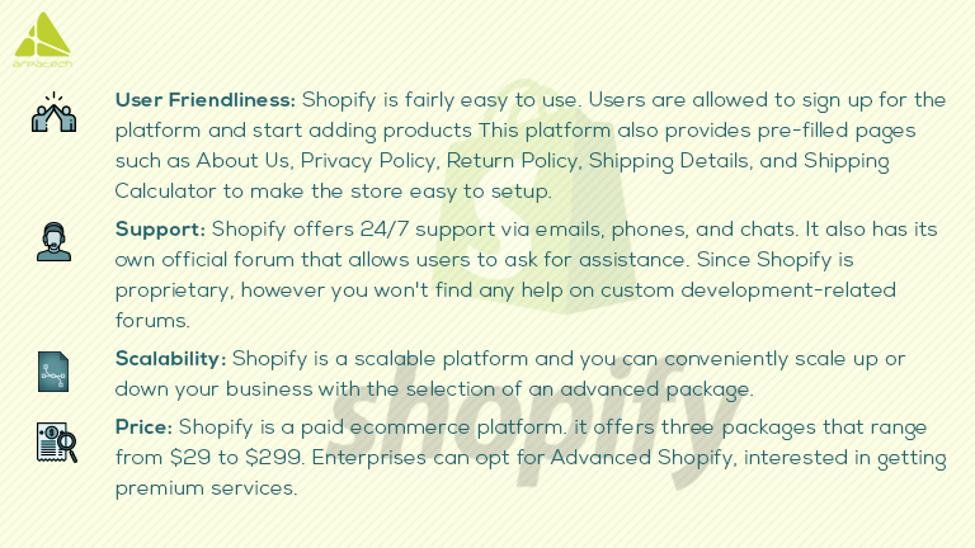
The second name in the list of best ecommerce platforms is Shopify. Until now, Shopify has helped almost 600,000 e-commerce stores worldwide, including dropshipping companies Oberlo, a dropshipping plugin that works exclusively on Shopify, can especially help you find products to sell from Oberlo Verified suppliers, Oberlo suppliers, or AliExpress suppliers.
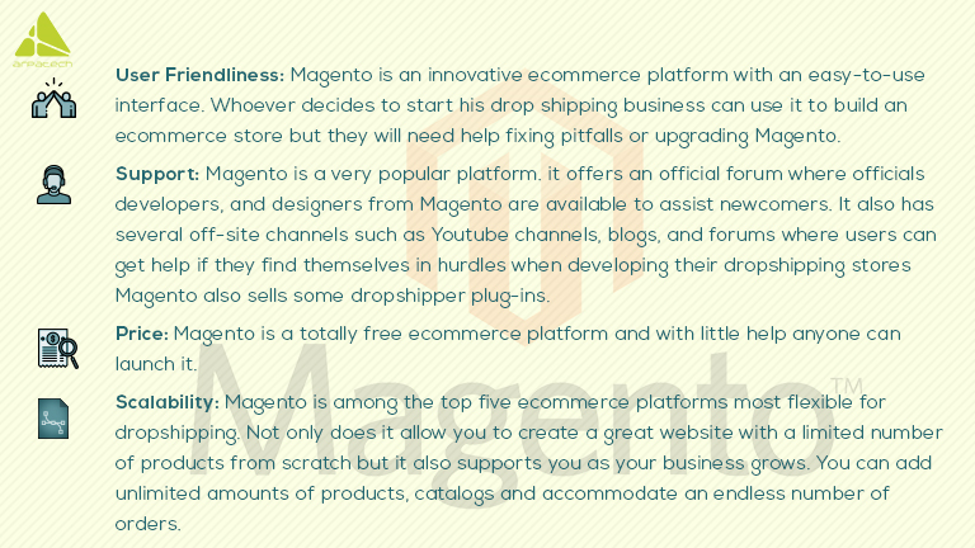
Suffice to say, up till now Magento is among the most successful ecommerce platforms to dropshipping. The user may choose between two versions (Magento 1 and Magento 2 – strongly recommended) and two editions (Magento Open Source – Free and Magento Commerce – Premium).
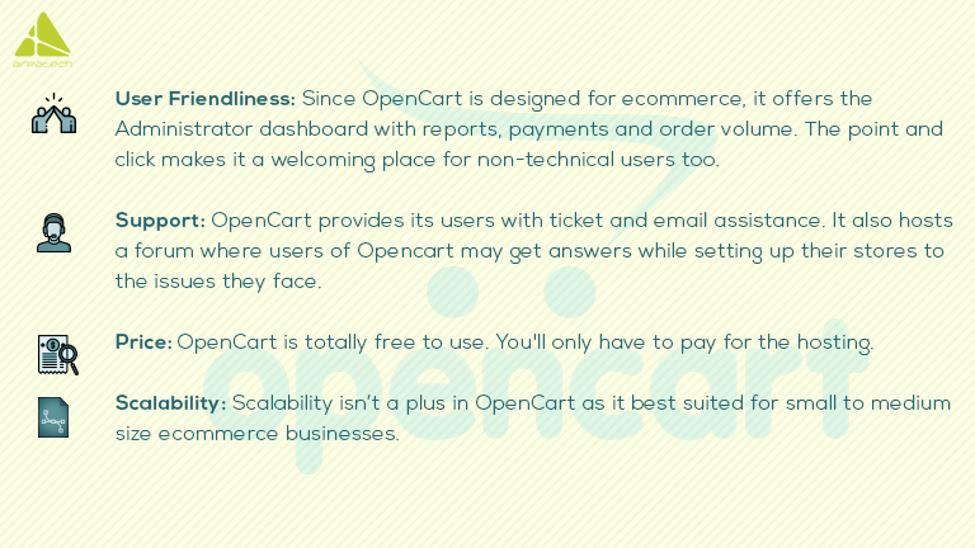
OpenCart is another free ecommerce platform you should consider for dropshipping. Magento and OpenCart share a lot of characteristics – free open source, efficient and more suited for tech savvies than the beginners. Nevertheless, as Magento’s community is wider and far more robust than OpenCart’s, and Magento has more themes and plugins, OpenCart is less famous.
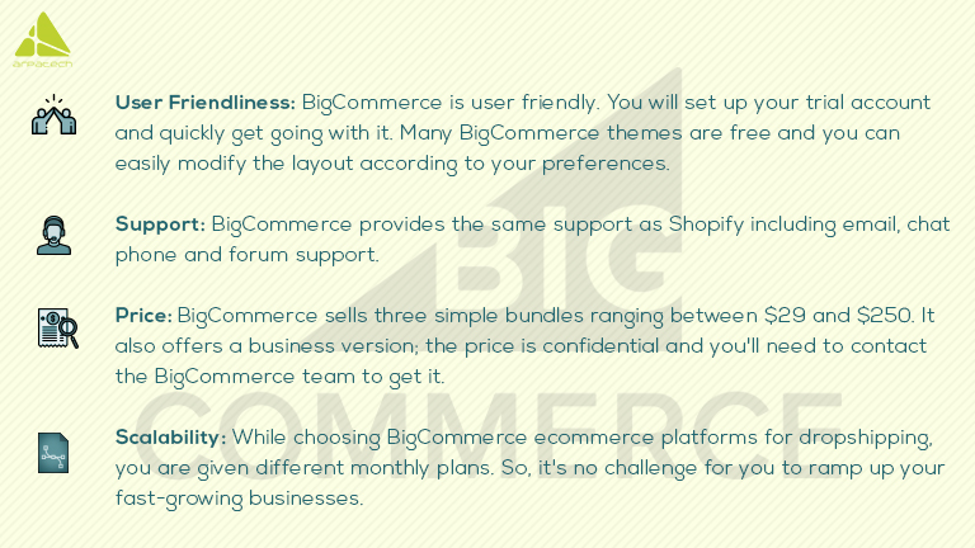
BigCommerce is a platform that hosts ecommerce. It also has a fair share of the market for ecommerce services, and claims to host more than 50,000 small business websites and 2,000 + enterprise firms. It is recognized for its simple user interface and quick setup process for ecommerce. Compared to Shopify, BigCommerce is more economical as a hosting ecommerce platform because it does not charge any transaction fees, and offers unlimited staff accounts, besides other prominent features.
Saima Naz
Mar 4, 2020

7 Points to Consider on Ecommerce Web Development
The development of an eCommerce site includes a lot of moving pieces. Therefore, before jumping into the head first, one has to take into account a number of factors. Designing a simple website is one thing, but developing an eCommerce site comes with a host of challenges.
If you have finally decided to create an e-commerce website, the seven points below will tell you how you can do that effectively.
A detailed description of the product makes the shopper’s decision for making a purchase. They must know all the facts about whatever product they are willing to buy from you.
Show shoppers how the product will benefit, and what features it has. Understand that people aren’t looking for a product but a solution to their problem.
Also, add product description for search engine optimization (SEO). Figure out what people are looking for online and then use those phrases on the search results page to get higher rankings.
There is nothing more annoying than using an e-commerce site’s search feature and getting hundreds of results that don’t match what you’ve been searching for. Try to ensure that your e-commerce site uses qualified, reliable search engine software, and allows filtering for more advanced search options if you hold a large product inventory.

Companies with e-commerce sites mostly want users to create an account to complete a purchase, as this enables follow-up communication that encourages future sales and tracks demographic information for customers to examine sales. Nevertheless, it’s important to keep in mind that not everyone wants to go through the account creation process while making a purchase.
But for repeated purchases, customers should be encouraged to get themselves registered and enjoy perks like getting notified for any upcoming sale, saving their information for any of the future purchases. However, it’s still a good idea to give an option to people who just want to place a one-time order.

It is extremely important to have high-quality images. The best way to sell anything is to get it into someone’s hands, but since it can’t be done online, the next best way is to allow them to visualize the product with the help of high-quality images of the products.
Also, keep website’s performance in consideration. Big images can significantly slow down your website load time. If a customer has to wait too long to load a web page, they may become annoyed and end up leaving. A skilled e-commerce web developer will ensure that images (and video) are optimized for websites so that pages can be loaded quickly while maintaining image quality.
Electronic commerce sites must always be user-friendly. A fulfilling user experience retains visitors to the site and keeps them coming back for more. Place product categories menus and links at a noticeable place, and make sure the names of the categories and the products in each category are accurate.
In addition, ensure that every page serves users with an easy way to get back to wherever they want on the website—whether it’s the home page, finding contact info, choosing another category, or going to the shopping cart directly.

This is the era of mobile devices, be it a smart phone, or a tablet. Therefore, the use of mobile devices to access websites is constantly expanding, and e-commerce purchases are a major part of this traffic. It’s extremely essential to ensure that your e-commerce website is mobile-optimized, providing users with the best experience regardless of which device they use to access your website.
The website launch is only the start of the whole process. You must have heard that, “if you build it, it’s going to come,” which is a total misconception. It includes a lot more for attracting visitors to your new website. Marketing strategies set up an online presence to accumulate traffic, leads and revenues.
There are several ways to attract visitors to your website. Here are just a few popular strategies that digital marketers follow:
SEO – Optimizing your pages with keyword phrases people will probably be looking for on search engines.
Social media – Communicating and engaging with prospective clients.
SEM – Paid Google ads as well as other search engines.
Content marketing – Delivering quality content for free on your websites can potentially bring new visitors and separate you from competitor websites.
Email marketing – An efficient way of engaging your customers and drawing their attention.
These strategies help bring visibility and traffic to your store. Staying updated with the eCommerce trends in software industry can also help you align your store with current consumer behavior and tech advancements.
In this digital era, e-commerce websites have the potential to transform your business. Not only can they increase your revenue, but they can also set up your business on a global level – without the hassle of running a brick-and-mortar store.
There’s no denying that it takes sweat, time, effort and money to create an e-commerce website. Nevertheless, if you follow the right strategies, a good e-commerce website will not only drive sales, but will also retain more loyal customers than you think.
Saima Naz
Feb 27, 2020

5 Ways to Speed Up Your E commerce Website
Website speed is among the key elements of any ecommerce store. If your online store is slow, people bounce even before the page loads.
As with recent updates from Google, website speed has become a significant factor for ranking. We have listed five ways that can help speed up your ecommerce site.

There’s no single strategy that’s guaranteed to work when it comes to making your website faster and more efficient. The best way to learn is by running a speed test on the website to find the real problem areas.
Having high-resolution images of your products on your website has become both important and prevalent. Always compress your images before sending them to upload on your website. Every bit of size of the file you remove helps improve load times.
Technical SEO covers several factors that directly affect site speed. Running an SEO audit on your site’s technical aspects is a brilliant way of identifying potential issues.
If an online store is loaded with dense, massive-page features such as carousel sliders, heavy images and more, mobile often takes longer to load. Simplify to the maximum. Use:
It takes a lot of time for a new website to load for the first time. Web caching helps prepare for the next visit by allowing the browser to store certain elements of the page. This means visitors won’t have to wait long to load the entire page next time.
Saima Naz
Feb 26, 2020


Before we begin, please solve this quick math check to confirm you're human, and you'll be all set to start chatting with our AI assistant.
Stay connected with us to receive the latest information, updates, and insights from our world of innovation.
By entering your email address you will receive promotional updates.


© 2026 ARPATECH (ADVANCED RESEARCH PROJECTS & TECHNOLOGY)