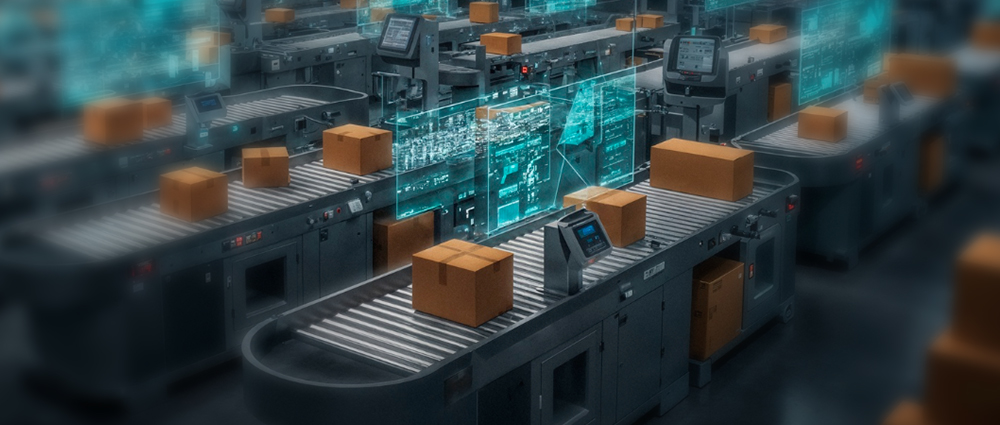
Walk into almost any large distribution center in the US today, and you will notice something different from just five years ago. Fewer people are pushing carts up and down long aisles. Robots glide past pallets, sensors track every box that moves, and software quietly makes hundreds of decisions a minute about where products should go next.
This is warehouse automation, and in 2026 it has become one of the biggest stories in US logistics.
For decades, warehouses ran mostly on manual labor, forklifts, and simple conveyor belts. That worked fine when order volumes were predictable, and customers were happy to wait a week for a package. But the world has changed.
Online shopping exploded; customers now expect two-day or even same-day delivery, and labor shortages have made it harder than ever to staff a warehouse the old-fashioned way. Companies had to find a better way to keep up, and that is exactly what warehouse automation delivers.
At its core, warehouse automation is the use of technology, machines, software, and robots to handle tasks that used to require manual effort. This includes everything from moving inventory and picking orders to packing boxes and tracking stock levels in real time.
There are generally two types of automation working together in modern facilities:
The goal is simple: take repetitive, time-consuming, and physically demanding tasks off human shoulders so workers can focus on higher-value work like quality control, exception handling, and problem-solving. It is not about replacing people entirely. It is about letting humans and machines each do what they do best.
A few forces are pushing US businesses toward automation faster than ever before. First, e-commerce keeps growing, and customers expect fast, accurate deliveries no matter how complex the order. Second, warehouse labor is genuinely hard to find and keep.
Turnover in warehousing has historically been high, and many facilities struggle to hire enough seasonal workers during peak periods like the holidays. Third, the technology itself has matured. Robots are cheaper, smarter, and easier to deploy than they were just a few years ago, and AI has moved from a buzzword into something that actually improves day-to-day operations.
The numbers also back this up.
According to Mordor Intelligence’s 2026 industry report, the global warehouse automation market is valued at $34.17 billion in 2026 and is projected to grow at a 13.98% CAGR to reach $65.74 billion by 2031. Millions of commercial robots are now installed in warehouses around the world, and that number keeps climbing every year.
Yet even with all this growth, a large share of warehouses worldwide still have not automated in any meaningful way. That gap is exactly where the opportunity lies for companies willing to modernize now.
To appreciate how far things have come, it helps to look at what traditional warehouse automation actually looked like. Older systems relied heavily on rigid, hand-coded programming. Conveyor belts followed fixed paths.
Automated guided vehicles, known as AGVs, needed magnetic tape or wires embedded in the floor to know where to go. If you wanted to change your warehouse layout, you often had to rip up flooring or rewire entire systems.
These traditional systems were reliable in a narrow sense, but they were also inflexible. They could not easily adapt to sudden changes in order volume, new product types, or shifting warehouse layouts.
A system built for one specific workflow would often struggle the moment that workflow changed even slightly. For years, this was simply accepted as the cost of automation. You picked a process, automated it, and hoped your business needs would not change too much.
Fast forward to today, and that inflexibility is exactly what modern warehouse automation technology has solved.
The biggest difference between old and new warehouse automation systems comes down to intelligence. Traditional automation followed strict, pre-written rules. Modern automation, powered by artificial intelligence and machine learning, can actually learn, adapt, and make decisions on the fly.
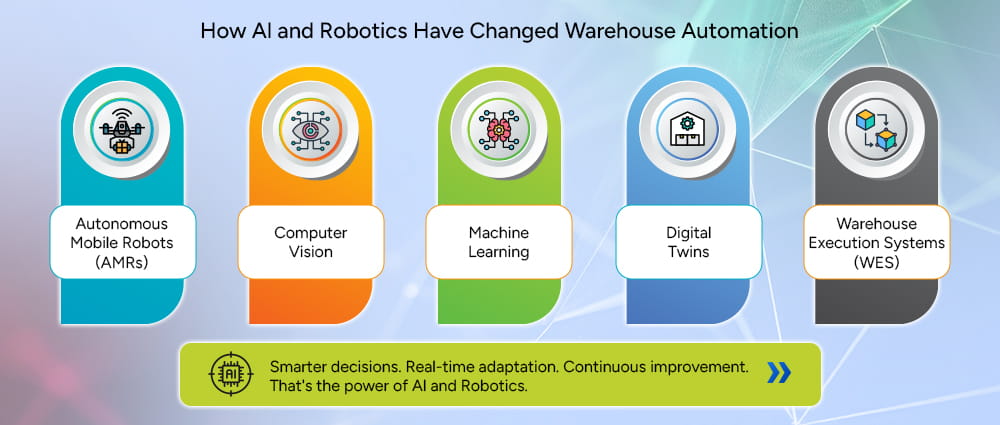
Here is what that shift looks like in practice:
This is what people mean when they talk about warehouse automation robotics moving from simple mechanical tools into genuinely smart systems. The robots are not just moving from point A to point B anymore. They are making decisions, adapting in real time, and getting smarter with every order processed.
If you are trying to keep up with where the industry is headed, a few clear warehouse automation trends stand out this year.
For years, automation mostly focused on bringing goods to a picker standing at a workstation. Now, robotic systems are also handling the movement of inventory between zones, replenishment, and returns, tasks that used to eat up a huge amount of labor time. Combining both approaches creates a smoother, more continuous flow from storage all the way to packing.
For a long time, most automation investment went toward outbound order fulfillment, meaning getting products out the door. In 2026, warehouses are applying the same intelligence to receiving, unloading, and putaway. Robotic case handlers and load exchangers now sort and store incoming shipments with far less manual handling than before.
Instead of paying millions of dollars upfront for robotic hardware, many companies now lease robots through a subscription model. The provider handles maintenance, updates, and scaling, while the warehouse simply pays a monthly fee. This has made warehouse automation solutions accessible to mid-sized businesses that could never have afforded a full robotic rollout a few years ago.
Rather than treating software as a side tool, warehouse leaders now view orchestration platforms as the backbone of their entire operation. These systems manage multiple robots, human teams, and inventory zones together, adjusting in real time as conditions change.
Collaborative robots, or cobots, work directly alongside human employees. They handle heavy lifting, repetitive motions, and other physically demanding tasks, freeing up people to focus on quality control and more complex decision-making.
Running a warehouse takes a lot of power, especially for lighting, heating, cooling, and running equipment. As automation expands, more companies are pairing new systems with energy-efficient designs and renewable energy sources to keep operating costs under control.
A system that is extremely efficient but impossible to reconfigure is no longer good enough. Businesses want automation that can flex with seasonal demand, new product lines, and unpredictable market shifts.
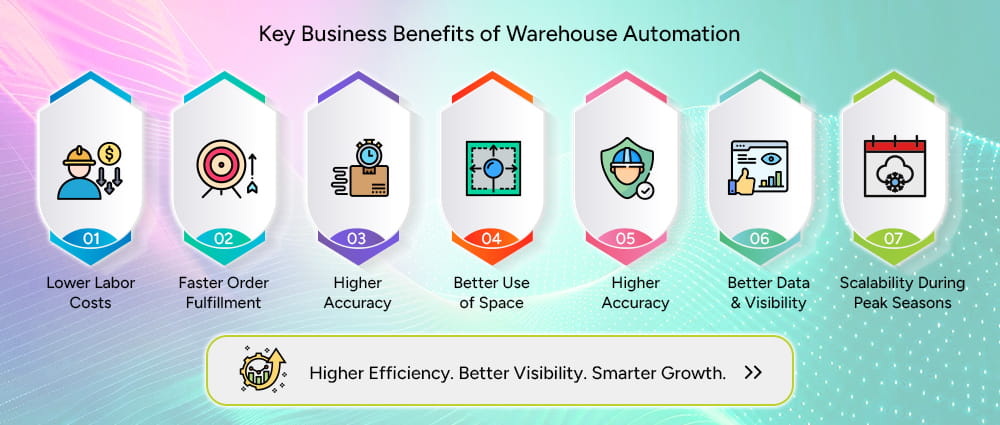
It is one thing to talk about trends, but what does automation actually deliver for a business? The benefits tend to fall into a few clear categories.
When we automate repetitive tasks, it reduces the number of labor hours needed for basic picking, packing, and moving inventory.
Automated systems can process orders far quicker than manual methods, which matters enormously when customers expect next-day or same-day shipping.
With automated picking and sorting dramatically cuts down on human error, which means fewer returns, fewer complaints, and happier customers.
Automated storage and retrieval systems make use of vertical space that would otherwise sit empty, letting warehouses store more inventory without expanding their physical footprint.
Warehouse Automation reduces the number of repetitive, physically strenuous tasks that lead to workplace injuries, one of the most persistent problems in traditional warehousing.
Modern automation software gives managers real-time visibility and insight into inventory levels, order status, and potential bottlenecks, something that is nearly impossible to track accurately with manual processes.
Automated systems, especially those using a robots-as-a-service model, can scale up during busy periods like the holidays and scale back down afterward without the cost of hiring and training large numbers of temporary workers.
These benefits explain why so many companies now view logistics automation not as a luxury but as a basic requirement for staying competitive.
While robots tend to get most of the attention, warehouse automation software is really what makes everything work together. A good warehouse management system, sometimes paired with a warehouse execution system, acts as the central nervous system of the entire operation.
These platforms handle tasks like:
Cloud-based warehouse management systems are becoming the standard choice in 2026 because they are easier to update, scale, and integrate with other systems compared to older on-premises software.
For businesses juggling multiple warehouse locations, this kind of software is what keeps everything running smoothly and prevents one facility’s problems from spilling over into another.
This is also where software companies like Arpatech can play a meaningful role. Building or customizing warehouse automation software that connects seamlessly with existing systems, whether that is a WMS, an ERP platform, or an e-commerce storefront, requires deep technical expertise.
The right software partner can help a business avoid the common trap of buying expensive hardware without the digital infrastructure needed to actually use it effectively.
There is no shortage of warehouse automation companies out there, and the range of options can feel overwhelming. Some specialize in robotics hardware, some focus purely on software, and others offer end-to-end solutions that combine both.
When comparing options, it helps to think through a few practical questions:
It is also worth noting that many of the companies leading the warehouse automation robotics space today started small, often piloting a single zone or process before scaling up across an entire facility. That approach tends to be far less risky than trying to automate everything at once.
This is probably the question business owners ask most often, and the honest answer is that it depends heavily on the size and complexity of your operation. That said, there are some general ranges worth knowing.
Beyond the hardware itself, businesses should budget for software licensing, installation and site preparation (which often adds 20 to 30 percent on top of equipment costs), employee training, and ongoing maintenance. Many companies find that the payback period, meaning how long it takes for the savings from automation to cover the initial investment, falls somewhere between two and five years, depending on labor savings, space efficiency, and order volume.
For smaller and mid-sized distribution centers specifically, the good news is that the entry point has gotten much more affordable thanks to robots-as-a-service models and modular automation systems that let you start small and expand gradually rather than committing to a massive investment on day one.
It is worth remembering that warehouse automation does not exist in isolation. It is one piece of a much bigger picture called logistics automation, which covers everything from transportation planning to optimizing last-mile delivery. Logistics automation software increasingly connects warehouse operations with transportation management systems, giving businesses a clearer view of their entire supply chain rather than just what happens inside four walls.
Robotic process automation in logistics, which uses software bots to handle repetitive digital tasks like data entry, order processing, and invoice matching, is also playing a growing role. These tools may not be as visible as a robot rolling down a warehouse aisle, but they save enormous amounts of administrative time and reduce costly errors in areas like shipping documentation and customer communication.
For logistics automation companies and the businesses that rely on them, the trend is clear: the future belongs to systems that connect every part of the supply chain, from the moment inventory arrives at a warehouse to the moment a package lands on a customer’s doorstep.
The US market has some unique pressures that make warehouse automation especially relevant right now. Warehouse rents in many parts of the country have climbed significantly in recent years, which puts pressure on companies to make the most of the space they already have rather than simply building bigger facilities. At the same time, labor shortages continue to challenge warehouse operators across the country, particularly during peak retail seasons.
Consumer expectations have not slowed down either. US citizens have actually grown accustomed to fast, accurate deliveries, and businesses that cannot keep pace risk losing customers to competitors who can. Automation offers a practical path forward, letting companies do more with the space and workforce they already have while improving accuracy and speed at the same time.
For small and medium-sized businesses in particular, the message is encouraging. You do not need a massive budget to get started. Beginning with one automated process, whether that is inventory tracking, order picking, or storage, can deliver real, measurable improvements without requiring a complete overhaul of your operations.
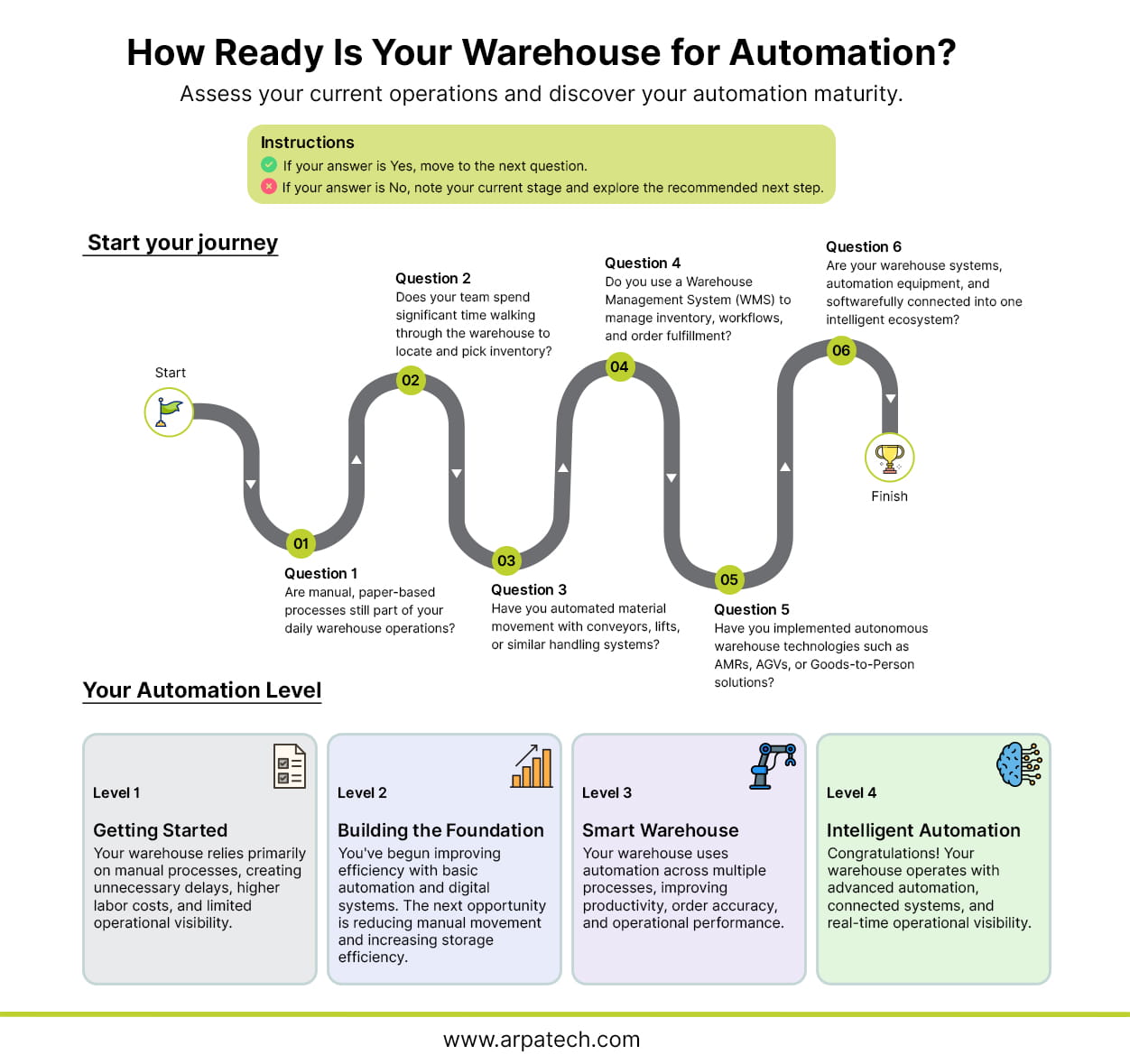
If you are considering automation for your own warehouse, it helps to take a structured approach rather than jumping straight into a big purchase.
Warehouse automation in 2026 looks nothing like it did even a decade ago. What used to be rigid, hard-coded systems have evolved into intelligent, adaptable networks of robots, sensors, and software working together in real time. This shift is not about removing people from the equation. It is about giving human workers better tools, safer working conditions, and more meaningful tasks, while letting machines handle the repetitive, physically demanding work that used to define warehouse jobs.
For US businesses facing rising costs, labor shortages, and ever-increasing customer expectations, automation is quickly moving from a nice-to-have to a genuine necessity. The good news is that today’s warehouse automation systems are more flexible, more affordable, and more accessible than ever before, whether you are a small distribution center just getting started or a large enterprise looking to modernize an existing network of facilities.
As a software company that understands both the technology and the business side of logistics, Team Arpatech believes the companies that will thrive over the next few years will be the ones that treat automation not as a one-time purchase, but as an ongoing investment in smarter, more resilient operations.
For medium-sized businesses, a mix of autonomous mobile robots (AMRs), automated storage and retrieval systems (AS/RS), and a cloud-based warehouse management system tends to offer the best balance of cost and impact.
Many mid-sized operations start with a robots-as-a-service model, which lowers the upfront investment while still delivering meaningful gains in speed and accuracy. The right choice ultimately depends on order volume, SKU complexity, and available warehouse space.
The main benefits include lower labor costs, faster order fulfillment, higher picking and packing accuracy, better use of vertical storage space, improved worker safety, and real-time visibility into inventory and operations. Together, these improvements help businesses handle more orders without a proportional increase in labor or errors.
There are many established and emerging players in this space, ranging from robotics-focused providers to full-service integrators that combine hardware, software, and support.
Rather than naming just one, businesses are usually better served by comparing a shortlist of vendors based on how well their systems integrate with existing WMS and ERP platforms, their pricing model, and their track record with warehouses of a similar size and complexity.
Autonomous mobile robots use onboard sensors, cameras, and artificial intelligence-based mapping to navigate a warehouse without fixed tracks or wires. This allows them to transport goods, assist with picking, and reroute around obstacles in real time.
Because they do not require rigid infrastructure, AMRs can be redeployed quickly as layouts or demand change, making them far more efficient and adaptable than older automated guided vehicles.
Start by looking at total cost of ownership rather than just the upfront price, including installation, software licensing, training, and maintenance. Then compare efficiency metrics like order fulfillment speed, picking accuracy, and space utilization across similar facility sizes.
Requesting case studies or references from businesses with comparable order volumes can also help you judge how a system performs in real conditions rather than just on paper.
Smaller, targeted automation projects for a distribution center often start around $50,000 to $150,000 for a focused pilot involving a handful of robots or a single automated storage system.
More complete semi-automated setups, including software integration, can range from $150,000 up to around $500,000 or more, depending on the technologies chosen and the complexity of the operation.
The most commonly used platforms fall into a few categories: warehouse management systems (WMS) for tracking inventory and orders, warehouse execution systems (WES) for coordinating robots and human workers in real time, and orchestration platforms that tie everything together across multiple facilities.
Increasingly, businesses look for cloud-based platforms that integrate smoothly with existing ERP and e-commerce systems rather than standalone tools that operate in isolation.

Before we begin, please solve this quick math check to confirm you're human, and you'll be all set to start chatting with our AI assistant.
Stay connected with us to receive the latest information, updates, and insights from our world of innovation.
By entering your email address you will receive promotional updates.


© 2026 ARPATECH (ADVANCED RESEARCH PROJECTS & TECHNOLOGY)