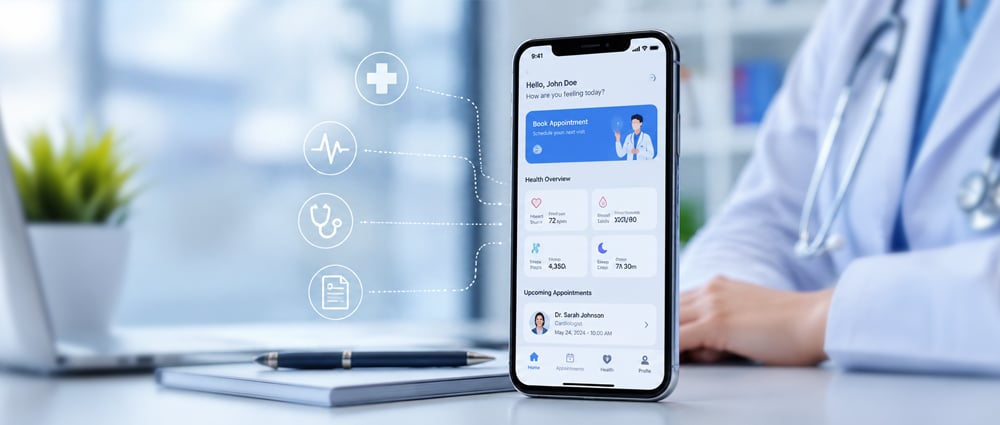
Healthcare is no longer restricted to hospitals and clinics. In today’s digital healthcare landscape, telemedicine and remote care have made it possible for patients to access essential medical services from home. With just a few taps on your phone, you can schedule appointments, access your medical records, or even speak to a doctor, thanks to healthcare mobile app development.
Healthcare mobile app development has become a priority for hospitals, clinics, and health-tech startups looking to improve patient care and stay ahead of changing expectations. AI is taking this even further by enabling features like symptom checkers, predictive analytics, and diagnostic tools that make healthcare apps smarter and more efficient.
Whether you’re a startup founder, a hospital administrator, or someone with an idea to improve the way healthcare is delivered, this guide walks you through what it takes to turn that concept into a fully functional, compliant healthcare app. If you’re ready to bring your idea to life, our mobile app development services can help you build secure, scalable solutions designed for the unique demands of the healthcare industry.
Key Takeaways:
Healthcare mobile app development helps hospitals, clinics, healthcare providers, and health-tech businesses simplify daily operations and connect better with patients. Because patients want healthcare services to be available anytime and anywhere, mobile apps let businesses offer more convenient care. Patients can book appointments, join virtual consultations, and access their medical records through these apps, and this is just one of many mobile app ideas for entrepreneurs that are changing how healthcare works.
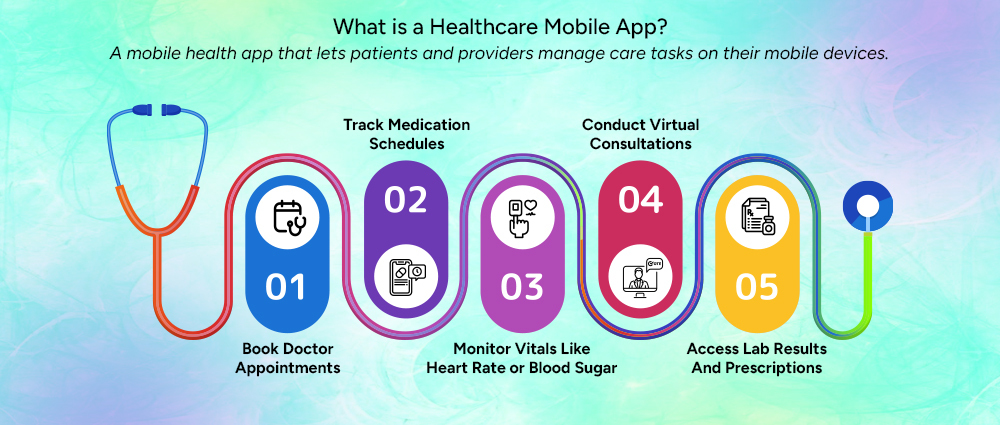
These apps make it easier for healthcare organizations to manage appointments, patient records, and daily tasks in one place. Patients can quickly access healthcare services, whether it’s scheduling an appointment, joining a virtual consultation, or checking their medical records. When healthcare services are easier to access, patients enjoy a smoother experience, and healthcare organizations can deliver more connected care.
Through healthcare mobile app development, patients can speak with doctors through secure video calls without leaving home. Whether it is a follow-up visit, a specialist consultation, or simply getting care in an area where healthcare facilities are hard to reach, these apps bring the doctor to the patient, removing the need to travel altogether.
For healthcare providers, staying connected with patients between appointments can make a real difference, and this is just one of many reasons small businesses need a mobile app in the healthcare space. Healthcare mobile app development supports patient engagement by giving patients an easy way to receive reminders, ask questions, and keep up with their treatment from one place.
Managing patient records across multiple departments or providers can be time-consuming. EHR and EMR apps developed through healthcare mobile app development bring that information together in one place, making it easier for healthcare teams to access accurate records while reducing paperwork and duplicate data entry.
Wearable devices and home monitoring tools can share real-time health data with healthcare mobile app development solutions, making it easier for healthcare providers to monitor heart rate, blood pressure, blood sugar, and other critical health indicators. Instead of waiting until the next appointment, providers can identify potential concerns early and take action when needed.
Patients can check available time slots and book appointments directly from their phones through healthcare mobile app development, cutting out the usual delays that come with calling a clinic. At the same time, healthcare providers can keep their calendars organized without relying on phone calls or manual scheduling, giving administrative teams more time to focus on patient support.
Healthcare mobile app development requirements differ from one project to another, but a few features have become essential for most healthcare applications:
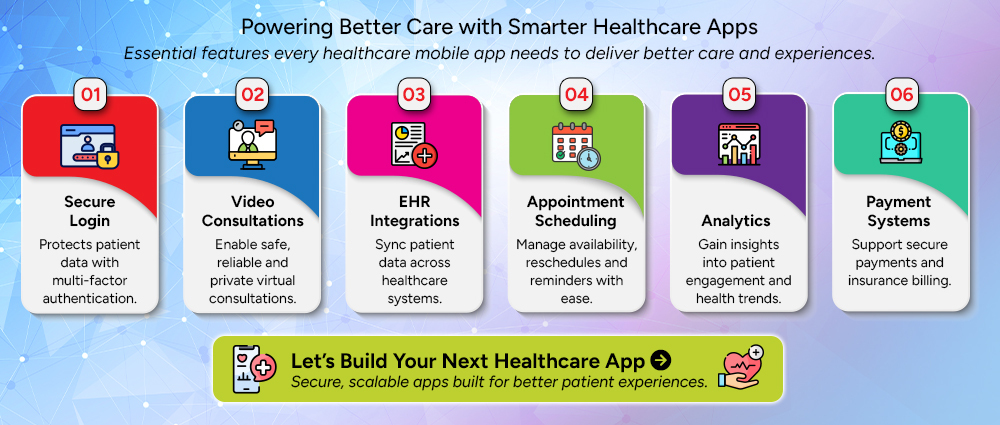
Secure login with multi-factor authentication protects sensitive patient data from the first interaction.
Video consultations form the backbone of telemedicine functionality, requiring reliable, low-latency infrastructure built for healthcare-grade privacy.
EHR integrations allow the app to pull and sync patient records with existing hospital or clinic systems, avoiding duplicate data entry and care that lacks coordination.
Appointment scheduling should make it easy to check provider availability, reschedule appointments, and send automatic reminders.
Analytics help providers understand patient engagement, appointment patterns, and health trends so they can make better care decisions.
Payment systems need to support insurance billing, patient payments, and secure transactions while staying compliant with financial data regulations.
Protecting patient data starts long before an app goes live. That’s why healthcare mobile app development includes security and compliance requirements throughout the development process.
HIPAA governs how patient health information is stored, transmitted, and accessed in the US, and non-compliance carries serious legal and financial consequences.
GDPR requires healthcare apps serving users in Europe to follow strict rules for collecting, storing, and sharing personal data. It also includes requirements for user consent and data portability.
Patient privacy has to be built into the architecture itself, not patched in after launch; role-based access controls and audit trails are standard requirements, not extras.
Encryption keeps data protected whether it is moving or stored, ensuring patient information stays secure across every point of the app.
Secure cloud storage ensures patient data is hosted in compliant environments with the redundancy and access controls healthcare regulations demand.
Healthcare organizations often rely on healthcare mobile app development services to make care more accessible while improving the overall patient experience.
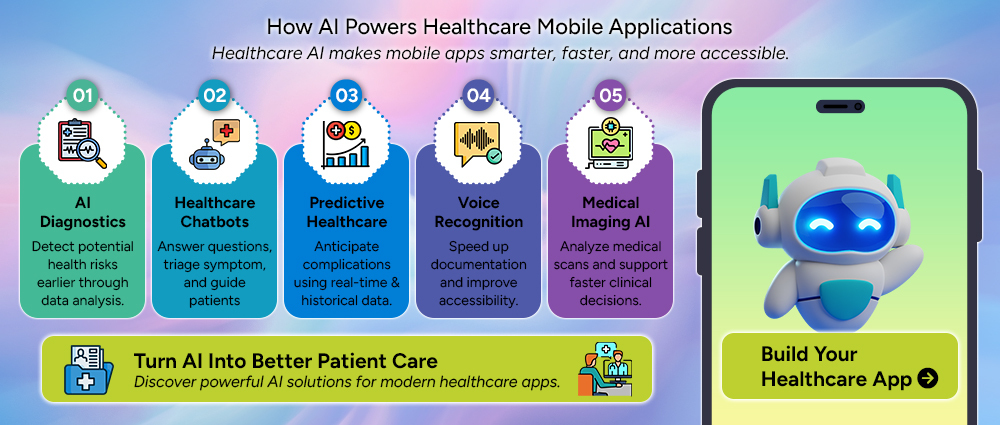
AI diagnostics help flag potential health issues earlier by analyzing patient data patterns that might be missed in a standard review.
Healthcare chatbots handle routine patient questions, triage symptoms, and guide users to the right next step, reducing the load on front-line staff.
Predictive healthcare tools use historical and real-time data to anticipate complications before they happen, particularly valuable in chronic disease management.
Voice recognition is making documentation faster for providers and accessibility easier for patients, particularly those with mobility or vision limitations.
Medical imaging AI assists in analyzing scans and diagnostic images, supporting (not replacing) clinical decision-making with faster, more consistent pattern recognition.
Building a healthcare app follows a structured path, with compliance woven through every stage rather than treated as a final checkpoint.
Research and Planning— Validate the problem you’re solving, study the competitive landscape, and define your core feature set before writing any code.
Compliance Planning— Map out HIPAA, GDPR, and HL7/FHIR requirements early, since they directly shape your architecture and data handling decisions.
UI/UX Design— Design for accessibility and simplicity, keeping in mind that healthcare users span every age group and technical comfort level.
Backend and API Development— Build the secure infrastructure, EHR integrations, and business logic that power the app’s core functionality.
Testing and QA — Run functionality, security, and compliance testing thoroughly, ideally with healthcare professionals involved in the process.
Deployment and Maintenance — Launch, monitor real-world performance, and keep iterating as regulations and user needs evolve.
Healthcare app costs vary more than most categories because of what’s riding on compliance and infrastructure. Key cost drivers include:
Compliance cost covers the legal review, security architecture, and audit processes required to meet HIPAA and GDPR standards; this alone sets healthcare apart from most other app categories.
Integrations with EHR systems, labs, pharmacies, and insurance providers each require dedicated development and testing work.
Telemedicine infrastructure for video consultations demands reliable, secure, low-latency systems that aren’t part of a standard app build.
AI functionality, where included, adds infrastructure for model training, data processing, and ongoing refinement.
Scalability needs to be planned for from the start, since healthcare apps that succeed often need to handle rapidly growing patient volumes without compromising performance or security, and this is just one of many reasons why choosing the best cross-platform app framework matters early in the process.
A healthcare mobile app development project is only as strong as the team behind it. Before selecting a development partner, consider their experience with security, compliance, scalability, and ongoing support.
Healthcare experience — Look for a team that has built health-tech products before, not one learning the regulatory landscape on your project.
Compliance expertise — Your partner should understand HIPAA, GDPR, and HL7/FHIR well enough to build compliance into the architecture, not bolt it on afterward.
Scalability — Choose a team that can architect for growth from day one, since healthcare apps that gain traction often scale quickly.
Post-launch support — Healthcare apps need ongoing updates, security patches, and feature development long after launch, so an engaged long-term partner matters.
AI is becoming an important part of healthcare mobile app development, helping healthcare teams automate routine tasks, personalize treatment plans, and support faster decision-making. This is just one of many ways AI is reshaping industries, from healthcare to AI apps for e-commerce businesses.
Remote monitoring helps healthcare providers keep track of patients with chronic conditions between appointments, making it easier to respond when health changes are detected.
Wearable integrations are deepening, with apps pulling real-time data from an increasing range of consumer health devices.
Telemedicine is still growing, and virtual care is now something patients expect as part of their treatment, not just an option on the side.
Predictive healthcare tools are no longer just being tested; they are now helping providers act early before a patient’s health gets worse.
Building secure, scalable mobile applications requires experience across industries where reliability, usability, and real-time performance matter. Two recent Arpatech projects highlight capabilities that also apply to healthcare mobile app development:
Our Electric Vehicle Service App for Accessibility and Higher Functionality demonstrates our experience in building accessible mobile applications for diverse user groups. Designing intuitive interfaces and improving accessibility are equally important in healthcare, where patients, caregivers, and medical professionals rely on apps with different needs and abilities.
Our real-time data tracking mobile app demonstrates our experience building apps that collect and display real-time data, which is exactly what healthcare apps need for remote patient monitoring, wearable integrations, and health tracking.
Building a healthcare mobile app development project is about more than picking the right features. Security, compliance, usability, and long-term maintenance all have to work together for the app to hold up in a real healthcare environment.
That is why healthcare mobile app development requires a team with hands-on experience in both healthcare technology and the compliance requirements that come with it. Whether you are launching a new project or improving an existing platform, the development partner you choose directly affects how secure, scalable, and sustainable the final product turns out to be.
Build your next healthcare mobile app. Contact Arpatech to discuss your project and create a secure, scalable solution that supports your business goals.
There’s no fixed price for healthcare mobile app development because every project is different. An app with basic features usually requires a smaller budget than one that includes telemedicine, AI capabilities, or EHR integrations. Compliance is another major factor. Meeting requirements such as HIPAA and GDPR means investing in secure architecture, encryption, and proper data protection. Having a clear list of features from the beginning also makes it much easier to plan your budget and development schedule.
The time required for healthcare mobile app development depends on what you want the app to do. A basic MVP with features such as appointment scheduling and secure messaging can often be completed within a few months, making it a practical starting point for businesses looking to validate their idea.
Projects that include telemedicine, EHR integrations, AI capabilities, and advanced security requirements naturally take longer. Compliance reviews, testing, and data security checks are all part of the development process; giving each stage the time it needs reduces the risk of expensive changes after launch.
Healthcare mobile apps are used for much more than virtual consultations. Healthcare mobile app development now supports solutions that help patients book appointments, track medications, monitor chronic conditions, access health records, and stay connected with their healthcare providers. As healthcare needs continue to evolve, organizations are also building specialized apps for areas such as cancer care, post-surgical recovery, and long-term disease management.

Before we begin, please solve this quick math check to confirm you're human, and you'll be all set to start chatting with our AI assistant.
Stay connected with us to receive the latest information, updates, and insights from our world of innovation.
By entering your email address you will receive promotional updates.


© 2026 ARPATECH (ADVANCED RESEARCH PROJECTS & TECHNOLOGY)