Digital finance is now a common part of the financial world. Most people today handle their money, payments, credit, and savings through digital platforms without a second thought. Over the last few years, the fintech industry has grown faster than most other sectors, driven by smartphone adoption, open banking policies, and a global shift away from traditional banking infrastructure.
According to the BCG and FT Partners Global FinTech Report 2026, the sector recorded $504 billion in revenues with 22 percent growth, and 74 percent of the largest public fintech companies are now profitable. Equity funding jumped 53 percent to $58 billion, marking one of the strongest investment recoveries the industry has seen. The BCG and FT Partners Global FinTech Report 2026 shows that fintech is no longer a new trend. It has become a major part of the global financial system.
By 2026, digital financial services will become more popular. This shows a strong need for safe and flexible financial applications. As customers’ needs change, financial businesses are working on mobile solutions to make services easier to access and to simplify everyday tasks. This has led to a greater focus on fintech app development that is both easy to use and compliant with regulations.
If your business is planning to build or upgrade a financial application, Arpatech’s mobile app development services provide the technical expertise and financial technology knowledge required to guide a fintech app development project from concept through deployment.
What you will learn:
Fintech app development refers to designing, building, and deploying software applications that deliver financial services through digital platforms. These applications can range from consumer-facing banking and payment apps to complex B2B financial software systems used by enterprises, lenders, and insurance providers.
A fintech application combines finance, technology, and regulation. It manages sensitive user data and processes transactions in real time. This means security and compliance must be built into the application from the beginning.
At the same time, the way people access financial services has changed significantly. Mobile technology has made it possible to manage payments, investments, and loans from smartphones, wearables, and other connected devices. As a result, fintech app development now includes a wide range of solutions, from digital wallets and trading platforms to lending and personal finance applications.
As more people want digital financial services, many organizations are investing in fintech app development. Some of the main reasons for this include:
Digital Transformation: Many traditional banking systems struggle to respond to changing user expectations and can be expensive to operate. Fintech applications address these gaps by delivering quicker, more efficient solutions that improve the performance of existing systems.
Customer Convenience: Users increasingly expect to manage financial activities such as account opening, money transfers, loan applications, and expense tracking through mobile apps. Platforms that meet these expectations build loyalty, while those that fail to meet these expectations may lose customers.
Embedded Finance: More companies outside traditional banking, such as retailers, logistics firms, and HR platforms, are now embedding financial services into their products. As a result, more businesses are investing in fintech app development.
Automation: From loan underwriting to fraud detection, financial automation reduces manual workload, cuts operational costs, and speeds up decision-making.
Financial Accessibility: Fintech platforms are expanding access to banking and credit for people with limited access to financial services, creating new opportunities for business growth.
Real-Time Transactions: Customers and businesses now want instant payments, real-time balance updates, and live transaction tracking. To meet these needs, companies need modern fintech systems.
These platforms replace traditional bank branches with mobile and web services. They help you manage your accounts, transfer money, pay bills, and get customer support. Neobanks and challenger banks are the most well-known examples. However, established banks are also investing a lot of resources in developing digital banking apps to improve their services.
Everyday transactions have become much simpler with payment apps and digital wallets working together. Users can transfer money, purchase goods and services, and split bills, while wallets store payment data, loyalty cards, and a record of your transactions, which helps you check out faster.
These platforms make it easier and faster to get loans by managing everything from applications to payouts. They use alternative data, credit scores, and automated systems to approve loans quickly and reduce risk. Buy-now-pay-later (BNPL) services are also included in this group.
More investors are using digital platforms and automated services to handle their finances and track portfolio performance, with tools like automated advisory platforms and live market data becoming a common feature in most trading apps.
The insurance industry is going through a major change, with InsurTech apps transforming how insurance plans are distributed, claims are processed, and pricing is determined. As a specialized area of financial app development, these platforms use data analytics, telematics, and intelligent algorithms to set premiums based on individual data and improve the efficiency of claims processing and risk evaluation.
Compliance is getting more complicated for financial institutions across the global market. As a result, these institutions are using regulatory technology to manage their compliance more effectively. These platforms automate reporting, identify suspicious transactions, and help businesses stay compliant with changing regulations.
In 2026, users expect more from fintech apps than the basics. Strong security and advanced functionality are now essential for any serious fintech app development project.
Secure Authentication: Account security starts with the right layers, including multi-factor authentication, biometric login, and device verification.
Payment Gateway Integration: Ensure fast and reliable transaction processing through seamless integrations with payment processors, card networks, and banking APIs.
Real-Time Analytics: Use dashboards and reporting tools to get instant information about transactions, account balances, and financial performance.
AI Fraud Detection: Machine learning tracks transaction behavior in real time, identifying suspicious activities and blocking them before they cause harm.
Transaction Tracking: Access detailed and searchable transaction histories. Categorization helps you make better financial decisions.
Push Notifications: Instant alerts for transactions, account changes, and security events make sure users always know what is happening with their money and can act on it fast.
Multi-Device Accessibility: Ensure a consistent and secure experience across smartphones, tablets, and desktops.
Blockchain Security: Transaction records on a distributed ledger are traceable and protected from unauthorized changes, making blockchain especially useful for international payments and financial asset management.
In fintech, security comes first. If it isn’t in place, nothing else works properly. The main compliance and security requirements in fintech app development include:
KYC (Know Your Customer): Identity verification processes that confirm users are who they claim to be. Required by regulators in virtually every market.
AML (Anti-Money Laundering): Transaction monitoring systems that detect and report suspicious financial activity to relevant authorities.
GDPR: For applications serving European users, strict data privacy and user consent requirements apply to how personal and financial data is gathered, stored, and used.
Fraud Prevention: Compliance sets the rules, but proactive fraud prevention does the actual work of catching unusual patterns, blocking unauthorized transactions, and reducing financial loss on both sides.
Encryption and Data Security: End-to-end encryption, secure data storage, and regular security audits are basic requirements for any financial application.
Building these standards into your app from the ground up is far more effective than retrofitting them later. For a deeper look at how to approach this, see Arpatech’s guide on fintech security solutions.
Fintech products that skip AI are already at a disadvantage. Here is where it handles the most critical work in modern fintech app development:
Fraud Detection: By reviewing transaction patterns in real time, AI can detect unusual activity that traditional fraud detection methods may not identify.
Predictive Analytics: Machine learning helps organizations identify trends, identify risks, and support better decision-making using historical financial data.
Personalized Financial Recommendations: AI helps users discover relevant financial products, spending insights, and savings opportunities based on their financial habits and preferences.
AI Automation: Tasks such as loan scoring, compliance checks, and customer onboarding can be automated to speed up processes and reduce manual work.
Customer Support Chatbots: Common inquiries, transaction disputes, and account management requests can be handled through AI-powered assistants available whenever users need support.
To understand how generative AI is reshaping financial products, Arpatech’s breakdown of AI in fintech covers real-world use cases worth reviewing.
In 2026, digital wallets have become a standard payment tool, used across mobile apps, physical store terminals, and international transfers:
Digital Wallets: These apps securely store payment credentials, bank account details, and loyalty cards in one place, removing the need for physical cards and cash.
Peer-to-Peer Payments: This means sending money directly between users through mobile apps, instantly and without needing a bank to process the transaction.
Contactless Payments: This allows users to pay with a tap of their phone or watch instead of pulling out a card. Retail stores, transit systems, and hotels have all made it a standard option.
Mobile Payment Ecosystems: These systems connect consumers, merchants, and financial institutions through a shared payment network.
Building a competitive payment product requires more than just transaction capability. For context on where this space is heading, Arpatech’s article on digital wallet solutions covers the broader ecosystem in detail.
One major shift in fintech is the embedding of financial services directly into non-financial platforms. The biggest impact is being seen in supply chain management, logistics, and B2B commerce.
Embedded Finance: Business software now comes with financial services like lending, insurance, and payments built in, so companies no longer need to step outside their existing workflows to access them.
B2B Fintech Systems: Large businesses now use dedicated platforms to manage invoice financing, trade credit, and inter-company payments, cutting out the delays and manual work that used to slow everything down.
Supply Chain Payments: Payment systems that automatically trigger based on delivery milestones, purchase orders, or contract terms, supporting better cash flow for both suppliers and buyers.
Financial Automation in Logistics: Real-time settlement, automated reconciliation, and digital trade finance tools are replacing the manual processes that have held supply chain finance back for years.
Arpatech’s article on fintech in supply chain covers how financial technology is being applied to logistics and B2B commerce in practical terms.
Understanding the fintech app development process helps businesses set realistic expectations and make better decisions at every stage.
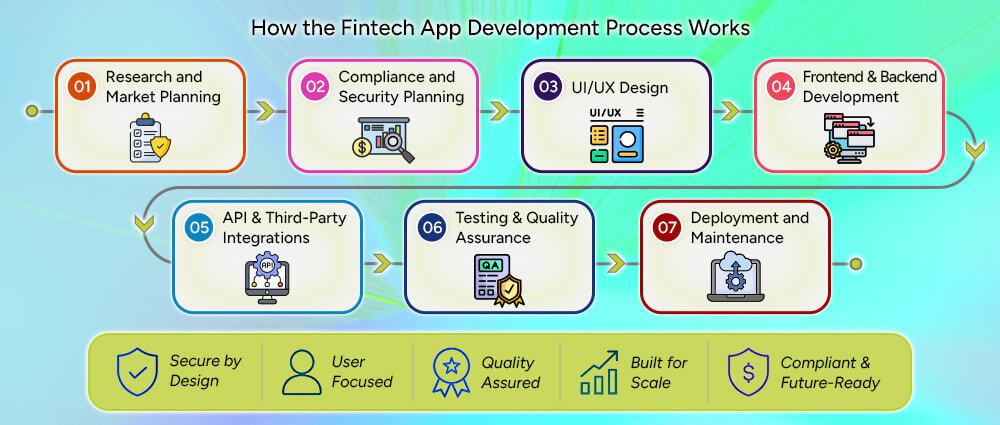
This stage establishes the foundation for the product and helps teams align business goals with user needs. At this stage, teams focus on:
With the project requirements established, teams define the compliance and security requirements the application needs to follow. This includes identifying relevant regulations, establishing KYC and AML processes, and implementing controls to protect sensitive data and maintain audit records.
Once the requirements are defined, designers create the user experience and interface for the application. This phase involves:
Development begins with building the application’s core functionality. Frontend development focuses on the user-facing interface, while backend development handles business logic, database management, transaction processing, and system architecture. Both must be built with performance and security in mind.
Fintech applications depend on multiple external services, including banking systems, payment gateways, credit information providers, and identity verification platforms. Managing these integrations reliably and securely is one of the more technically demanding aspects of fintech app development.
Fintech applications go through multiple layers of testing before release, covering functionality, security, performance, and regulatory compliance. For teams offering fintech mobile app development services, penetration testing, load testing, and regulatory validation are standard checks that confirm the platform is ready for real users
Launching a fintech application opens the door to an ongoing set of responsibilities. In fintech software development, regular maintenance, security updates, compliance reviews, and feature work are what keep the platform dependable long after the first release. The work continues with:
The technology stack behind a fintech app development project determines how it performs under load, how easily it scales, and how well it holds up against security threats. These are the tools and frameworks most teams rely on:
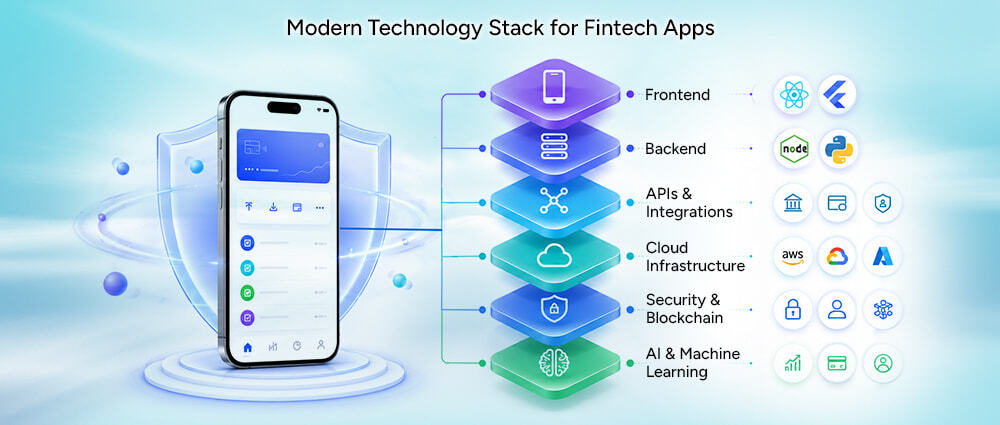
React Native and Flutter: These frameworks help teams run on both iOS and Android from a single development base, reducing the time and cost of development while making sure users get the same experience regardless of their device.
Node.js and Python: For backend work, Node.js is well-suited to handling large amounts of transactions simultaneously, and Python covers data analysis, fraud detection, and AI-driven features.
APIs: The ability to connect with banking networks, payment processors, and identity verification services comes down to the APIs a fintech application is built around, and how securely they handle data exchange.
Cloud Infrastructure: Providers like AWS, Google Cloud, and Azure give fintech teams the infrastructure to store data securely, process transactions reliably, and scale the application as the user base expands.
Blockchain Integration: Applications that need a clear, tamper-resistant record of every transaction can use blockchain technology to improve traceability and make audits more reliable.
AI Integration: Machine learning technologies support features such as fraud detection, credit assessment, and personalized financial experiences.
Fintech app development costs depend on what you are building and how. These are the factors that push costs up or down:
App Complexity: A basic digital wallet with core payment features costs considerably less than a full-service neobank platform with lending, investment, and compliance automation built in. Broadly, simple fintech apps can range from $30,000 to $80,000, while complex, enterprise-grade platforms often run from $150,000 upward.
Compliance Requirements: Building KYC and AML compliance into an application adds development time and cost. The more markets you operate in, the more fintech security compliance layers you need to account for in your budget and timeline.
AI Features: Fraud detection models, credit scoring engines, and personalization systems require data science work on top of standard development, which adds to the overall budget.
Integrations: Each connection to a payment gateway, banking network, or identity provider comes with its own integration work, testing requirements, and long-term maintenance costs.
Security Infrastructure: Encryption, secure storage, penetration testing, and ongoing security audits are necessary costs that should be budgeted from the start.
Development Team Size: Bigger teams with fintech experience move faster but cost more. The right size comes down to how much time you have and how much you are building.
Fintech applications are harder to build than most. These are the challenges fintech app development teams deal with most often:
Cybersecurity Risks: Financial applications are high-value targets for attackers. Protecting user data, transaction records, and payment credentials requires sustained investment in security architecture and monitoring.
Scalability: A fintech app built for today’s user base may not hold up as it grows. An app running smoothly at 10,000 users can struggle badly under 1 million, which is why scalability needs to be built in from the start, not added later.
Compliance Complexity: Regulatory requirements vary by country, product type, and user segment, and they change regularly. Keeping a fintech application compliant across multiple markets is an ongoing operational responsibility that does not get easier as the product grows.
API Integration Challenges: Fintech applications are connected to external APIs for important services. Provider updates, connection issues, and incomplete documentation can affect integrations and require continuous attention from development teams.
Customer Trust and Security: Users do not provide their financial data to apps they do not trust. Building trust requires visible security features, privacy policies that are easy to understand, and responsive support channels, supported by security systems built to handle evolving threats.
Choosing the right fintech app development company can have a major impact on the success of your project. Here are a few things to consider:
Fintech Expertise: Review their experience with financial applications, payment platforms, digital banking solutions, or similar products. Teams with a fintech background are typically better prepared for the industry’s technical and regulatory requirements.
Security Capabilities: Ask about their approach to secure development, penetration testing, and how they handle sensitive data. A credible fintech app development company will have clear, practiced answers.
Compliance Knowledge: Your development partner should understand the regulatory environment your product operates in. Compliance gaps discovered after launch are expensive to fix.
Scalability: Make sure the architecture they propose can support your user base and feature set without requiring a full rebuild.
Post-Launch Support: Ongoing support plays a major role in the long-term success of a fintech app development project. Choose a partner that can assist with maintenance, security updates, compliance changes, and future product improvements.
Fintech is changing rapidly, with new technologies and customer expectations influencing how fintech app development is approached. Here are some of the key trends shaping the industry in 2026.
AI-Powered Finance: Financial institutions are using AI to automate decision-making, strengthen fraud prevention, and provide more personalized customer experiences across multiple fintech products.
Blockchain Finance: Beyond cryptocurrency, blockchain is being applied to trade finance, cross-border payments, and digital asset management in practical, regulated contexts.
Open Banking: API-driven data sharing between financial institutions is enabling a new generation of aggregation, comparison, and personalization products built on top of existing bank infrastructure.
Embedded Finance: As noted earlier, financial services are being woven into non-financial platforms at a growing rate, creating new revenue streams and distribution channels for fintech products.
Decentralized Finance (DeFi): Regulated DeFi products are emerging as institutions look for ways to participate in decentralized lending, staking, and asset management within compliance frameworks.
Digital Identity Verification: Biometric authentication, document scanning, and blockchain-based identity systems make KYC processes easier, reducing onboarding time without compromising on security.
Operational efficiency and digital transformation in financial services rarely happen in isolation. They require the right technology partner, a clear process, and the ability to execute at scale.
Arpatech’s back office team optimization case study demonstrates how targeted technology implementation can streamline financial operations and reduce overhead without disrupting core workflows.
For organizations managing complex procurement and vendor finance across global operations, Arpatech’s global IT procurement case study shows how digital transformation delivers measurable results in high-stakes environments.
These examples reflect the kind of work that goes into building financial technology that actually performs in the real world.
Fintech app development in 2026 is defined by three things: security, intelligence, and scale. The financial applications gaining traction today are not just feature-rich. They are compliant by design, powered by AI, and built to grow with the demands placed on them.
No matter what you are building, whether it is a digital bank, a payment solution, a lending product, or a finance integration tool, the basics do not change. You still need strong compliance, secure architecture, and the right technology choices to support long-term scale.
The opportunity in financial technology is significant. The path to capturing it runs through disciplined, well-engineered product development.
Building a fintech product requires the right balance of compliance, security, and scalability. Arpatech can help you translate your idea into a fintech app development solution designed for long-term growth. Get in touch to start building your fintech product today.
What is fintech app development?
It is the process of building digital financial products such as banking apps, payment platforms, loan management systems, and investment tools, while ensuring security and regulatory compliance.
How to choose a fintech app development service for startups?
Startups should prioritize development partners with proven fintech experience, strong compliance knowledge, and the ability to build scalable MVPs. Look for teams that have shipped regulated financial products before, not just general-purpose apps.
What are the key features of modern fintech applications?
The most important features include secure authentication, payment gateway integration, real-time analytics, AI-powered fraud detection, transaction tracking, and multi-device accessibility. Compliance features like KYC and AML workflows are also standard in any production-ready fintech product.
What are the cost estimates for building a fintech app from scratch?
The cost of fintech app development varies by complexity. Basic applications often fall in the $30,000 to $80,000 range, while more advanced platforms with AI capabilities, compliance across markets, and more advanced integrations can exceed $150,000.
What security standards are required for fintech applications?
At minimum, fintech applications require GDPR for European users, KYC for identity verification, and AML for transaction monitoring. The specific standards required will vary based on the product type and the markets it serves.
What fintech app development tools support rapid prototyping?
React Native and Flutter support fast cross-platform app development, while Node.js and Python are commonly used for backend services. Firebase and Supabase are often used in early MVP stages before scaling to more robust infrastructure.
How do I identify reputable development firms specializing in secure financial technology?
Choose firms that have shipped regulated financial products and can show relevant fintech app development case studies. Their approach to security testing and compliance should be clear, and client references or certifications can help validate credibility.
How long does it take to build a fintech application?
A basic fintech MVP usually takes 3 to 6 months to build. A more complex platform with compliance requirements, AI features, and multiple integrations can take 9 to 18 months, depending on scope and team size.

Before we begin, please solve this quick math check to confirm you're human, and you'll be all set to start chatting with our AI assistant.
Stay connected with us to receive the latest information, updates, and insights from our world of innovation.
By entering your email address you will receive promotional updates.


© 2026 ARPATECH (ADVANCED RESEARCH PROJECTS & TECHNOLOGY)