ESG reporting is no longer a “nice-to-have” checkbox for logistics companies operating in the United States. It has become a core business requirement. Customers want proof that their goods are moving through clean, ethical supply chains. Regulators want verified data, not estimates. Investors want to know that a company’s sustainability claims can actually hold up under scrutiny.
And yet, walk into the back office of many logistics companies today, and you will still find spreadsheets, disconnected software platforms, and teams manually pulling numbers together every quarter just to answer one simple question: how sustainable are we, really?
This is where artificial intelligence enters the picture, and not just as another automation catchphrase. AI is becoming the intelligence layer that helps logistics companies collect, analyze, verify, and report ESG compliance data faster and more accurately than any human team could manage alone.
So, can AI actually accelerate ESG compliance in logistics? The short answer is yes. But it only works when it is backed by quality data and properly integrated logistics systems. Bolting AI onto broken processes will not fix the problem. Used correctly, though, AI can turn ESG compliance from a painful, backward-looking chore into a real-time, forward-looking advantage.
The future of ESG in logistics is moving from once-a-year reporting toward continuous, real-time sustainability intelligence. So, today we will be discussing exactly how AI is reshaping ESG compliance software and why logistics companies in the US are under growing pressure to act now.
ESG regulatory compliance has moved from a European concern to a global one, and American logistics companies are feeling the effects even without a single unified federal ESG law. Supply chain transparency requirements are showing up in customer contracts, state-level disclosure rules, and international trade requirements that any company shipping goods overseas has to follow.
A few of the pressures driving this shift include:
This last point matters more than most logistics executives realize. Multinational shippers and large retail brands are increasingly requiring their logistics providers to share verified sustainability data before they will even sign a contract. If a trucking company or third-party logistics provider cannot produce accurate emissions numbers, they risk losing business to a competitor who can.
This is exactly why interest in ESG compliance consulting has grown so quickly. Companies know the stakes, but many do not know where to start, and that gap is exactly what AI-powered tools are now stepping in to close.
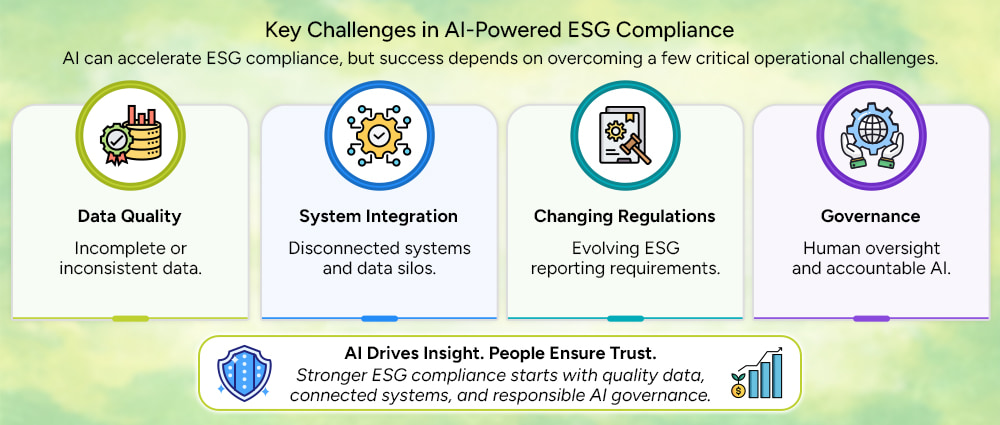
Before talking about solutions, it helps to understand why ESG regulatory compliance is so difficult for logistics companies in the first place. Logistics is a data-heavy industry, but that data is rarely organized in a way that supports clean sustainability reporting.
Common challenges include:
Put simply, ESG compliance software in logistics cannot succeed if it is bolted onto a foundation of scattered, inconsistent, manually collected data. That is the real problem AI needs to solve first and fast.
It is easy to assume ESG is mostly about emissions, but the “S” and “G” matter just as much, and AI has a role to play in both.
The environmental side of ESG is usually where logistics companies start, and for good reason. It is the most data-rich part of the framework, and it is where AI has the clearest, most immediate impact.
Every fleet, warehouse, and delivery route generates a steady stream of data that AI can turn into real insight, whether that means tracking emissions accurately or making a warehouse run on less power.
Here are some other ways AI is optimizing the Environmental side of supply chain and logistics:
This is also the area regulators and customers scrutinize most closely, so getting it right tends to set the tone for the rest of a company’s ESG program.
The social pillar is where AI starts to touch people directly, not just fuel gauges and energy meters.
This is where driver and warehouse worker safety has always mattered, but proving that a company actually monitors and improves working conditions is a different challenge, one that used to depend on incident reports filed after the fact.
AI changes this by watching for warning signs before something goes wrong, whether that is a driver showing signs of fatigue or a warehouse zone with a pattern of near-misses. Some other ways AI is advancing on the social side are:
This kind of proactive monitoring is also what makes social reporting far more credible to regulators, customers, and employees themselves.
Governance is often the least talked about part of ESG, but it is arguably the part that holds everything else together. Without strong governance, even accurate environmental and social data can lose credibility, because there is no clear system showing how that data was collected, checked, or reported.
AI helps here by creating consistent audit trails, flagging irregularities before they become bigger problems, and keeping compliance monitoring running continuously instead of relying on a once-a-year review. These are other ways AI is helping companies automate governance regulations:
For companies trying to stay ahead of shifting ESG standards, this kind of built-in governance is what makes ESG reporting defensible under scrutiny.
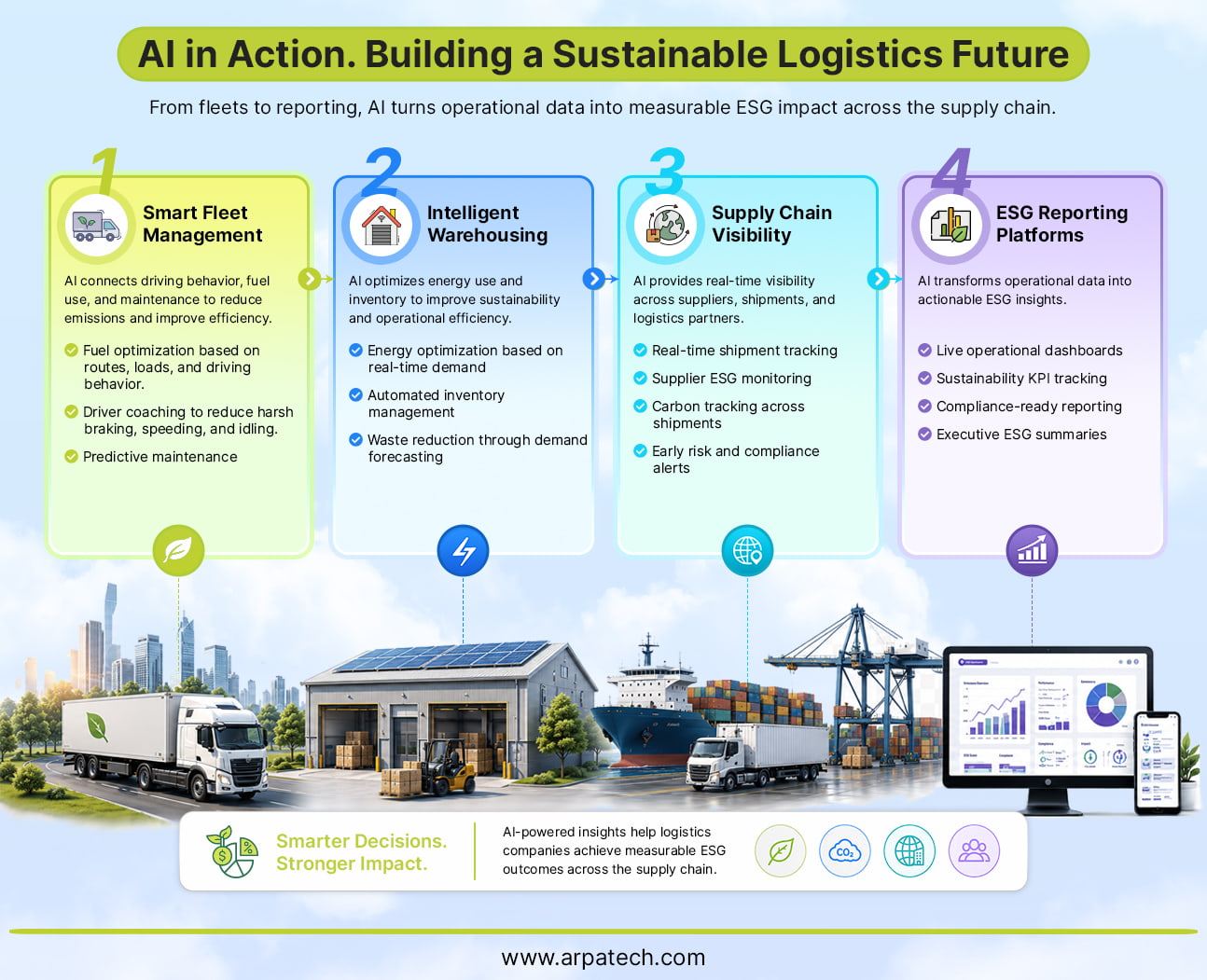
Rather than focusing on specific vendors, it helps to think about AI’s role in ESG through four broad categories of use.
Fleets are often the single biggest source of emissions and operational cost in a logistics business, which makes them a natural starting point for AI-driven ESG improvements.
Instead of treating fuel use, driver behavior, and maintenance as three separate problems, AI ties them together into one continuous feedback loop. A driver’s habits affect fuel burn, fuel burn affects emissions data, and maintenance timing affects how efficiently the whole vehicle runs. Managing all three with AI, rather than reacting to each one separately, is what turns a fleet from a compliance liability into a genuine sustainability asset.
Warehouses tend to get less attention than fleets in sustainability conversations, but they are significant energy consumers in their own right. AI-driven warehousing focuses on matching energy use to actual need, rather than running lighting, equipment, and climate control on fixed schedules regardless of demand.
This same intelligence extends to inventory, where better forecasting means fewer overstocked items sitting unused and less waste overall. Together, these improvements make warehouses a much stronger contributor to a company’s sustainable logistics and supply chain management goals.
ESG risk rarely stays contained within a single company. It travels through suppliers, carriers, and partners, which is exactly why visibility matters so much.
AI makes it possible to track shipments, monitor supplier certifications, and calculate emissions across multiple transportation modes all in one connected view, rather than piecing together updates from separate systems.
This kind of visibility also means risk alerts can surface early, giving teams time to respond to a compliance issue or disruption before it escalates into a bigger problem for the whole supply chain.
All the data collection and monitoring in the world does not help much if it never reaches the people who need to act on it. This is where ESG reporting platforms come in, pulling live data from operational systems and turning it into dashboards that different audiences can actually use.
Operations teams need day-to-day KPI tracking, compliance teams need reporting formatted to specific regulatory requirements, and executives need a clear, high-level summary they can bring to the board.
AI-powered reporting platforms are built to serve all three audiences from the same underlying data, instead of requiring separate reports built by hand for each one.
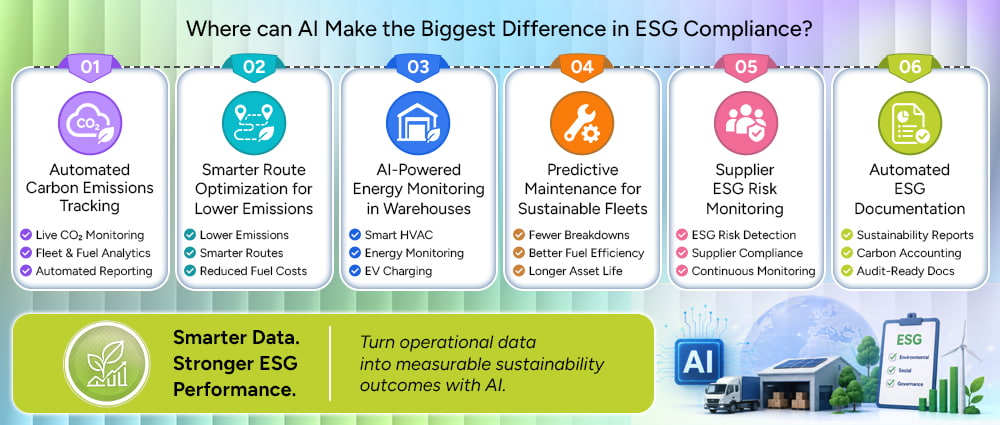
Here is the good news: logistics companies already generate enormous amounts of operational data every single day. Every mile driven, every gallon of fuel burned, every warehouse light left on, and every shipment tracked creates a data point. The problem has never been a lack of data. It has been a lack of a system smart enough to turn that data into something usable.
That is exactly the gap AI in logistics is built to fill.
Instead of manually calculating emissions every quarter using outdated spreadsheets, AI can automatically pull data from multiple sources at once, including:
Once this data is connected, AI can handle CO2 estimation, fuel consumption analysis, route-based emissions calculations, and vehicle efficiency scoring, all continuously and automatically. This alone turns what used to be a multi-week manual process into something closer to a live dashboard.
This is one of the most powerful and immediate ways AI supports green logistics. AI-driven route optimization can:
This directly supports ESG environmental goals while also lowering fuel costs and improving fleet utilization. It is one of those rare wins where sustainability and cost savings point in exactly the same direction.
According to a white paper published by the World Economic Forum in partnership with McKinsey & Company, titled “Intelligent Transport, Greener Future,” AI-enabled optimization could reduce total emissions from freight logistics by roughly 10 to 15 percent. The paper breaks this down further, noting that AI-driven route optimization and asset management alone can achieve up to a 7 percent reduction in emissions by using real-time data and predictive analytics to make every trip more efficient.
For an industry where freight logistics alone contributes close to half of all transport-related greenhouse gas emissions globally, a 10 to 15 percent reduction is not a small win. It is a meaningful step toward real decarbonization, and it comes from better use of data that companies are often already collecting.
Sustainable logistics and supply chain management does not stop at the truck. Warehouses are massive energy consumers, and AI is increasingly being used to optimize:
The result is a meaningful drop in electricity consumption, a smaller carbon footprint, and cleaner data for sustainability reporting. When warehouse energy data is automatically logged and analyzed, ESG teams no longer have to chase down utility bills from a dozen different facilities.
Reactive maintenance, where trucks and equipment are only serviced after something breaks, is expensive and inefficient. AI-powered predictive maintenance flips this model by using sensor and performance data to predict issues before they happen, including:
The benefits go well beyond convenience. Well-maintained vehicles run more efficiently, which improves fuel efficiency and extends vehicle lifespan. Fewer breakdowns mean fewer emergency repairs, fewer emissions from poorly running engines, and lower overall maintenance costs. For fleet managers focused on ESG risk management, predictive maintenance is one of the simplest ways to reduce both operational risk and environmental impact at the same time.
Supply chains are only as strong as their weakest link, and this is especially true for ESG risk and compliance. AI can continuously scan and analyze:
Instead of relying on an annual supplier questionnaire that may already be outdated by the time it is reviewed, AI-driven monitoring allows logistics companies to identify supply chain ESG risks much earlier. This is a major upgrade for companies trying to get ahead of ESG regulatory compliance requirements rather than reacting to them after a problem becomes public.
Finally, AI is dramatically speeding up the paperwork side of ESG compliance software. This includes helping teams produce:
Work that used to take weeks of manual effort, pulling numbers from different departments and cross-checking calculations by hand, can now be compiled, validated, and formatted in a fraction of the time.
It is worth stepping back and reframing the conversation here. ESG compliance should not be viewed purely as a regulatory obligation that companies grudgingly satisfy. When done well, it becomes a genuine competitive advantage.
Logistics companies that invest in AI-powered ESG compliance software tend to see benefits including:
In other words, sustainability in logistics and strong financial performance are no longer opposing goals. They are increasingly the same goal, approached from two different angles.
None of this is to suggest that adopting AI for ESG compliance is simple. There are real challenges that logistics companies need to address honestly.
Data Quality
AI is only as effective as the data it receives. If fuel records are incomplete, if telematics data is inconsistent, or if warehouse energy usage is not properly tracked, AI will produce flawed or incomplete results. Garbage in, garbage out still applies, no matter how advanced the model is.
System Integration
Many logistics companies still operate on a patchwork of legacy ERP systems, older warehouse management software, separate fleet management platforms, and multiple data silos that were never designed to communicate with each other. Getting these systems to share data cleanly is often the hardest and most time-consuming part of any AI-driven ESG initiative.
Changing Regulations
ESG regulations are not static. Reporting frameworks, disclosure requirements, and ESG standards continue to evolve at both the state and federal level, as well as internationally for companies with global supply chains. AI models and reporting templates require continual updates to stay aligned with these shifting requirements.
Governance and Human Oversight
Finally, AI should never operate as a total black box, especially when the output feeds directly into regulatory disclosures. Logistics companies need to prioritize:
AI should accelerate the work. It should not replace human judgment on decisions that carry legal and reputational weight.
For logistics companies ready to move forward, a phased and practical approach tends to work best. Consider the following steps:
This is often exactly where ESG compliance consulting becomes valuable, helping companies figure out which systems need to be connected first and which AI tools will actually solve their specific bottlenecks, rather than adopting technology for its own sake.
Looking ahead, the direction of travel is clear. ESG compliance is shifting away from a once-a-year reporting exercise and toward continuous, real-time intelligence.
Emerging trends worth watching include:
As the World Economic Forum’s research on AI and freight decarbonization makes clear, the technology is no longer just theoretical. Companies are already using AI to make measurable progress on emissions today, not years down the road. The next phase of this shift is AI evolving from a reporting assistant into a genuine decision-making partner for logistics operations, one that does not just tell companies what happened last quarter, but helps them make better sustainability decisions in the moment.
At Arpatech, sustainability is something we actively build for, not just something we help clients report on. We have partnered with multiple companies putting real technology behind their environmental goals.
For one of our clients, we helped build a free mobile app that connects to a driver’s vehicle and shows them how their driving habits impact the environment, helping people make small, practical changes since its launch in 2021.
On another occasion, we worked for a California-based client encouraging the adoption of electric vehicles by rewarding smarter, more sustainable mobility choices. Both projects reflect what we believe drives real environmental progress: good intentions backed by the right technology.
ESG compliance in logistics is only getting more complex. Regulations are expanding, customer and investor expectations keep rising, and the sheer volume of operational data companies generate every day continues to grow. Trying to manage all of this manually, through spreadsheets and disconnected systems, is no longer a realistic long-term strategy for any serious logistics operation.
AI offers a genuine way forward. It helps companies move beyond manual, backward-looking reporting by automating emissions tracking, optimizing routes and warehouse energy use, predicting maintenance needs, monitoring supplier risk, and speeding up the documentation that regulators and customers demand. It supports the full ESG picture, not just environmental metrics, but social and governance priorities as well.
None of this happens automatically, though. It requires clean data, integrated systems, and continued human oversight to make sure AI-driven ESG reporting is accurate, explainable, and trustworthy. Companies that get this foundation right and invest in AI-powered ESG capabilities today will be far better positioned to reduce their compliance burden, run more efficient operations, and build supply chains that are genuinely more sustainable and resilient in the years ahead.
At Arpatech, we work with logistics and supply chain companies to build the software development foundation that makes this possible, connecting fragmented systems, automating data collection, and turning ESG compliance from a quarterly scramble into a real-time capability.
Ready to turn ESG compliance into a competitive advantage? Let’s bring AI into your sustainability strategy. Reach out to Arpatech and let’s talk about what’s possible.
The best ESG compliance software connects fleet, warehouse, and ERP data into one system so emissions and compliance data update automatically instead of being tracked by hand.
Arpatech builds custom software solutions like this for logistics companies looking to automate ESG data collection and reporting rather than relying on generic, one-size-fits-all tools.
ESG compliance in logistics means meeting environmental, social, and governance standards across operations, from tracking fleet emissions and warehouse energy use to ensuring driver safety and transparent reporting.
It has become a requirement for working with major shippers and retailers, not just a regulatory formality.
Start by cleaning up and centralizing your data, then integrate fleet, warehouse, and ERP systems so information flows automatically.
From there, automate data collection before automating reporting, and keep humans involved for final review. Arpatech helps logistics companies build this kind of connected system from the ground up.
Logistics companies commonly report against frameworks tied to Scope 1, 2, and 3 emissions, along with broader disclosure standards used for investor and regulatory reporting.
The right framework often depends on company size, region, and customer requirements, so it’s worth confirming current standards with a compliance professional.
Good ESG consulting for logistics firms focuses on data readiness, system integration, and aligning reporting with current regulations, not just generic sustainability advice.
Arpatech supports this work from the technology side, helping companies build the software backbone that makes accurate ESG reporting possible.
Several consulting firms offer ESG compliance services tailored to mid-sized companies, and the right fit usually depends on industry, region, and reporting needs.
It’s worth comparing a few firms directly to see which understands logistics-specific challenges like fleet emissions and supplier data gaps. Our teams at Arpatech can also help you figure out the best solutions for your business, just leave us a message and an expert will reach out to you.
Supply chain ESG risk tools typically monitor supplier certifications, environmental incidents, and compliance disclosures in real time, rather than relying on annual questionnaires.
Arpatech develops software that supports this kind of continuous risk monitoring as part of a broader ESG compliance system.

Before we begin, please solve this quick math check to confirm you're human, and you'll be all set to start chatting with our AI assistant.
Stay connected with us to receive the latest information, updates, and insights from our world of innovation.
By entering your email address you will receive promotional updates.


© 2026 ARPATECH (ADVANCED RESEARCH PROJECTS & TECHNOLOGY)