The global financial technology industry is attracting significant investor attention. During the first half of 2026, fintech investment reached $103.1 billion across 2,100 deals, marking a considerable increase from the $72.2 billion recorded in the second half of 2025.
According to KPMG’s Pulse of Fintech H1 2026 report, the industry is on track for its strongest annual investment performance in four years.
But according to us, the figure only tells part of the story. While investment is increasing, the number of deals is declining. Investors are becoming more selective, directing larger amounts of capital towards established businesses, strategic acquisitions, and technologies with clear commercial value.
From digital payments and artificial intelligence (AI) to digital assets and financial infrastructure, the distribution of fintech funding reveals where investors see the greatest opportunities. Understanding these trends offers valuable fintech insights into how the industry is evolving and what businesses can expect from the next phase of financial innovation.
The increase in global fintech investment reflects renewed confidence in financial technology. However, the decline in deal volume suggests that investors are approaching the market differently.
In the second half of 2025, the industry recorded approximately 2,501 deals worth $72.2 billion. During the first half of 2026, investment increased to $103.1 billion, but the number of deals fell to 2,100.
This means more money is being invested in fewer transactions.
Rather than distributing capital across a large number of early-stage startups, investors are prioritizing companies with established customer bases, reliable revenue streams, and business models that can support long-term growth.
This shift also reflects a broader change in investment priorities. Fintech businesses are increasingly expected to demonstrate sustainable operations, financial stability, and measurable returns rather than relying solely on user growth or promising technology.
For startups, this creates a more competitive funding environment. Having an innovative product is important, but demonstrating how that product generates value is becoming equally important.
A closer look at investment categories reveals that mergers and acquisitions account for the largest share of global fintech investment, followed by venture capital and private equity.
According to KPMG, the distribution during the first half of 2026 was:
| Investment category | Investment | Number of deals |
| Mergers and acquisitions (M&A) | $67.9 billion | 394 |
| Venture capital (VC) | $31.5 billion | 1,641 |
| Private equity (PE) | $3.6 billion | – |
| Total | $103.1 billion | 2,100 |
The numbers highlight an important distinction between investing in new businesses and acquiring existing ones.
M&A activity accounted for approximately two-thirds of total investment, indicating that established financial technology companies are becoming increasingly valuable acquisition targets.
Meanwhile, venture capital continues to support fintech startups and growing businesses, although investors are placing greater emphasis on proven business models.
Private equity also contributed to the total, supporting investment in more mature businesses.
Let’s look at the sectors attracting the most attention.
Digital payments attracted $44.2 billion in investment during the first half of 2026, making them the largest investment category among the fintech sectors highlighted by KPMG.
A significant portion of this investment came from major acquisitions, particularly Global Payments’ $24.3 billion acquisition of Worldpay and FIS’s $13.5 billion acquisition of Total System Services (TSYS).
These transactions reflect the growing importance of payment infrastructure in the global financial ecosystem.
Digital payments have become essential to everyday financial activities, including online shopping, international money transfers, subscription payments, and business transactions. As more businesses move their operations online, the demand for reliable payment processing systems continues to increase.
Investors are particularly interested in companies that can process large transaction volumes, operate across multiple markets, and provide secure payment infrastructure.
The growing focus on payment infrastructure also creates opportunities for technologies that support:
The investment trend suggests that the future of digital payments will depend not only on convenient payment experiences but also on the infrastructure, security, and scalability supporting them.
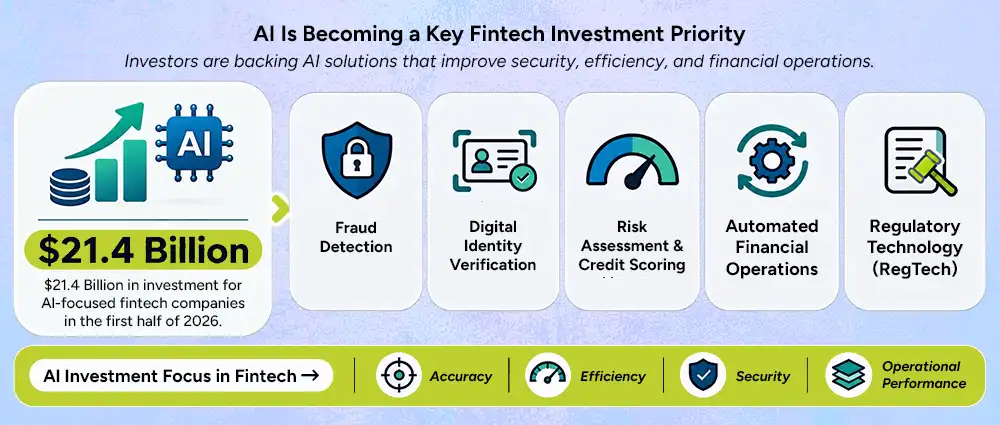
Artificial intelligence is moving beyond experimentation in financial services. Investors are increasingly interested in businesses using AI to improve financial operations, strengthen security, and automate complex processes.
KPMG reported that AI-focused fintech companies attracted $21.4 billion across venture capital, private equity, and M&A transactions during the first half of 2026.
This investment reflects growing demand for practical AI applications that address existing challenges within financial institutions.
Some of the areas receiving attention include:
AI systems can analyze transaction patterns, identify unusual activities, and flag potentially fraudulent behavior. This helps financial institutions respond to suspicious transactions more effectively.
AI-powered identity verification can help detect manipulated documents, synthetic identities, and deepfake-based impersonation attempts. These capabilities are becoming increasingly important as digital financial services expand.
Financial institutions can use AI to analyze financial information, identify risk patterns, and support lending decisions. This can improve how businesses assess creditworthiness while helping them manage potential losses.
AI can support repetitive activities such as document processing, transaction reconciliation, compliance checks, and customer service. This allows financial teams to reduce manual workloads and focus on more complex tasks.
Financial institutions operate under increasingly complex regulatory requirements. AI-powered RegTech solutions can help monitor transactions, support anti-money laundering (AML) processes, and streamline compliance workflows.
The growing investment in these applications suggests that investors are looking beyond general-purpose AI tools. They are increasingly interested in specialized technologies that solve measurable problems within financial services.
For fintech businesses, the opportunity lies in developing AI solutions that improve accuracy, efficiency, security, and operational performance.
Digital assets attracted $11.1 billion in investment during the first half of 2026, making them another significant area of fintech activity.
The sector includes cryptocurrencies, blockchain-based financial platforms, stablecoins, and the infrastructure supporting digital asset transactions.
While digital assets have historically been associated with speculation and volatile cryptocurrency markets, their role in financial services is gradually expanding.
Traditional financial institutions are exploring how blockchain and distributed ledger technologies can support financial transactions, asset management, and settlement processes.
Some of the key areas attracting interest include:
Growing institutional participation and developments in regulatory frameworks are helping digital assets become a more established part of the financial technology landscape.
However, regulatory uncertainty, cybersecurity risks, and market volatility remain important considerations for businesses operating in this space.
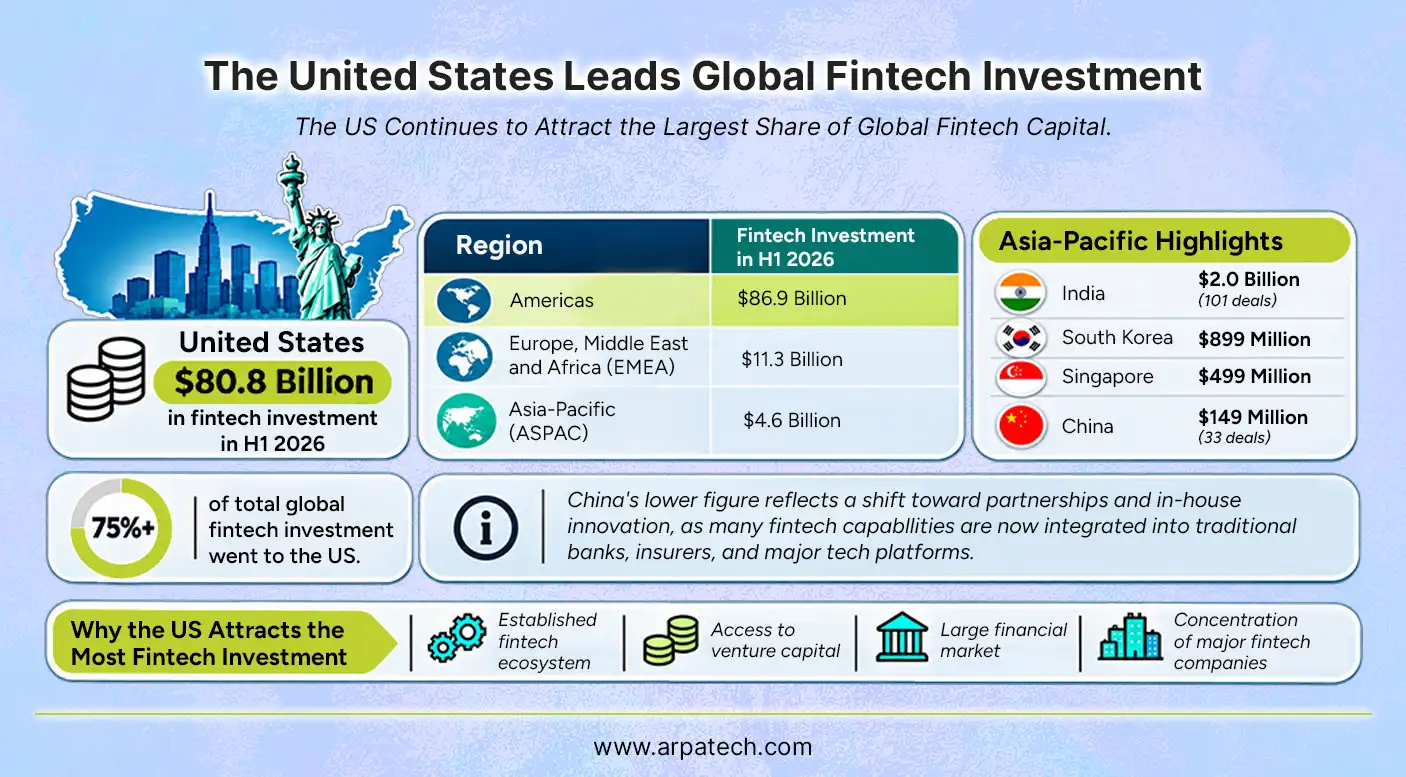
The geographical distribution of investment shows that the United States continues to attract the largest share of global fintech capital.
During the first half of 2026, the Americas received $86.9 billion in fintech investment, with the United States accounting for $80.8 billion.
This represents more than 75% of total global fintech investment.
Other regions recorded considerably lower figures:
| Region | Fintech investment in H1 2026 |
| Americas | $86.9 billion |
| Europe, Middle East and Africa (EMEA) | $11.3 billion |
| Asia-Pacific (ASPAC) | $4.6 billion |
The US continues to attract investment because of its established financial technology ecosystem, access to venture capital, large financial services market, and concentration of major fintech companies.
Meanwhile, investment across Europe, the Middle East, and Africa remained relatively subdued. Asia-Pacific also experienced a decline compared with the second half of 2025.
However, regional performance was not uniform. India, for example, attracted $2 billion across 101 deals, making it the leading fintech investment destination in the Asia-Pacific region.
South Korea followed with $899 million, while Singapore attracted $499 million.
China, on the other hand, recorded only $149 million across 33 deals.
This difference highlights how investment opportunities can vary significantly between markets, even within the same region.
China’s relatively low figure also requires some context. KPMG notes that several fintech capabilities have become integrated into traditional banks, insurers, and large technology platforms. As a result, some financial technology development now takes place through partnerships and internal research rather than conventional venture capital, private equity, or acquisition deals.
Therefore, lower reported investment does not necessarily mean that financial technology innovation has stopped.

One of the most significant findings from the latest fintech industry report is the growing role of mergers and acquisitions.
Global fintech Mergers and Acquisitions reached $67.9 billion across 394 deals in the first half of 2026, compared with $37.2 billion across 514 deals in the second half of 2025.
This increase indicates that established financial technology companies are increasingly looking towards acquisitions to strengthen their market positions.
Instead of building every capability internally, businesses can acquire companies that already have the technology, infrastructure, customer base, or expertise they need.
For example, a payment processing company may acquire another provider to expand its international operations, improve transaction capabilities, or gain access to a larger merchant network.
Fintech M&A is also helping businesses consolidate their operations and compete in increasingly crowded markets.
The growing value of M&A transactions suggests that consolidation will remain an important part of the industry’s development, particularly in payments, digital banking, and financial infrastructure.
The latest investment figures point towards an industry that is becoming more established, competitive, and focused on long-term value.
While early-stage innovation remains important, investors are increasingly interested in technologies that can integrate into existing financial systems and deliver measurable improvements.
Several trends are likely to influence the next phase of fintech development.
AI will play a growing role in fraud prevention, identity verification, financial analysis, customer support, and regulatory compliance. Businesses that can apply AI to specific financial challenges are likely to attract continued interest.
As digital transactions increase, so do the risks associated with identity theft, financial fraud, data breaches, and cyberattacks. Financial institutions will need stronger identity verification systems, fraud monitoring capabilities, and cybersecurity infrastructure.
Get secure and optimal Fintech apps with Arpatech.
Payment processing, digital banking platforms, transaction management, and cross-border payment systems will remain important investment areas. Businesses need infrastructure that can handle increasing transaction volumes without compromising security or reliability.
Fintech companies will face greater pressure to demonstrate profitability, operational efficiency in the supply chain, and a clear path towards sustainable growth. Access to fintech venture capital may become more competitive for businesses that cannot demonstrate their long-term commercial value.
As established companies look to expand their capabilities and market reach, fintech M&A is likely to remain a major driver of industry activity. Smaller businesses with specialized technologies may become attractive acquisition targets.
The $103.1 billion invested in fintech during the first half of 2026 reflects more than just renewed investor confidence. It highlights a shift in how the industry is developing and where financial institutions see opportunities for growth.
Digital payments remain the largest investment category, while AI and digital assets are gaining greater attention. At the same time, M&A activity is reshaping the competitive landscape, with investors and established companies prioritizing scale, technology capabilities, and proven business models.
For fintech businesses, the next phase of growth will depend on more than introducing new financial products. Developing secure infrastructure, improving operational efficiency, addressing emerging security risks, and delivering measurable value will be equally important.
This is where Arpatech can help. Through our high-velocity engineering and cyber and compliance services, Arpatech helps fintech businesses build and maintain secure, scalable technology solutions. From developing financial applications and strengthening cloud infrastructure to improving system reliability and addressing security risks, Arpatech supports businesses throughout their technology journey.
As financial services become increasingly digital, the companies best positioned to succeed will be those that combine technological innovation with reliable, scalable, and secure financial solutions. With the right technology partner, fintech businesses can build the infrastructure and capabilities needed to support that growth.
Integrate Security as an Essential Part of Your Application Development.
Digital payments attracted the highest investment, receiving $44.2 billion during the first half of 2026. AI-focused fintech businesses followed with $21.4 billion in deal value, while digital assets attracted $11.1 billion. These figures highlight growing interest in payment infrastructure, financial automation, and blockchain-based services.
Investors are increasingly prioritizing fintech companies with established customers, reliable revenue streams, sustainable business models, and opportunities for expansion. Although global investment increased in H1 2026, deal volume declined, suggesting that investors are committing larger amounts to fewer businesses rather than spreading capital across numerous startups.
The United States led global fintech investment, attracting $80.8 billion during the first half of 2026. Its established financial services ecosystem, access to venture capital, and concentration of major fintech companies make it an attractive market for investors.
AI investment in fintech is growing because financial institutions are looking for better ways to detect fraud, verify digital identities, assess financial risks, automate operations, and improve customer experiences. AI-powered solutions can help businesses improve operational efficiency while addressing increasingly complex financial security challenges.
Fintech venture capital involves investing in startups and growing companies in exchange for equity or ownership. Fintech M&A, on the other hand, involves one company acquiring, merging with, or purchasing another business. While venture capital helps emerging fintech businesses develop and expand, M&A allows established companies to acquire technology, customers, and market capabilities.

Before we begin, please solve this quick math check to confirm you're human, and you'll be all set to start chatting with our AI assistant.
Stay connected with us to receive the latest information, updates, and insights from our world of innovation.
By entering your email address you will receive promotional updates.


© 2026 ARPATECH (ADVANCED RESEARCH PROJECTS & TECHNOLOGY)