Healthcare is moving into a new era where patients expect fast digital services, hospitals need stronger data security, and administrators want systems that actually make their jobs easier. With so much pressure to upgrade, one thing has become clear. Legacy systems can no longer keep up. The future belongs to digital platforms that integrate smoothly, scale easily, and support automation.
This is where Healthcare Software Development Services and enterprise software development services come into play. Application Modernization Services that rebuild old legacy systems into cloud-native solutions are no longer optional. It is essential for better patient outcomes and smoother hospital operations.
Here, we’re going to explain what is changing in the healthcare industry, why modernization is necessary, and how hospitals can transition to secure, cloud-based, AI-enabled systems by 2026 and offer better healthcare for a long time with no data or power outages for a long long time.
So, let’s learn about the challenges that these legacy systems are burdening the healthcare industry with right now, and how bringing in a cloud-based native system can change it all:
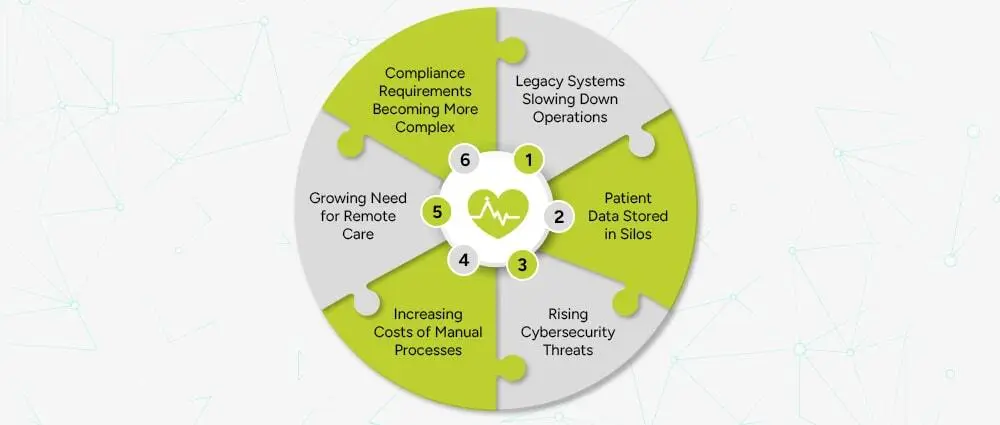
Healthcare organizations across the world face several challenges. Many of these problems come from outdated technology, slow systems, and disconnected software platforms.
Many hospitals still use systems built 10 to 20 years ago. These legacy platforms create problems such as:
These issues affect doctors, nurses, administrators, and patients alike, which is why it is necessary to employ legacy application modernization strategies within our systems.
Patient information is often divided across multiple systems. The lab has its own records. The pharmacy uses separate software. Insurance claims run on a third system. This creates delays, errors, and miscommunication.
Healthcare is among the most attacked sectors globally in cybersecurity. Ransomware assaults, data leaks, and downtime of systems are sources of financial and legal risks. Outdated systems are the easiest to attack.
Manual work is a necessary component in tasks like billing, scheduling, insurance checking, following up with patients, and keeping track of inventory. The burden can be lessened through automation, but older systems do not have the capability to work with the new automation tools.
Telehealth, virtual consultations, and cloud-based patient monitoring grew after the pandemic. Many hospitals still lack systems that support remote services effectively.
Healthcare organizations must follow strict standards like HIPAA, GDPR, local authority rules, and insurance reporting requirements. Outdated systems often lack built-in compliance support.
All of these issues point to the same solution. Healthcare institutions need Custom Software Development, cloud solutions, application modernization services, and modern enterprise software platforms that can meet the demands of 2026 and beyond.
Enterprise software development services are designed to help hospitals move from outdated platforms to smart, scalable, and fully integrated systems. With the right Healthcare Software Development Company, healthcare organizations can build custom software development solutions that support their exact workflows.
Hospitals depend on many systems. Cloud application modernization does not mean replacing everything. It means upgrading or rebuilding these systems into a connected cloud ecosystem.
Let’s break down the core healthcare systems that are commonly used in hospitals today, and how they can be modernized.
Hospitals require a complete management solution that handles:
Legacy HMS platforms often lack automation and advanced analytics. Modern application modernization services and enterprise solutions include cloud native architecture, mobile access, and smart dashboards.
A PMS, Patient Management System, also known as Patient Portal, manages individual patient records, history, medications, and reports. Older PMS systems are slow and disconnected. Today’s application modernization services offer:
Hospital ERP systems manage:
Modern ERP solutions improve cost control through:
Insurance processes are often manual. Healthcare Software Development Services can create custom insurance claim apps that enable:
Hospitals are rapidly adopting telemedicine. With custom software application development, hospitals can integrate:
An LIMS systems created using application modernization services help labs automate:
A pharmacy system currently made using application modernization services supports:
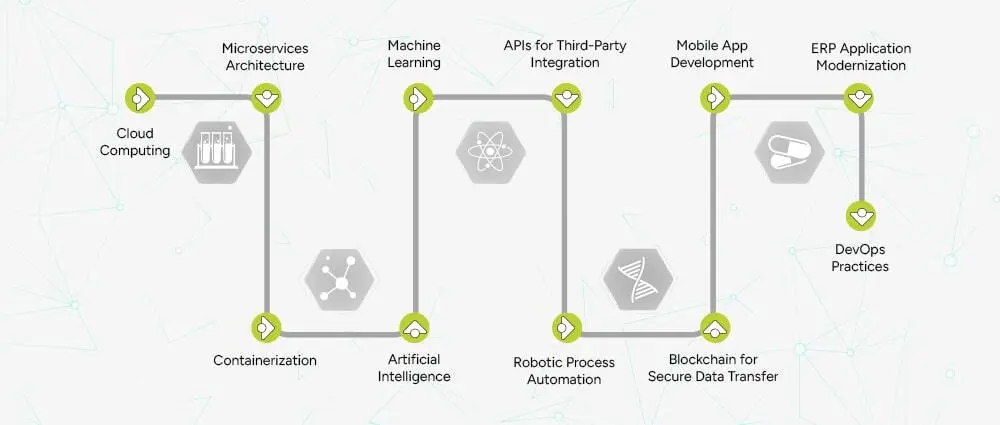
To modernize these systems, healthcare organizations can rely on several technologies offered through Custom Software Development Services. Key technologies include:
Cloud computing is a big step forward for hospitals. They get rid of their old servers and can keep their data securely in the cloud. The systems are therefore faster, easier, and are accessible from anywhere you like.
Microservices help large hospital systems get divided into smaller parts, which can then be updated or fixed without interrupting the entire thing. This way, hospitals can scale faster and ensure better performance.
Containerization packages apps in a way that enables them to run flawlessly on any device or environment. With the help of application modernization services, in return, it allows development teams to quickly release updates with fewer errors.
AI serves as a helpful tool for hospitals by making data analysis, decision-making, and doctor-assistive tools easier and smarter. By providing faster insights, it not only reduces mistakes but also improves medical treatment.
In application modernization services, machine learning gives power to software programs to learn from past data and improve and become smarter over time. Hospitals can use it to predict patient care, identify high-risk groups early, and cut down on the time it takes for diagnosis.
APIs help different healthcare systems talk to each other easily. Through them, hospitals can link laboratories, pharmacy systems, insurance platforms, and patient applications without the necessity of manual work.
RPA is a technology that takes care of the repetitive administrative tasks of the organization, allowing staff to devote more time to patient care. It is particularly suitable for activities like billing, scheduling, claim processing, and data entry. So, add RPA into application modernization services and get rid of manual work for a long time.
The use of blockchain in the healthcare industry is there to ensure that medical data files are shared safely between parties and are not tampered with. This is the foundation that builds trust between hospitals, insurance companies, and patients.
Mobile apps are the main source through which doctors, nurses, and patients can get instant access to important information. Hospitals can provide telemedicine, appointment booking, and easily get patient record access to their clients via cell phones.
Modern ERPs help hospitals manage finance, HR management, procurement, and operations more efficiently, all in one place. ERP application Modernization services and systems of integrated networks offer real-time insights that help reduce costs and improve planning.
DevOps practices are the base that enable development teams to deliver updates faster without system downtime. This makes sure that hospital software stays stable, secure, and up to date at all times.
Each technology helps hospitals reduce costs and increase efficiency.
One of the biggest steps in application modernization services is cloud adoption. By moving systems to the cloud, hospitals gain flexibility, speed, and stronger security.
Healthcare Software Development Services often include the following cloud solutions.
Cloud Migration involves moving existing systems to cloud platforms like AWS, Azure, or Google Cloud. Cloud migration offers:
Instead of simply migrating old systems, hospitals can build entirely new cloud native apps that support:
DevOps in application modernization services helps hospitals release updates faster and maintain systems without downtime. DevOps engineers support:
DevOps combined with cloud technology improves patient services and lowers maintenance costs.
Healthcare data is highly sensitive. Cloud-based systems require strict compliance. A reliable Healthcare Software Development Company offers:
Healthcare systems cannot afford downtime. When offering application modernization services, reliable providers offer:
Ongoing support ensures that healthcare teams remain productive around the clock.
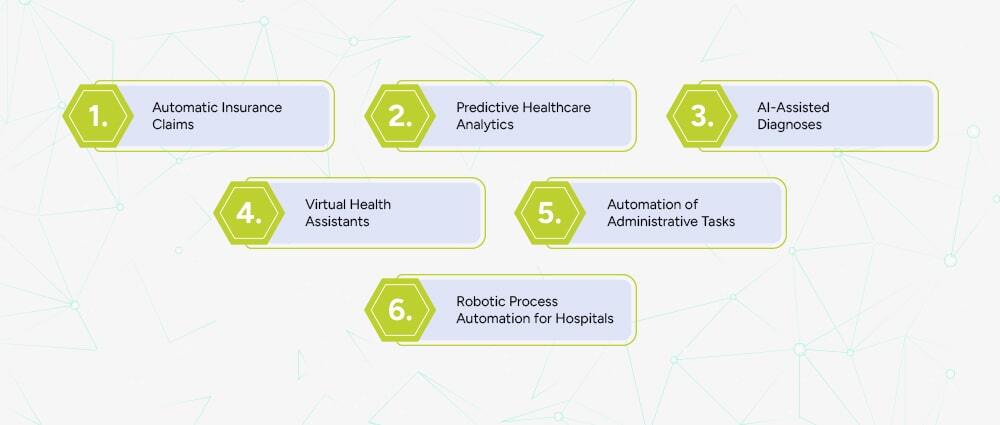
Artificial intelligence and automation are transforming the healthcare industry faster than ever before. By 2026, AI-driven systems will be an essential part of healthcare operations.
Below are some of the latest advancements.
AI can read claim documents, verify details, detect errors, and submit claims automatically. This reduces delays and increases approval rates.
AI in application modernization services can analyze large datasets to predict:
Predictive analytics helps hospitals prepare in advance.
By using AI in application modernization services and following AI software development companies that are building tools that support doctors by analyzing:
These tools help identify diseases early and reduce human error.
Chatbots and virtual assistants can help patients with:
By enabling application modernization services in thier systems, hospitals can automate:
Automation reduces the burden on staff and improves patient satisfaction.
RPA is being used to automate repetitive tasks inside hospital systems, including:
These technologies make healthcare operations faster and more cost-effective.
Choosing the right Healthcare Software Development Company is the most important decision for modernizing systems. Hospitals must assess expertise, security practices, technology stack, and long-term support capabilities.
Here are some factors to consider.
Pick a company that has experience in:
Your partner should be able to upgrade or create:
Advisory services are important because they help hospitals understand:
Hospitals have unique workflows. Your partner must offer:
By choosing Offshore Software Development Services or Nearshore Software Development, hospitals can reduce development costs while working with skilled experts.
Offshore Software Development also provides access to larger talent pools.
When you are outsourcing software development, you must ensure your partner provides:
Your partner must understand:
Arpatech offers healthcare organizations a complete range of Application Modernization Services and enterprise software development services. Hospitals can rely on Arpatech to modernize their legacy systems and build cloud native apps for 2026.
Arpatech supports businesses that want to:
This allows hospitals to reduce costs while receiving high-quality development.
Fast, secure, cloud-based, and AI-enabled systems will be the ones that define the future of the healthcare industry. If hospitals want to compete, they have to give up on old-fashioned platforms and provide first-rate care to patients.
Taking advantage of Healthcare Software Development Services, modern enterprise software development practices, and cloud native infrastructure, healthcare organizations will be able to build an excellent digital foundation for 2026 and the years to come.
website
Modernization of applications is not solely about technology shift. It is a move towards the direction of better treatment to patients, more efficient operations, less expenditure, and sustained victory.
If you require assistance in reshaping your medical systems, then firms such as Arpatech can supply you with the experience, technology, and support that will lead you from the status quo of old systems to the transformation of native cloud application modernization healthcare platforms.
Let’s work on your Healthcare system today!
App modernization is the way of turning an old application into a new one by upgrading it really fast, making it very secure, and adapting it to new technology. The app can choose from a range of options such as moving to a new location, getting extra features, or even a better user interface.
Legacy systems in healthcare signify the long-used technologies that hospitals still depend on even if they do not meet the current requirements. Most of the time, these systems function slowly and do not have the capability to interact with and work along with the new applications.
A large variety of digital tools are available in healthcare, each fulfilling a certain need. The most common types include:
All these tools combined make it possible for hospitals to operate more efficiently and provide better care.
There are several reasons why application modernization is necessary:
Not modernizing might mean that companies lose their competitive edge and suffer from poor customer service.
Application modernization is typically done in a step-by-step manner:
Following these steps will enable companies to upgrade their applications without affecting their everyday operations and will be done in a timely manner.
Cloud application modernization means moving existing applications to cloud infrastructure while updating them to take full advantage of cloud features. This allows apps to scale easily, run faster, and be accessed from anywhere. It also improves security and reduces the cost of maintaining physical servers.


Before we begin, please solve this quick math check to confirm you're human, and you'll be all set to start chatting with our AI assistant.
Stay connected with us to receive the latest information, updates, and insights from our world of innovation.
By entering your email address you will receive promotional updates.


© 2026 ARPATECH (ADVANCED RESEARCH PROJECTS & TECHNOLOGY)