Securing skilled tech talent has become one of the biggest challenges businesses face today, and Software Development Staff Augmentation has emerged as a practical solution to address this growing gap. Developer shortages are increasing each year, while expertise in areas like AI, DevOps, and cybersecurity is becoming harder to source internally.
For businesses, the impact is significant. Recruitment cycles slow down, critical skill gaps appear, and in-house software teams are often stretched beyond capacity. As a result, deadlines slip, MVPs get delayed, and organizations struggle to stay competitive in a fast-moving tech landscape.
This is where software development staff augmentation steps in as a strategic solution. Instead of going through long hiring processes or completely outsourcing projects, software development staff augmentation lets businesses add skilled outside developers to their teams when needed. This gives companies the flexibility to grow their team while staying in full control.
Many organizations are now shifting toward software development staff augmentation because it bridges the gap between traditional hiring and full outsourcing with staff augmentation services. It allows companies to stay agile while still maintaining ownership of their development process.
This approach helps startups and large companies quickly fill skill gaps and maintain project progress using software development staff augmentation as a scalable workforce model.
In this blog, we’ll cover:
Software development staff augmentation is a flexible hiring model where a company brings in external software developers or IT professionals to work alongside their existing in-house team, either temporarily or long-term, based on project needs. Unlike project outsourcing, where you hand over an entire project to a third party, staff augmentation software development keeps management control firmly with you.
The augmented team members integrate into your workflows, follow your processes, and are directed by your project managers. They simply work as part of your team rather than independently.
In short, you get the talent you need without the extra costs, and you stay in control of your project throughout, using software development staff augmentation.
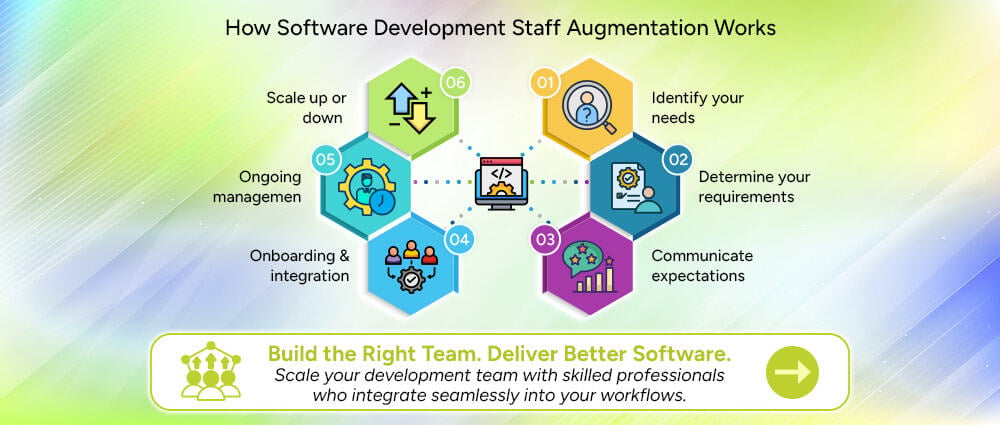
The software development staff augmentation procedure is simple and generally follows these steps:
There are specific scenarios where software development staff augmentation becomes the most effective solution:
Product Launch Deadlines: When a release date is locked in, but your internal team doesn’t have the bandwidth to hit it, augmenting with additional developers lets you surge capacity without permanent commitments.
Lack of Specialized Skills: Niche expertise, like machine learning engineers, DevSecOps specialists, or cloud architects, can be extremely difficult to hire full-time. Staff augmentation lets you access these specialists exactly when you need them.
Scaling Development Teams: During periods of rapid growth, you need to scale fast. Staff augmentation allows you to expand your development team in days rather than months, without the overhead of full-time hires.
Replacing Unavailable Team Members: When key developers go on leave, resign unexpectedly, or are pulled onto other critical projects, augmented staff can fill those gaps immediately to prevent project delays.
MVP Development: Startups building a Minimum Viable Product need fast, cost-efficient development. Augmenting with experienced developers helps get an MVP to market without building a full-time team prematurely.
Software development staff augmentation offers several key benefits that help businesses if the best practices are used in resource allocation:
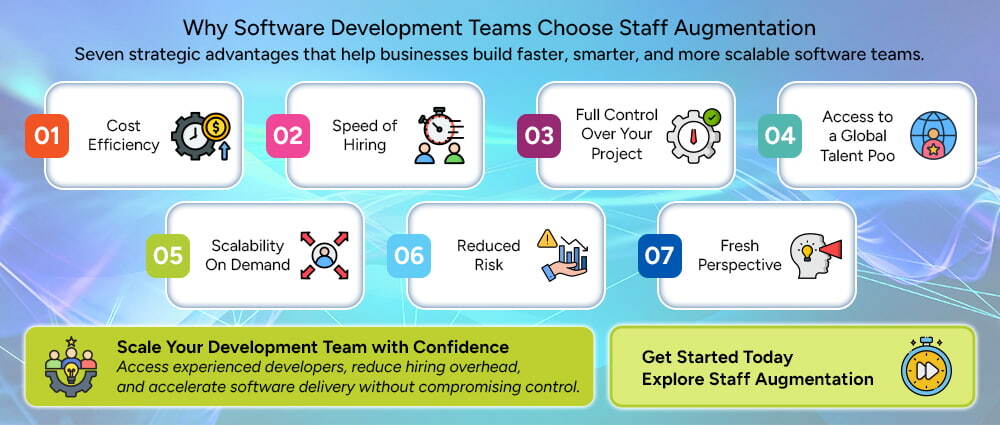
Cost Efficiency
Hiring full-time developers comes with salaries, benefits, recruitment costs, and training expenses. Staff augmentation lets you pay only for the skills you need, for as long as you need them, significantly reducing overhead.
Speed of Hiring
Traditional hiring can take weeks or months. With staff augmentation, pre-vetted professionals can join your project within days, keeping development timelines intact.
Full Control Over Your Project
Unlike outsourcing, where a third party takes the wheel, staff augmentation keeps you in the driver’s seat. You manage the work, set priorities, and oversee quality directly.
Access to a Global Talent Pool
With staff augmentation, location is no longer a barrier. You can work with experienced developers from across the globe and fill skill gaps that your local talent pool cannot cover.
Scalability On Demand
App development project requirements change, and your team should be able to change with them. Staff augmentation lets you add developers when workload increases and reduce the team when things slow down, without getting tied up in lengthy contracts.
Reduced Risk
Because augmented developers work directly within your systems and under your supervision, you always know where the project stands. This keeps quality in check and reduces the risks that often come with handing a project over to an outside vendor.
Fresh Perspective
External developers often bring new ideas, best practices, and outside-the-box thinking that can improve your existing codebase and processes in ways your permanent team may overlook.
|
Factor |
Staff Augmentation |
Software Development Outsourcing |
|
Management Control |
Client retains full control | The vendor manages the project |
|
Team Integration |
Works within your existing team |
Works as a separate external team |
|
Flexibility |
Large, scale up/down easily |
Low, bound by project scope |
|
Best For |
Filling skill gaps, scaling teams |
End-to-end project delivery |
|
Communication |
Direct, daily collaboration |
Typically, through a project manager |
|
Cost Model |
Pay per resource/time |
Fixed price or milestone-based |
| Confidentiality | Higher resources work in your environment |
Lower IP exposure risk |
|
Speed to Start |
Very fast (days) |
Slower (requires scoping, contracts) |
|
Quality Control |
Managed by you |
Managed by vendor |
| Risk | The lower you oversee everything |
Higher dependent on vendor delivery |
Both models have their place. If you need complete project ownership and team continuity, staff augmentation is the winner. If you want to hand off an entire deliverable and focus on other priorities, outsourcing software development may be the better fit.
With software development staff augmentation, companies like Arpatech have the depth and breadth of talent available. Here are the expert roles you can access:
Full-stack, front-end, and back-end developers work with various programming languages and frameworks. They are experienced in Python, JavaScript, React, Node.js, Java, PHP, .NET, and many more.
Experts create smart systems that use natural language processing, computer vision, predictive models, and applications powered by large language models (LLMs).
Certified professionals across AWS, Azure, and Google Cloud platforms who help businesses architect, migrate, and manage scalable cloud infrastructure.
Engineers optimize the process of continuous integration and continuous delivery (CI/CD). They automate software deployments and manage containerization with tools like Docker and Kubernetes. Their goal is to make software delivery fast and reliable.
Security professionals protect your systems. They perform penetration tests, set up compliance frameworks, and deal with threats before they lead to harm.
Testing professionals who make sure your software is bug-free, stable, and production-ready, using tools like Selenium, Cypress, and Postman.
iOS and Android developers with hands-on experience building native and cross-platform applications using Swift, Kotlin, Flutter, and React Native.
Designers who create clean, user-friendly digital experiences that improve engagement and make products easier to use.
Working with a reliable IT staff augmentation company goes far beyond just getting extra headcount. Here’s why businesses increasingly turn to partners like Arpatech:
You don’t spend weeks screening resumes. IT staff augmentation companies maintain a ready pool of thoroughly vetted, tested professionals who can hit the ground running.
The best augmentation partners understand software development deeply; they don’t just send you people, they match you with the right people for your tech stack and project type.
Augmentation companies handle employment contracts, payroll, compliance, and HR, so you can focus entirely on building your product.
Whether you need a developer for six weeks or six months, you get the same level of professionalism and expertise without long-term hiring obligations.
Top-tier augmentation partners like Arpatech ensure backup resources are available should anything change, so your project never stalls.
If you’re looking to scale your development team quickly without compromising on quality, IT staff augmentation services give you access to expert talent across every major technology domain.
In today’s fast-moving digital landscape, software development staff augmentation has become essential as businesses can no longer rely solely on traditional hiring to meet growing development demands. Competition is intense, timelines are tighter, and the need for specialized technical skills continues to rise across every industry.
With Arpatech’s IT Staff Augmentation Services, companies get the flexibility to scale development teams quickly, access global talent on demand, and maintain full control over their projects without the long-term cost and commitment of permanent hiring. Whether you are building a new product, scaling an existing platform, or filling critical skill gaps, this model ensures your team stays agile and delivery-focused.
As technologies like AI, cloud computing, and DevOps continue to evolve, software development staff augmentation will remain a key strategy for businesses that want to stay competitive and innovative without slowing down execution.
Ready to scale your team the smart way? Contact Arpatech, and let’s build something great together.
Software development staff augmentation is a model where businesses hire external developers to work as part of their in-house team on a temporary or project basis, without transferring management control to an outside vendor.
With staff augmentation, you retain full management control, and the external developers integrate into your team and processes. With outsourcing, you hand an entire project or function to a third-party vendor who manages delivery independently.
You can hire a wide range of roles, including software developers, AI/ML engineers, DevOps engineers, cloud architects, cybersecurity specialists, QA testers, mobile app developers, and UI/UX designers.
In most cases, augmented developers can be onboarded and integrated into your project within a few days to a week, depending on the complexity of requirements and the availability of matched talent.
Staff augmentation is an excellent model for startups, especially for MVP development. It gives early-stage businesses access to senior talent at a fraction of the cost of building a full-time team, with the flexibility to scale as needed.

Before we begin, please solve this quick math check to confirm you're human, and you'll be all set to start chatting with our AI assistant.
Stay connected with us to receive the latest information, updates, and insights from our world of innovation.
By entering your email address you will receive promotional updates.


© 2026 ARPATECH (ADVANCED RESEARCH PROJECTS & TECHNOLOGY)