Telemedicine has come a long way, and it is no longer just a convenient video call to the rehabilitation doctor. By 2026, it had developed to become a major staple of contemporary health care. Fast consulting, remote monitoring, digital prescriptions, and seamless communication with medical professionals are some of the things that patients are now expecting and that is why more and more hospitals, clinics, and health care startups are pouring their resources into telemedicine apps. Patients no longer have to visit the provider in person; they just go where there is digital access.
The need for trustworthy and safe telehealth platforms has led to organizations hunting for the best telemedicine app development company. But here is the bright side. The creation of a telemedicine application from scratch is fully doable, even if you’re not a techie. What you need is only a well-defined strategy, appropriate tools, and a clear roadmap.
Today, here we will guide you through the entire process, starting from the understanding of the telemedicine market in 2026 to the telemedicine app development, what features it should have, and the trends your app should be following.
Telemedicine is no longer a niche convenience service. It is rapidly becoming a foundational component of global healthcare. As we look toward 2026, the scale, reach, and expectations for digital health platforms have grown dramatically. The market data from 2023–2025 point to a strong and accelerating adoption across regions, settings, and specialties.
In short, this data above clearly shows an expanding and accelerating market.
Because of this growth, more institutions are investing in, custom telemedicine app development solutions to future-proof their services and offer digital health at scale.
Multiple factors contribute to the boom in telemedicine. The data and broader industry shifts help explain why demand for telemedicine apps and services is skyrocketing:
The boom in telemedicine can be attributed to multiple factors. The data and wider industry transitions are helpful in explaining the increase in the demand for telemedicine applications and services in the following ways:
The global elderly population, rise in chronic diseases, and absence of adequate medical professionals in remote or sparsely populated areas have all contributed to the need for healthcare systems to be remote and accessible.
Patients like to have the option to choose: they can have remote consultations, less travel or waiting time, and better follow-ups. This has facilitated the transition of many providers to the digital-first model. Telehealth contributes to a reduction in hospital readmissions and emergency visits, hence creating a win-win situation for both patients and providers.
Better internet access, widespread smartphone usage, wearables, and infrastructure improvements are making remote monitoring, data sharing, and digital consultations more dependable. The above-mentioned improvements have empowered the healthcare organizations to take the risk of investing in telemedicine mobile app development solutions.
There is a greater focus on preventive care and remote monitoring (especially for chronic disease patients). Now, patients don’t have to go to the hospital for every check-up; they can just have a telemedicine consultation and get care at home. This shift pushes the use of remote patient monitoring together with virtual consultations.
More and more hospitals and healthcare providers are now seeing telehealth not as a temporary solution but as a permanent strategic option. They are making investments in establishing or joining forces with others to create comprehensive telemedicine ecosystems.
With the success of telemedicine, the governments and regulatory bodies in different parts of the world have started to set up the necessary conditions for digital health services. This not only increases trust and compliance but also diminishes the obstacles for healthcare organizations to put in place remote care solutions and thus, the demand for full-fledged edge computing telemedicine app development services is rising sharply.
Healthcare organizations are increasingly inclined toward custom telemedicine app development, which is secure, scalable, integrated and tailored to meet their specific needs rather than towards one-size-fits-all generic solutions.
From the perspective of market dynamics, generic or off-the-shelf telehealth platforms usually do not meet the needs of the organizations. This is the reason why custom-built solutions are widely chosen:
All these factors put together provide an explanation for the strong demand for and the high supply of telemedicine app development services, and for the trend of many healthcare providers to collaborate with experienced development firms instead of sticking to generic products.
The telemedicine industry in 2026 is shaped by both technology and patient expectations. Here are the top trends influencing the future of telehealth platforms.
AI has reached the point where it is the main character in all the healthcare digital transformation stories, from smart symptom checking to clinical decision support, appointment routing, and predictive analysis. To put it simply, AI triage apps have turned doctors into less busy but more efficient healthcare providers as they get patient answers in no time.
Telemedicine applications work hand in hand with smartwatches, glucose monitors, ECG devices, and fitness bands that cut each other’s waiting time. As a result, monitoring of chronic diseases such as diabetes and hypertension can be done remotely.
Certain medical areas are utilizing VR in rehabilitation, mental health, and physical therapy. VR provides engrossing treatment sessions, making therapy more effective and at the same time more reachable.
Patients count on the applications to keep track of their medical history, habits, medication timings as well as preferences. Bespoke dashboards not only enhance but also engage and keep the patients.
The benefits of telemedicine apps include automatic system prescription updates, reminders, and pharmacy delivery services.
Rather than developing separate video call applications, healthcare companies nowadays prefer investing in entire systems. Such systems comprise patient portals, doctor dashboards, admin control panels, and integrated billing.
These trends indicate why organizations lean towards custom telemedicine app development rather than opting for off-the-shelf software. A custom approach gives total control over the features, the user experience, and the compliance.
Telemedicine is not just for general checkups. It has expanded into nearly every area of healthcare with practical, high-impact use cases.
Patients have the opportunity to consult with doctors at any time, without the need to travel or deal with congestion in hospitals.
Mobile applications follow up and monitor chronic diseases like diabetes, asthma, and heart disease. Physicians keep an eye on the patients’ health data and make changes to treatment plans from afar.
Internet-based counseling, therapy, and psychology consultations are not only frequently used but also very effective.
Prescription medicines are stored electronically, renewal process is simple, and delivery to pharmacies is done automatically.
Patients in underserved regions get access to specialists that are not available locally.
Patients are able to send recovery photos, vital signs, and symptoms to the medical staff via the application instead of going for several hospital visits.
Telehealth with the support of AI is helpful in the evaluation of emergency cases and the redirection of patients to instant care.
Telehealth services provide safe and easy-to-do consultations for young children and seniors who cannot leave their homes due to health issues.
Healthcare providers that implement such models usually search for a telemedicine application development that offers a good user experience along with strong compliance and efficient real-time data management.
If you are planning to build a telemedicine app from scratch, following a clear step-by-step approach makes the entire journey easier.
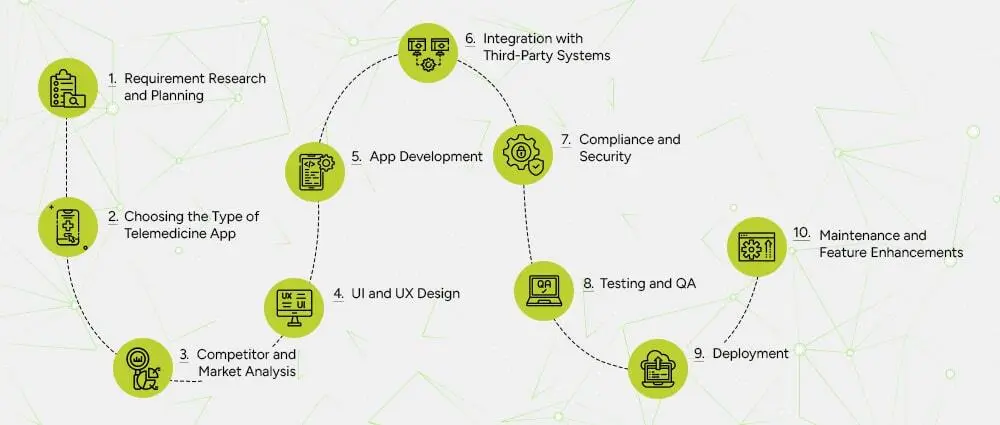
Telemedicine users want clarity. Good design keeps them engaged and confident.
The real coding action starts here. Developers create:
This phase often needs a skilled telemedicine application development company.
Compliance is critical in telemedicine. Developers ensure:
Security is a non-negotiable part of every custom telemedicine app development solution.
Test for:
Launch your app to the Apple App Store, Google Play Store, or your organization’s private environment, depending on your target audience.
Maintenance and on-going support includes:
A long-term partnership with a reliable telemedicine app development service ensures your app continues to grow with your business.
To succeed in 2026, every telemedicine app must include a strong set of essential features that support smooth communication, secure data handling and reliable patient care.
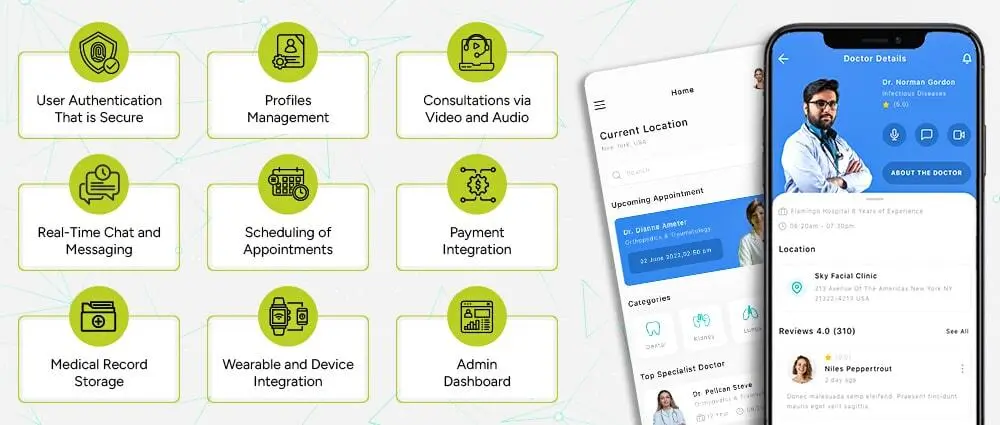
Provide login through email, phone number, and two-factor confirmation, so that only the authorized people to access medical information can be there.
Make it possible for patients, doctors, and admins to create comprehensive profiles that keep the major facts and make the diagnosis more precise.
Offer very good and clear communication in terms of video and voice because virtual appointments are very much dependent on stable and clear connections.
Facilitate secure text messaging for the purpose of making patients asking follow-up questions and sharing reports or images, for instance, file sharing.
Allow the users to book, reschedule, or cancel appointments without any problem while doctors are controlling their availability in real-time.
Support smooth and secure online payments for consultations, follow ups and treatment plans.
Store reports, images, previous consultation notes and health history in encrypted formats for easy future access.
Connect with smartwatches, glucometers and other devices to capture live patient data for better diagnosis.
With healthcare IT support, give administrators tools to manage users, doctors, reports, billing, support tickets and system analytics in one place.
Companies that build all these elements into their apps usually offer a wide range of telemedicine app development solutions that meet modern healthcare needs.
The cost of telemedicine app development is based on several factors like features, the type of app, technology used, and the place where it is done. Even though all projects differ, below is a rough estimate.
This is where companies usually invest in custom telemedicine app development for long term scalability.
Cost also depends on whether you choose:
Telemedicine has completely changed the entire healthcare interoperability experience by increasing accessibility, speed, and efficiency of medical support.
As we step into the year 2026, every healthcare provider that wishes to remain competitive must undergo a digital transformation. This is the reason why telemedicine app development process is emerging as a high-growth area in healthcare technology.
Building your telemedicine platform is a way to growth, better patient engagement, and stronger service delivery irrespective of whether you are running a clinic, managing a hospital network, or creating a healthcare startup. Besides, the telemedicine app development company, a good plan, and user experience will help create a trustworthy digital healthcare ecosystem that is audience-tailored.
Each phase from market trend comprehension to needed features selection, following telemedicine app development process, modern technologies addition, security assurance, etc., is a contributor to a successful launch. Custom solutions that allow designing workflows, interfaces, and connections really match your medical operation are particularly diversified.
Digital is the future of healthcare and telemedicine is at the forefront of it. So, work with Arpatech to give your telemedicine shape and create a solution for your patients that helps them to the maximum.
The telemedicine software spectrum is quite vast comprising different types of applications based on the requirement, from very basic video consultation platforms to sophisticated health record and remote monitoring systems. The most common software parts are:
If you choose to work on a custom telemedicine solution, the entire software components are integrated to provide a secure, flexible, and scalable telemedicine experience.
Yes, AI and other associated technologies have become a major factor in the development of modern telemedicine. The use of AI in telemedicine apps is not uncommon. Here are some of the activities that AI performs in this field:
Thus, AI is not simply something you can say is nice-to-have; in fact, it is the core part of the solution in the case of multiple advanced telemedicine app development, where it helps to improve efficiency, accuracy, and patient experience.
Remote consultation, which allows to see, hear, or chat with the doctor, is the most common type of telemedicine, and this type is without a doubt the most preferred among all doctor-patient consultations, which makes it the main scenario in telemedicine.
Nonetheless, there are also other consultations supported by telemedicine like remote monitoring of the patient, managing diseases, e-prescriptions, and mental health consultations, etc.
Though physicians’ consultation via telemedicine is the most common and the simplest form of it, yet telemedicine is wide-ranging and continues to be the impenetrable barrier of accessing healthcare for a lot of providers that have already gone digital.
Choosing the best telemedicine app or development solution depends on your needs and priorities. Here are key factors to guide you:
Selecting a telemedicine app development company’s solution that balances all these factors will make your telemedicine app reliable, user-friendly, and future-proof.
The implementation or utilization of telehealth apps has numerous advantages for physicians and medical practitioners:
This is actually a matter of who your target users are and what are their scenarios. The following is a decision guide that is very simple:
To put it simply: there is no one-size-fits-all solution. You can say that the best platform is determined by your user base, budget, required features and long-term vision.
To build modern telemedicine applications, the following are the technologies that top the list:
These technologies, when combined properly, allow building a robust, secure, and feature-rich telemedicine mobile app development solution.


Before we begin, please solve this quick math check to confirm you're human, and you'll be all set to start chatting with our AI assistant.
Stay connected with us to receive the latest information, updates, and insights from our world of innovation.
By entering your email address you will receive promotional updates.


© 2026 ARPATECH (ADVANCED RESEARCH PROJECTS & TECHNOLOGY)