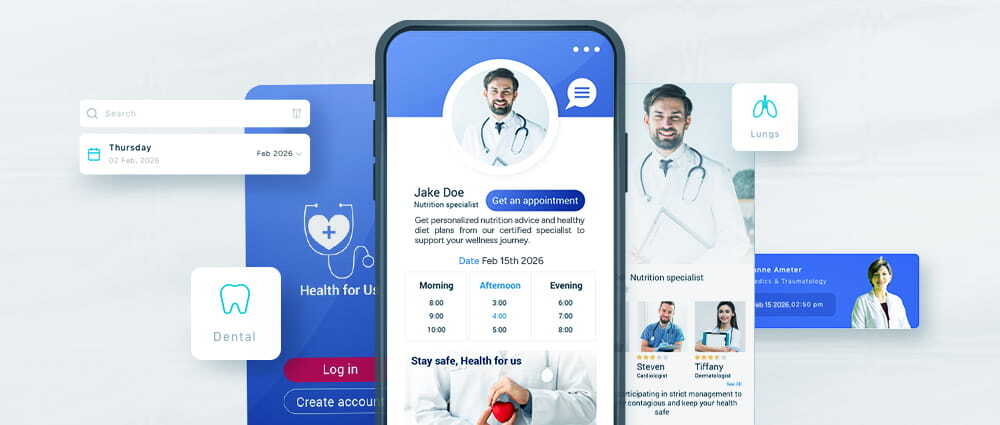
Telemedicine has become a critical part of modern healthcare, enabling patients to receive care remotely while giving healthcare providers tools to expand their reach efficiently. Whether it’s virtual consultations, remote patient monitoring, or teletherapy sessions, telehealth is reshaping how care is delivered.
For entrepreneurs entering this field, the first question is often: What is the telemedicine startup cost in 2026?
Costs vary depending on technology, regulatory compliance, staffing, equipment, and marketing. Today, we will break down the factors affecting telemedicine startup costs, explain different platform options, and provide a roadmap for building a successful telehealth business.
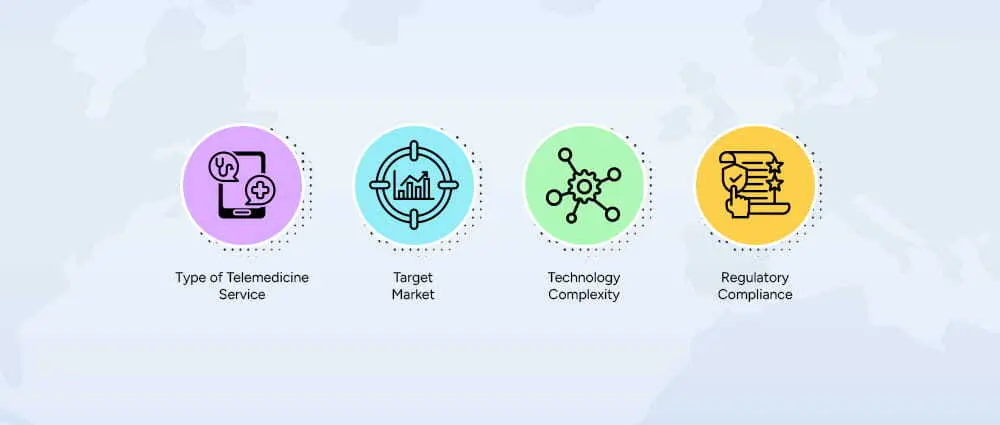
Even though we can say that a telemedicine startup cost can range from $8,000 to $150,000+, if you’re looking for the breakdown, read ahead for that and learn what factors affect the costs. Telemedicine startup costs are not fixed. Several key factors determine how much your platform will cost:
The type of service that you provide will significantly affect costs. In the case of mental health therapy platforms, they will need to set up secure video consultations and also enact strict patient privacy measures, whereas, for chronic disease management, there will be a need for medical device integration and a more sophisticated analytics dashboard. The service’s degree of complexity will lead to increased telemedicine startup costs.
The budget is determined by the extent of your startup’s market. Providing services to a local clinic is much cheaper than targeting the whole country. A wider market is going to need more infrastructure, looser compliance, and most probably, a higher staff count.
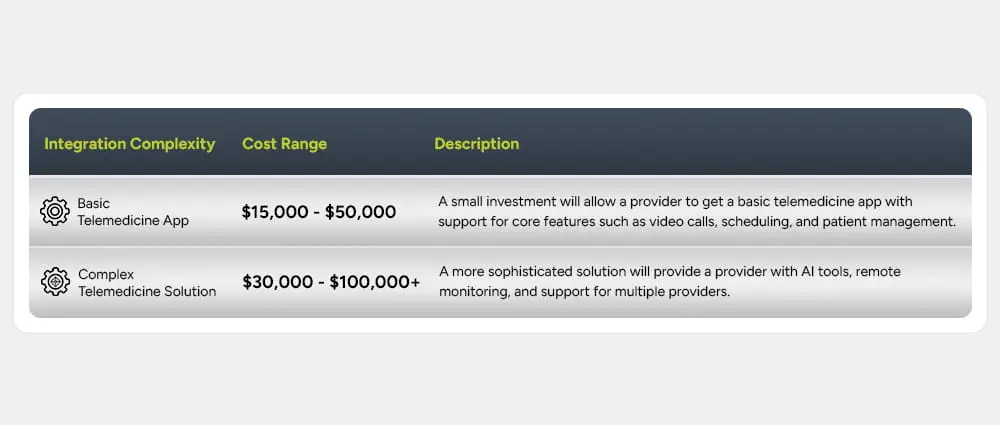
Basic video consultation features, along with the patient chat option, are easy to build and cost around $15,000 – $50,000. On the other hand, next-generation solutions incorporating AI, remote patient monitoring, or multi-provider support can run up to $30,000 to $100,000+ or even more.
Healthcare is heavily regulated. In the US, HIPAA compliance and licensing are mandatory. Startups typically spend $5,000 – $15,000 on licensing and compliance. Skipping this step is risky and can lead to fines or legal issues.
Telemedicine platforms are not merely costly; they, along with the healthcare workers, save money too.
A smaller number of rooms is needed for the clinic, thus less rent and overhead.
Virtual consultations permit the doctors to have more patients at the same time, thereby lessening the monthly staff cost, which is between $3,000 – $25,000+, depending on the size of the team.
The automated processes of scheduling, reminders, and billing lead to a reduction in administrative costs.
Your telemedicine platform becomes more appealing to providers due to the cost savings it demonstrates, which leads to higher adoption rates and thus the long-term profitability of the providers.
Partnering with the right development team can make or break your startup.
Choose a telemedicine app development company that understands patient workflows and provider requirements.
The company should be familiar with HIPAA, state licensing, and other healthcare regulations.
A good development partner can start with an MVP and support future feature expansions.
Avoid hidden costs. Your partner should provide a clear breakdown of telemedicine app development services and related expenses.
A telemedicine startup is not just a technology project. It is a healthcare business, and healthcare leaves very little room for guesswork. A well-structured telehealth business development plan helps you avoid costly mistakes, control your telemedicine startup cost, and build a platform that can grow sustainably over time.
Think of this plan as your blueprint. It guides every major decision, from what features you build first to how much money you need to raise and how quickly you can scale.
The telehealth concept gets the examination of the market demand in the first place, and that is where the market analysis comes in. In order to develop the product, one must first have a clear picture of the user group and the specific issues that they want to solve.
The process includes understanding the patients’ behaviors, pinpointing the existing telehealth platforms’ weaknesses, and getting a grasp of the competitors’ strategies. This procedure is particularly crucial for new businesses planning to enter the US market, as patient expectations are high, and there are strict regulations over the quality of care.
During the market analysis, the following aspects should be considered:
Well-executed market analysis means that your startup costs for a telemedicine company in the U.S. or globally will be spent on the right solution, one that people indeed want and need.
A service model of your business will tell about the telemedicine startup in a way that it will make money. In fact, this decision will have a direct impact on both your revenue and long-term scalability.
The core question is whether the platform you would offer would serve patients, healthcare providers, or both. Each model has different operational and technical requirements.
The typical telemedicine service models are:
Choosing the right service model early on helps create features that align with revenue goals and also saves the cost of making changes later in the development process, which can be costly.
The technological roadmap of your platform indicates its evolution in the future. This particular method not only gives quicker launches but also better and more economical spending since everything will not be built at once.
At first, you should decide on your Minimum Viable Product, or MVP. Only the most critical features that can provide value are included here, such as video consultations, user onboarding, and appointment scheduling, etc. You will, later on, be able to add more advanced features gradually, depending on the user feedback, after the MVP is up and running.
A technology roadmap that is clear and precise usually contains the following:
The above-mentioned staggered method will help reduce costs related to the telemedicine app development, but at the same time, it will guarantee that the platform is flexible and ready for the future.
Financial projections summarize all aspects of the business scenario. It is in this section that you perform the calculation for the realistic cost of your telemedicine startup and the time needed to achieve the break-even point.
The projections must reflect not only the initial expenses but also the recurrent ones. Development, compliance, staffing, infrastructure, marketing, and equipment, among others, are included in this. The majority of startups fail to accurately calculate these costs, and if the budget is not controlled well, it can lead to significant financial problems.
Your financial road map should cover the areas of:
By indicating these costs explicitly, you will have an accurate estimation of the total cost of starting a telemedicine business and will be able to set funding or revenue milestones accordingly.
The business development plan for a telehealth company that is well structured and one that can adapt to any market, whether US or global, ensures that the budget for the telemedicine company is not based on pure guesses but on a well-thought-out strategy, market research, and the setting of clear priorities.
It not only enables you to maintain your attention but also facilitates decision-making based on facts, and the development of a telemedicine platform that meets the requirements of being financially secure, ready for expansion, and compatible with the actual needs of the healthcare sector.
Telemedicine offers more than just software. One of the main factors involving telemedicine apps is the equipment:
Among hardware necessities are video conferencing devices, diagnostic tools, and networking equipment.
On the other hand are digital stethoscopes for tele-health, patient monitoring gadgets, and AI-assisted diagnostic tools.
The range of equipment costs is from $10,000 to more than $110,000 based on the complexity and scale of the establishment.
Opting for the right equipment provides the guarantee of patient safety and the effectiveness of service delivery at the least possible cost.
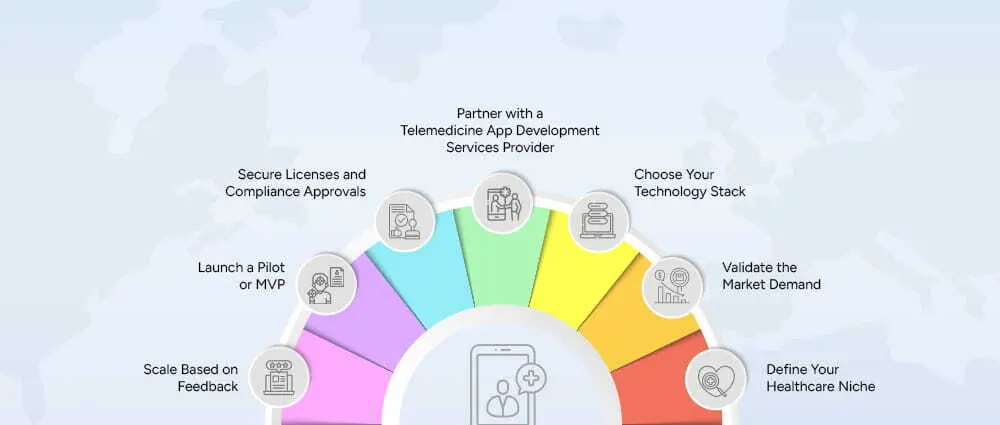
Establishing a telemedicine startup demands an organized plan. Every stage is highly important in managing the cost of your telemedicine startup and at the same time, setting up for future success.
The first thing that you need to do is to decide what kind of telemedicine service you are going to provide to your audience. Will the application focus on psychotherapy, general practitioners, ongoing illness treatment, or expert advice?
Narrowing down your niche will simplify your tasks like developing the product, coming up with a marketing plan, and even taking care of legal matters. A specific niche can cut down on costs that would otherwise be spent on uncovered features and services. The audience to whom these are directed is the one who needs them.
Before going the heavy investment route, check if there is demand for the niche you have selected. You may conduct surveys, interview potential users, and do competitor analysis.
Grasping the market is a way of ensuring that your medical costs for the US or global market are not wasted, thus the risk of developing a non-used platform is minimized.
The selection of your technology will impact your development costs alot. Therefore, it is essential to make a decision whether you need a mobile application, a web application, or both at this stage. Besides, you will have to go for the frameworks, databases, and cloud infrastructure that guarantee security and scalability.
Early selection of the right tech stack may help in eliminating rework with an accompanying cost and also ensure your platform is able to cope with the entire growth.
A reliable partner for development will provide you with the expertise of medical workflows, safety measures, and complying with regulations. A telemedicine application development business can help you efficiently establish your platform while still assuring that it meets the legal standards.
Healthcare interoperability is a highly regulated industry. Securing licenses and complying with HIPAA or local regulations is mandatory. If you fail to meet these requirements, it can lead to legal penalties and project delays.
Usually, licensing and compliance can cost $5,000 – $15,000, but this investment safeguards your startup in the long term.
Instead of creating a comprehensive platform with all the functionalities at once, start with a Minimum Viable Product (MVP), which includes the most important features like video consultations, patient registration, and scheduling.
The starting startup costs for telemedicine company US MVPs can go as low as $15,000 to $50,000 and at the same time, you can also test the market and collect user feedback without making a large expenditure.
Following the launch of your MVP, assess user activity and opinions to determine the order of improvements. Step by step, introduce sophisticated features like AI analytics, remote monitoring, or multi-provider support.
The process of scaling gradually makes sure that every investment is backed and it is less likely that you will build features that are expensive and not needed by the users. The cost of complex telemedicine solutions usually starts from $30,000 – $100,000+ as you scale up.
Each of these steps helps control your telemedicine startup cost by reducing uncertainty, avoiding rework, and ensuring your platform meets both market needs and compliance requirements. Following this roadmap sets the stage for a sustainable and successful telehealth business.
The true cost goes beyond development. Consider:
Accounting for these ensures you are not surprised by hidden expenses.
It is anticipated that overall spending on development projects will go up just a little in 2026 because the demand for sophisticated features will be on the rise as one of the main factors influencing this decision.
Most of the time, startups will start off with a white-label solution to validate their market, and then scale up their operations by switching to custom development later on.
To start smart:
This approach keeps your startup costs for telemedicine company US under control while building a sustainable business.
Launching a telemedicine startup in 2026 requires careful planning and budgeting. Understanding telemedicine startup costs, from development and staffing to equipment and compliance, helps you avoid surprises and maximize ROI.
At Arpatech, we specialize in creating custom telemedicine platforms that are secure, scalable, and fully compliant. Whether you need a basic MVP to test your market or an enterprise-level solution with advanced features, Arpatech’s telemedicine app development services can help you turn your vision into reality efficiently and cost-effectively.
When it comes to telemedicine startup in the US, it is mandatory to follow with HIPAA, state licensing, and patient data protection laws.
The price ranges from $8,000 through $150,000 or more, depending on the features, compliance, and staffing. Outsource the development or hire a telemedicine app development company, you will get about the same pricing.
Telemedicine is profitable through subscription fees, per-consultation charges, and B2B collaborations. Besides, reduction in operational costs for doctors makes it easier for them to switch over to telemedicine.
The charges depend on platform complexity, session volume, and staffing. Teletherapy necessitates a secure video infrastructure and compliance measures.
Telemedicine is not just an issue of accessibility, convenience, and cost but a very strong rotating business opportunity with a growing demand factor.


Before we begin, please solve this quick math check to confirm you're human, and you'll be all set to start chatting with our AI assistant.
Stay connected with us to receive the latest information, updates, and insights from our world of innovation.
By entering your email address you will receive promotional updates.


© 2026 ARPATECH (ADVANCED RESEARCH PROJECTS & TECHNOLOGY)