In 2026, businesses are navigating a complex digital landscape. From cloud computing to AI-driven analytics, technology powers almost every aspect of operations. But as IT systems become more sophisticated, the need for reliable tech support grows. You can have an in-house IT team to handle everything, or you can have an outsourced IT help Desk team.
However, according to a LinkedIn study, the turnover rate of IT professionals in the software and technology industry has remained high at about 13.2% or higher for years. And if we’re talking about costs, just in the Northern US, a help desk agent remains in the office for about 2 years, but replacing them can cost around $12,000.
So, what are you to do in a position like this?
You can choose to go ‘the IT help desk outsourcing way’.
Not only is this a cost-effective solution, but a great partnership can go a long way, and both teams can benefit from it for years.
Whether you are a small startup or a large enterprise, understanding what an IT help desk is? and how it can benefit your business is critical for staying competitive. Let’s explore the role of IT help desks, their key functions, and why outsourcing IT services is becoming the norm for companies worldwide.
An IT help desk is a centralized point of contact within an organization for resolving technology-related issues. Think of it as the “frontline” of IT support, handling everything from troubleshooting software problems to assisting employees with network access.
If we answer simply, what does an IT help desk do? We can say that it ensures that technology-related challenges don’t slow down business operations. A well-run IT helpdesk doesn’t just fix issues; it anticipates them, helping teams work efficiently and securely.
Some fundamental points about an IT help desk include:
By understanding the basics, companies can appreciate why an IT help desk is essential.
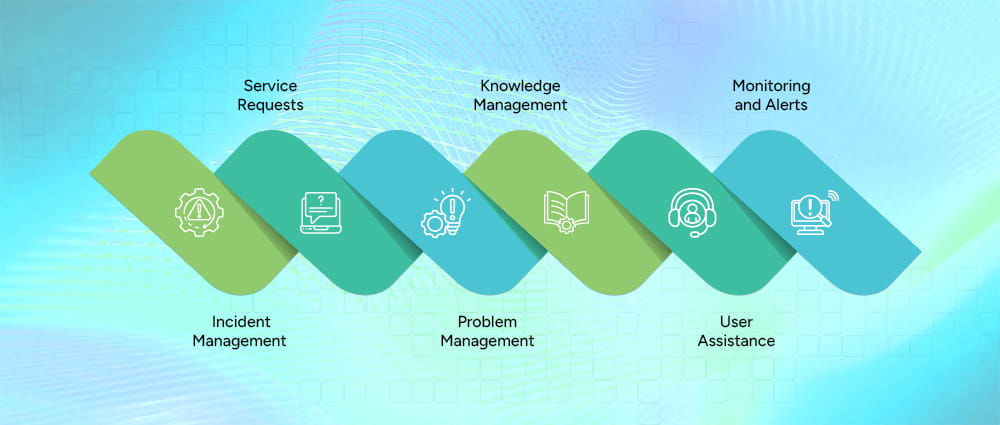
As mentioned above, an IT helpdesk is the central point of contact for all technology-related queries and issue resolution within an organization. The core functions of an IT help desk revolve around ensuring smooth IT operations.
Some of the main functions of an IT help desk are:
In the event of an incident, IT teams quickly identify and resolve user-reported issues to restore normal operations as fast as possible, reducing employee downtime and business disruptions.
There can be many employee requests for hardware or software. They send these service requests to the IT team, which manages everyday IT requests, including password resets, software installations, system access, and hardware upgrades, ensuring employees have what they need to work efficiently.
In this, your IT help desk services analyze recurring or complex issues to find the root cause and apply permanent fixes, helping prevent the same problems from happening again.
Through knowledge management, the team builds and maintains a centralized library of solutions, FAQs, and troubleshooting guides, enabling faster resolution of common issues in the future.
Like your customers need customer service, your employees, users, and team also require User Assistance. Your IT helpdesk service is primarily there for this function. They provide timely, real-time support via chat, email, or phone to guide users through technical issues and improve their overall experience.
Your IT service team continuously monitors systems, networks, and applications, sending alerts when potential issues arise so teams can act before failures impact users.
Essentially, an IT help desk fills the gap between technology and users, ensuring business operations stay uninterrupted.
Fundamentally speaking, an IT help desk software is a centralized platform that the IT team uses to manage, track, prioritize, and resolve technical issues reported by employees and users. Modern IT helpdesks rely heavily on specialized software to streamline support. Most IT help desk services use tools and software with the following features:
Efficiently log, track, and prioritize user issues from multiple channels such as email, chats, or web portals. Advanced ticketing systems can actually automatically categorize tickets, assign them to the right technician, and track progress until resolution, ensuring no request is lost or delayed.
AI-powered bots and workflows can handle repetitive tasks, such as password resets, software installations, and basic troubleshooting, freeing human agents to handle complex problems.
Allow users to solve common problems themselves through searchable knowledge bases, FAQs, and step-by-step guides. Self-service portals not only save IT staff time but also increase user satisfaction by providing instant solutions.
You can get easy-to-read reports showing things like how fast issues are being resolved, how many tickets are coming in, and any recurring problems. These insights help IT teams work smarter, improve performance, and fix issues before they become bigger problems.
Connect and work seamlessly with other business software, such as CRM or ERP systems, collaboration tools (Slack, Teams), and monitoring systems.
Provide technical support without physically being on-site, which is essential for distributed or remote teams. Remote access enables IT staff to troubleshoot devices, install updates, or fix configurations securely from anywhere, especially good for outsourced IT services.
Ensure secure handling of sensitive company data and compliance with regulations such as GDPR, HIPAA, and SOC 2. Features like role-based access, encryption, and audit logs protect information and maintain accountability.
Adapt workflows, ticket forms, dashboards, and automation rules to fit the organization’s needs. Scalable solutions grow with the business, supporting more users, devices, and complex processes as requirements evolve.
With these tools, companies can enhance efficiency, reduce downtime, and deliver consistent IT help desk benefits to employees and customers alike.
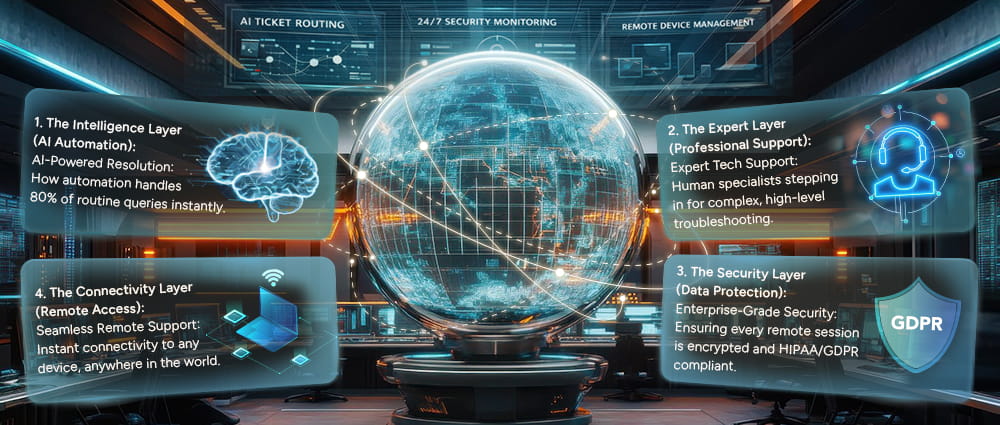
Outsourcing IT support is no longer just a cost-saving tactic—it’s a strategic decision for companies aiming to scale and innovate. Here are six reasons why outsourced IT services will be crucial in 2026.
According to studies, IT helpdesk outsourcing has grown rapidly over the past few years, and the global market is expected to jump from around $10 billion in 2024 to $18.3 billion by 2033.
Help desk outsourcing is set to keep growing, with 91% of organizations planning to either maintain (56%) or increase (36%) the work they outsource. This means that the IT help desk outsourcing market has matured, making it easier for businesses to rely on proven external solutions instead of building in-house teams.
This convenience makes outsourcing a smart and attractive choice, and businesses are able to focus on core operations while ensuring seamless IT support.
Maintaining an internal IT team can be expensive due to salaries, training, and infrastructure costs, and well, the turnover rate mentioned above isn’t helping companies scale either.
Outsourcing to lower-cost regions like Asia and Latin America cuts both labor costs and the extra expenses of hiring, training, and keeping in-house staff. Plus, top providers offer flexible pricing, so companies can easily scale services up or down as needed.
Outsourcing IT help desk services allows businesses to convert fixed costs into flexible expenses. Companies pay for services as needed, optimizing budgets without compromising quality.
By 2026, AI and automation will play an even bigger role in IT support. Chatbots, predictive analytics, and AI-driven ticket routing help resolve issues quickly while enhancing the user experience.
One 2025 report by CallMiner CX Landscape found that almost all (96%) customer experience and contact center providers see using AI, including Generative and Agentic AI, as a crucial part of their success strategy.
Automated tools ensure that routine problems are addressed instantly, allowing human agents to focus on complex cases.
Outsourced IT help desk teams handle day-to-day issues, freeing internal IT staff to focus on strategic initiatives like software upgrades, network optimization, and cybersecurity.
However, most employees are quite frustrated with IT responses and prefer to solve their problems themselves. This means that IT services need quite a lot of improvement. This is one of the reasons why, in 2026, Managed IT services or IT service management (ITSM) is focusing on resolving issues faster and improving the overall user experience.
In this environment, companies are outsourcing their service desks to cut costs and deliver better support than they could in-house. Nearly 80% of organizations say their service is now better than when handled internally.
This improves overall IT help desk benefits, driving higher productivity across the organization.
Traditional Service Level Agreements (SLAs) focus on speed and resolution, but Experience Level Agreements (XLAs) prioritize user satisfaction.
Zendesk reports that 87% of IT leaders say experience-level agreements (XLAs) help them pinpoint areas where support can improve, with employee satisfaction being the top measure of service quality.
This is why outsourced IT helpdesk providers are increasingly adopting XLAs to ensure that employees feel supported, improving morale and efficiency.
Swarming support is a collaborative problem-solving approach where multiple experts tackle complex tickets simultaneously.
The traditional three-tier service desk, made up of generalists, technicians, and subject matter experts (SMEs), can slow things down for complex issues. Each handoff adds delays, increases costs, and reduces productivity. In fact, as tickets move up the levels, employee downtime can jump from 2 hours to an average of 9 hours and 28 minutes according to HappySignals.
Fast and efficient ticket handling is essential to keep employees happy and productive. That is why many help desk providers are turning to swarming for urgent or complex problems.
Swarming is a modern IT support approach where experts from different teams collaborate right from the start to solve issues quickly. It works especially well for time-sensitive or cross-functional problems, avoiding the delays and frustration that come with the traditional tiered model.
This method reduces resolution time and ensures higher success rates, giving businesses a competitive edge in fast-paced markets.
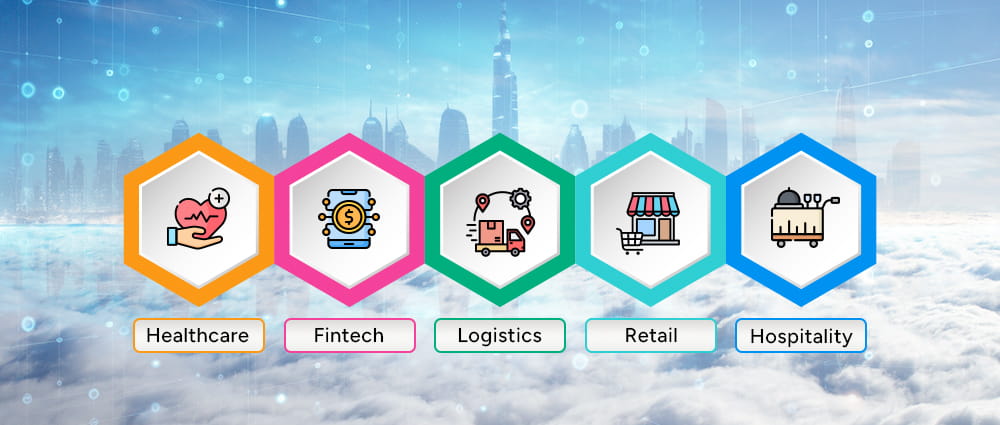
Several industries are adopting outsourced IT services to address unique challenges in 2026. Here’s a look:
The healthcare sector relies heavily on digital systems, from patient records to telemedicine platforms. Healthcare IT support ensures that hospitals and clinics maintain uptime, secure patient data, and provide uninterrupted care.
Outsourcing IT help desk services allows healthcare providers to focus on patient outcomes rather than tech issues.
Financial technology companies operate in highly regulated environments. Banking IT infrastructure and support for fintech platforms require precision, speed, and security.
Partnering with a fintech software development company offering IT help desk services ensures seamless transactions, cybersecurity, and minimal downtime.
Logistics operations depend on real-time tracking and system reliability. Logistics IT support ensures that shipments, inventory, and fleet management systems run smoothly, reducing operational bottlenecks and improving customer satisfaction.
Retailers are moving towards omnichannel experiences, which require constant IT support. Retail IT solutions and retail IT support help maintain e-commerce platforms, point-of-sale systems, and inventory management tools, ensuring a seamless shopping experience for customers.
Hotels and travel services are increasingly digital, using booking platforms, property management systems, and guest apps. Hospitality IT support ensures these systems function without interruption, enhancing guest satisfaction and operational efficiency.
As businesses evolve, partnering with the right IT helpdesk provider can make all the difference. Here, at Arpatech, we offer customized IT help desk services for each business we work with, designed specifically to meet the demands of 2026.
Two of the most important reasons why partnering with us can benefit your business for the better are:
Arpatech provides bespoke IT helpdesk solutions for businesses of all sizes. From SMEs to large enterprises, our team adapts support strategies to align with your goals, ensuring faster resolutions and improved efficiency.
With remote work becoming standard, Arpatech’s IT help desk for professional tech support ensures round-the-clock assistance, robust cybersecurity measures, and compliance with global standards. Businesses can rely on secure, efficient, and scalable IT support.
In 2026, the role of the IT help desk will be more critical than ever. Whether through outsourced IT services or in-house teams, companies that invest in reliable IT support will enjoy higher productivity, better user experience, and a competitive advantage in their industries.
By embracing automation, AI, and modern IT help desk software, businesses can resolve issues faster, reduce costs, and focus on innovation. Partnering with the IT Help Desk Support Services at Arpatech, you can ensure that your IT infrastructure remains robust, secure, and future-ready.
An IT help desk is no longer just a support function; it is a strategic tool for growth, efficiency, and operational resilience.
Choosing the right IT helpdesk service comes down to your company’s specific needs. At Arpatech, we recommend looking for a provider that offers:
A good IT help desk should not only fix problems fast but also help your team stay productive and satisfied.
While the terms are often used interchangeably, there is a difference:
Help Desk: Focuses on resolving technical issues like password resets, software problems, and hardware troubleshooting. It’s mostly reactive.
Service Desk: Offers a broader approach, including IT service management (ITSM), process improvements, and proactive support. It can handle incidents, service requests, change management, and reporting.
Many companies make these mistakes when setting up an IT helpdesk:
Arpatech helps companies avoid these pitfalls by providing easy-to-use platforms, optimized workflows, and actionable reporting from day one.
Internal Help Desk: Handles IT issues within your organization, supporting employees with devices, software, and network problems.
Technical Support: Can refer to broader support, including external customers, product troubleshooting, or specialized tech services.


Before we begin, please solve this quick math check to confirm you're human, and you'll be all set to start chatting with our AI assistant.
Stay connected with us to receive the latest information, updates, and insights from our world of innovation.
By entering your email address you will receive promotional updates.


© 2026 ARPATECH (ADVANCED RESEARCH PROJECTS & TECHNOLOGY)