If you’re a CISO or a senior security leader in 2026, there’s a good chance you’ve sat in a budget meeting recently and had to answer a very uncomfortable question: “Do we really need to build our own Security Operations Center, or should we just outsource it?”
It’s not a simple question.
The pressure coming from every direction has never been more intense. Ransomware attacks are faster and more automated than ever. The CrowdStrike 2026 Global Threat Report documented an average attacker breakout time of just 29 minutes in 2025, meaning that’s how long it takes a threat actor to move from initial access to lateral movement across your systems.
That’s not a comfortable margin. And with AI-powered attacks now automating the early stages of intrusion, that window is only going to keep shrinking, which is why we need governance and risk management.
At the same time, the talent market is a disaster. The global cybersecurity staffing gap has reached 4.8 million unfilled positions according to ISC2’s latest workforce study, with over 500,000 of those vacancies sitting in the United States alone. Regulatory requirements are tightening. Budgets are being scrutinized like never before. And you’re expected to deliver 24/7 protection while somehow keeping everyone on your team from burning out and walking out the door.
So the in-house vs. managed SOC debate is no longer purely philosophical. In 2026, it’s one of the most consequential operational decisions a security leader will make.
This guide walks CISOs through the real cost comparison, talent challenges, compliance considerations, and a practical decision checklist for choosing the right SOC model in 2026
Before diving into the comparison, it’s worth grounding the conversation for any stakeholders who may not live in this world every day.
A security operations center (SOC) is a centralized function: either a physical team room or a virtual capability, staffed by security analysts who monitor, detect, investigate, and respond to cybersecurity threats around the clock. A SOC is the operational nerve center of your security program. It’s where SIEM alerts get triaged, where incident response kicks off, where threat hunters look for adversary behavior that automated tools might miss, and where your compliance monitoring gets turned into actionable intelligence.
The core tools inside a SOC typically include a Security Information and Event Management (SIEM) platform, Security Orchestration, Automation and Response (SOAR) capabilities, Endpoint Detection and Response (EDR) or Extended Detection and Response (XDR), and network detection tools. Managing all of this, and keeping it staffed is the operational challenge that makes the build vs. buy question so relevant.
A managed SOC, sometimes called SOC as a service or security operations center as a service, is essentially what it sounds like: you engage a third-party managed security services provider (MSSP) who brings their own analysts, tools, infrastructure, and processes to monitor and protect your environment. You get the output of a fully staffed SOC without having to build or staff one yourself.
The question every CISO has to answer is which approach actually makes more sense for their specific organization in 2026.
The Numbers Nobody Puts in the First Slide.
Let’s start with what it actually costs to build and operate your own security operations center, because internal budget proposals almost always undercount the true total.
The highest cost in running a SOC is people.
To truly operate 24/7, you need three shifts every day of the week. You also need extra staff to cover sick days, vacations, and training. This means building a fairly large team just to keep monitoring continuously and reliably.
Then comes the technology. A modern SOC depends on multiple security tools working together, along with the infrastructure needed to run them. As your environment grows, the effort and expense to maintain these tools also grow.
Recruiting and training are often overlooked. Hiring and preparing security analysts takes time, effort, and resources. On top of that, many SOC analysts leave their jobs after a short period due to burnout. This means you are frequently replacing team members, and each departure takes valuable experience and knowledge with it.
The all-in number for a mid-sized organization building a true in-house SOC lands between $1.2 million and $2.5 million per year. Enterprise-level operations with more complex environments can run $4 million or more annually when you factor in everything.
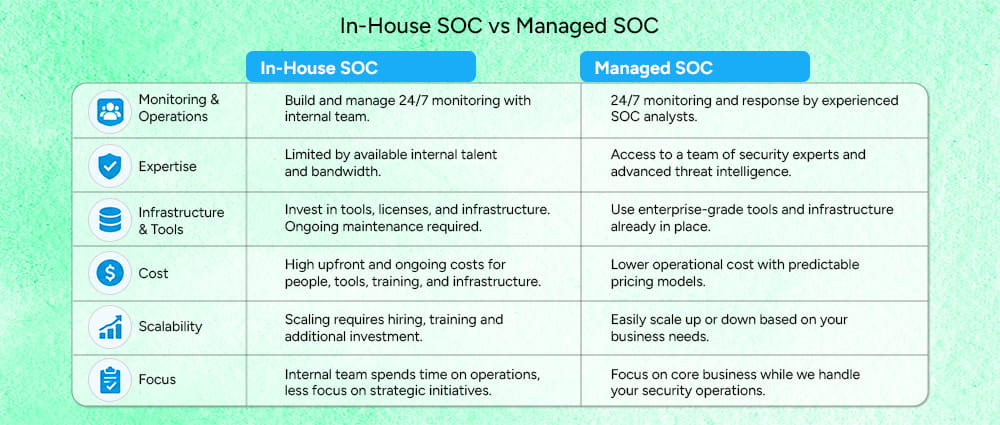
Managed SOC services in 2026 are priced primarily on a subscription model, typically based on the number of endpoints monitored, the volume of data ingested, or user counts, depending on the provider’s model.
For organizations with 200 to 2,000 employees, market pricing generally runs between $5,000 and $25,000 per month, or $60,000 to $300,000 annually. For a mid-market company, this translates to roughly $120,000 to $720,000 per year, depending on scope, endpoint count, and compliance requirements.
The bottom line on cost comparison: managed SOC services tend to cost 30 to 50 percent less than building a comparable in-house SOC, once staffing, tooling, and turnover costs are fully accounted for. A 2026 analysis of mid-sized organizations found that managed SOC services cost approximately $630,000 to $965,000 less annually than in-house operations. Organizations implementing outsourced managed security services have reported saving an average of $2.22 million compared to maintaining internal security teams.
Those are not small numbers.
The cost advantage of managed SOC is compelling on its own. But in 2026, the talent problem is just as important, and it’s getting worse, not better.
The numbers tell a brutal story. The global cybersecurity workforce would need to nearly double just to fill every open role today. That’s not a rounding error; it’s a structural crisis that’s been building for years and shows no signs of slowing down.
What’s making it worse is that the hiring barrier has shifted. It’s no longer just about finding qualified people. Budget cuts have now become the bigger obstacle, meaning many organizations have the job postings ready but simply can’t afford to pay what the market demands. They want to hire. They just can’t.
And the consequences are showing up in real incidents. According to the 2026 SANS/GIAC Cybersecurity Workforce Research Report, 88% of organizations experienced a significant security incident in the past year that they directly tied to not having enough skilled people on staff. The skills gap isn’t an HR problem anymore. It’s a security failure waiting to happen.
Then there’s burnout, and inside SOC teams, it’s a crisis of its own. According to Sophos research, here’s what the average SOC team looks like right now:
What does this mean practically? Even if you successfully build your SOC team, you’re essentially managing a revolving door. You’re constantly recruiting. You’re losing institutional knowledge every time someone walks out.
And in a competitive labor market, a larger organization with a bigger brand and a higher salary budget can simply outbid you for the same candidates.
A managed security services provider operates differently. Their scale lets them attract, develop, and retain analysts in ways a single mid-sized business simply can’t match.
Those analysts work across dozens of client environments, which means they’re exposed to a wider range of attack scenarios and threat patterns than any in-house team would typically see.
The practical result is that the analyst quality you get through a managed engagement is often higher than what you could realistically hire and keep on your own.
To be fair to the other side of the argument, because this is a CISO’s decision framework, not a managed SOC sales pitch, there are real scenarios where building in-house makes sense.
If you’re operating at a scale where you can sustain the headcount, the tool spend, and the leadership infrastructure, an in-house SOC gives you maximum control, full customization of detection logic, and the ability to build institutional knowledge that’s deeply tailored to your environment.
Defense contractors, certain government agencies, and organizations dealing with classified data sometimes face constraints that make third-party access to their environments impractical or legally prohibited. In those cases, you don’t really have a choice: you build in-house.
If you have a strong Director of Security Operations and an established detection engineering capability, you may be past the tipping point where building makes more sense than buying. The investment has already been made in people and process.
Some organizations have such unique environments: bespoke industrial systems, highly specialized regulatory requirements, or niche technology stacks, that a generalist managed provider simply can’t deliver the detection depth you need.
Outside of these scenarios, however, the calculus for most mid-sized US organizations has shifted considerably toward managed SOC services.
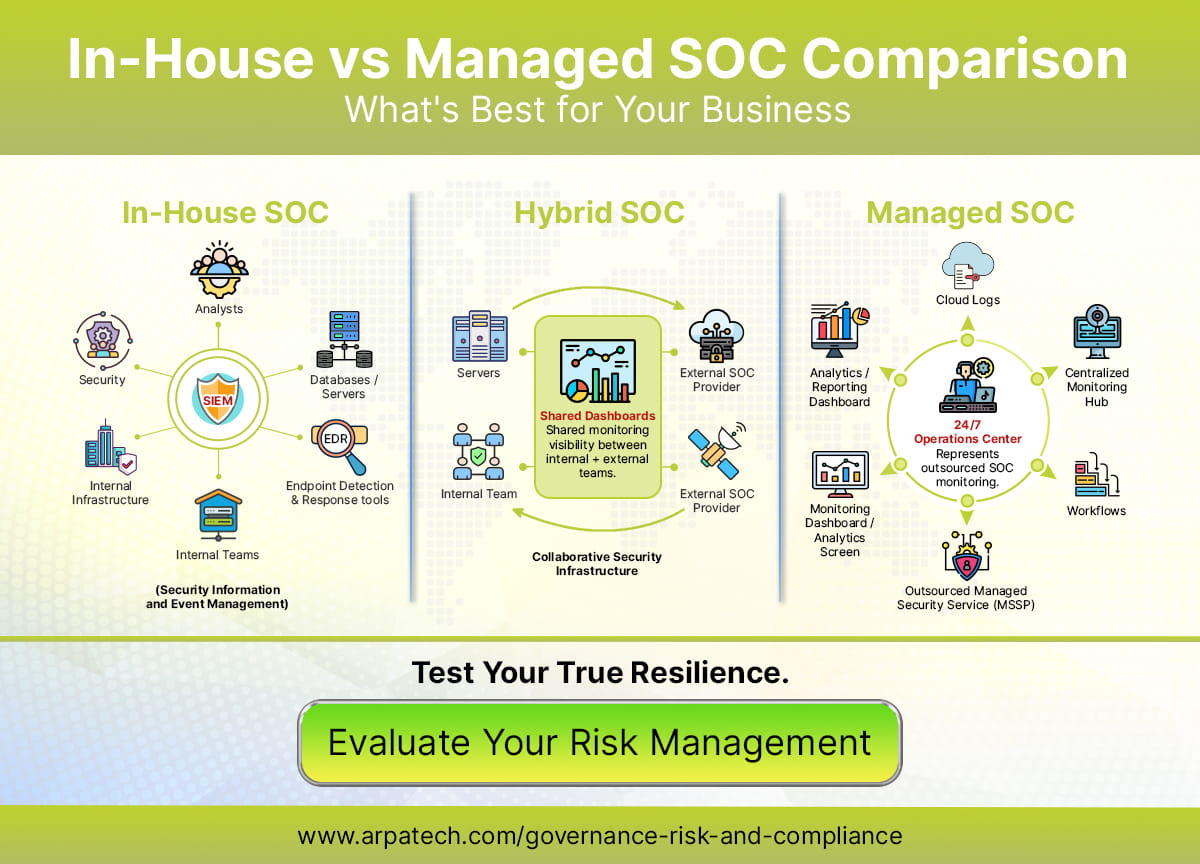
Rather than making this a pure cost comparison, here’s how to think through the full set of considerations that should drive your decision.
A two-hour gap in analyst coverage on a Saturday night isn’t a compliance problem: it’s how a contained incident becomes a breach. True 24/7 monitoring requires significant headcount and shift scheduling that most mid-sized organizations struggle to sustain. Managed SOC providers operate under SLA commitments, typically promising a response within 15 to 60 minutes, depending on severity. And because they’re monitoring your environment with AI-assisted tooling and cross-client threat intelligence, they often detect threats faster, even with that SLA window.
Managed security services increasingly include compliance automation capabilities that address frameworks like SOC 2, HIPAA, CMMC, and others. Organizations with managed SOC coverage typically see 15 to 30% reductions in cyber insurance premiums, partly because carriers are increasingly requiring evidence of 24/7 SOC monitoring as a baseline policy condition. The compliance lift from a managed provider can be substantial, and often more defensible in an audit than a self-attested in-house program.
An in-house SOC typically requires 6 to 18 months to reach operational maturity. That’s 6 to 18 months of exposure during a period when you’re building processes, tuning detection rules, and getting your analysts up to speed. Managed SOC providers come pre-built. Most can onboard a new client in 30 days or less.
If your organization is growing, expanding into new cloud environments, or making acquisitions, a managed SOC can scale with you without requiring you to hire and train new analysts every time. An in-house SOC is somewhat rigid: scaling up means a hiring cycle that could take months.
This is a legitimate concern with managed providers. How much visibility do you get into what they’re actually doing? The better providers offer full investigation transparency, observable actions, and regular reporting that gives you genuine insight into your security posture.
When evaluating a managed security services SOC provider, transparency into detection logic and incident workflow should be a non-negotiable requirement.
It’s worth noting that the choice isn’t always binary. Many mid-sized organizations in 2026 are running a hybrid model: a small internal team handles governance, compliance oversight, strategic risk management, and vendor oversight, while the managed provider covers 24/7 monitoring and response.
This isn’t a compromise: it’s often the most practical model for organizations that have outgrown a purely reactive posture but can’t justify the headcount for a full internal SOC. According to recent industry data, 43% of organizations now outsource parts of their security operations. The managed layer adds capacity and specialized capability where the internal team has gaps, without giving up all strategic ownership.
The hybrid approach works particularly well when:
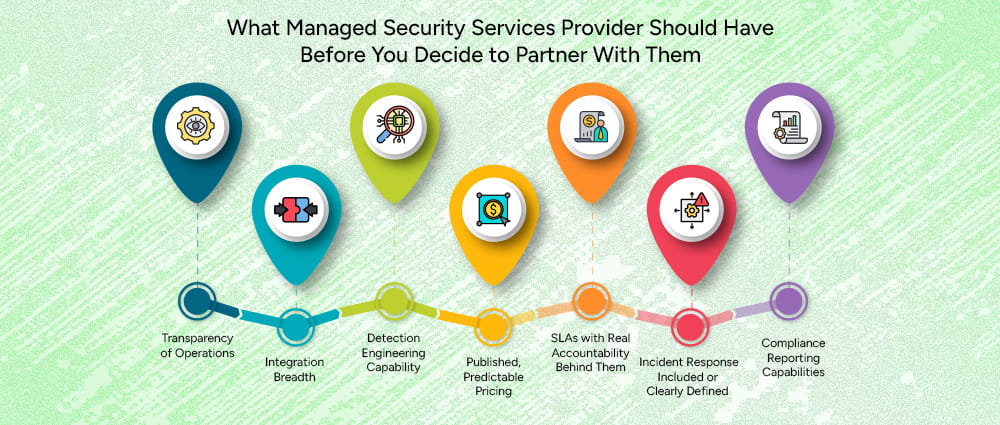
If you’re leaning toward managed SOC services, the provider selection process matters enormously. The market has become crowded, and not every provider delivers what it promises. Here’s what to vet rigorously:
Can you see what your analysts are doing, what alerts they’re prioritizing, and how they’re resolving incidents? Opacity is a red flag. You need to be able to see the entire process.
A good managed security services provider should be able to integrate with your existing tool stack, not require you to rip and replace everything. Look for vendors with broad integration libraries.
Are they doing custom detection work for your environment, or just applying a generic ruleset? The best providers tune detection logic during onboarding.
Hidden ingestion fees and per-ticket charges can turn a seemingly affordable contract into a budget problem. Demand transparent pricing before you sign.
Mean time to detect (MTTD) and mean time to respond (MTTR) should be contractually committed, not just aspirational.
What happens when something major occurs? Do they have an IR team, or do they just hand you a report and wish you luck?
If you’re in a regulated industry, confirm that their reporting outputs actually map to your framework requirements.
One of the hardest parts of this conversation for CISOs is making the financial case internally. Here’s how to frame it.
The global average cost of a single data breach reached $4.44 million in 2025. In the United States, that number climbed to $10.22 million. Organizations with significant security staffing shortages pay nearly $2 million more per breach than well-staffed peers. Meanwhile, organizations that make extensive use of security AI and automation- the kind that’s embedded in modern managed SOC platforms- save an average of $2.2 million in data breach costs and identify and contain breaches nearly 100 days faster.
A managed SOC that prevents even one major incident pays for itself multiple times over.
There’s also the insurance angle. Cyber insurers are increasingly requiring evidence of 24/7 SOC monitoring, documented incident response capability, and measurable MTTD/MTTR as baseline underwriting conditions. Organizations with managed SOC coverage typically see 15 to 30% premium reductions. The cost savings on insurance alone can offset a meaningful portion of a managed SOC contract.
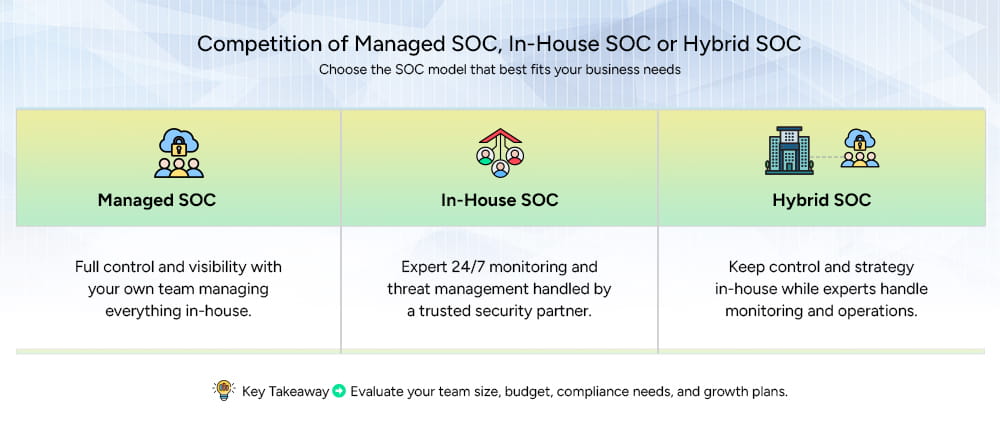
Here’s a practical checklist to help you organize your thinking:
In 2026, the question isn’t whether your organization needs a security operations center. The threat environment has settled that debate. The question is which operating model actually reduces risk, fits your budget, and gives you the resilience to sustain security operations over time: not just during a good staffing year.
For most mid-sized US organizations, managed SOC services deliver faster detection, more consistent response, lower operational burden, predictable costs, and fewer security blind spots. The talent market is too difficult, the burnout rates are too high, and the cost differential is too significant to ignore.
That’s where a partner like Arpatech comes in. For organizations that need more than just monitoring, Arpatech’s Governance, Risk, and Compliance (GRC) services help security leaders build the structural foundation that makes a managed SOC investment actually stick.
Detection and response are only part of the equation. Without a clear governance framework, a documented risk posture, and compliance controls that map to your regulatory obligations, even the best SOC is operating without a blueprint.
Arpatech mitigates that gap, helping mid-sized organizations align their security operations with business risk, satisfy auditors and insurers, and make confident, board-ready decisions about where to invest next.
Make sure someone’s watching. And make sure there’s a program built to last.
Not always.
Many people assume that keeping a SOC in-house makes compliance easier because everything stays under your direct control. In reality, compliance is about process, visibility, documentation, and response, not just location.
A well-run outsourced SOC can meet the same compliance requirements, and often does it more consistently because monitoring, logging, and reporting are handled by specialists who do this every day.
How Arpatech helps:
Arpatech helps you map your SOC operations directly to your compliance needs. Whether your SOC is in-house, outsourced, or hybrid, we make sure the monitoring, reporting, and documentation align with standards like SOC 2, ISO 27001, HIPAA, and others.
for more information, visit our trust center.
The biggest risk is loss of context.
An external SOC team may not fully understand your business, your systems, or what “normal” looks like in your environment. This can lead to slower investigations, false alarms, or missed signals if knowledge transfer is weak.
This risk is not about capability. It is about communication and integration.
Arpatech works as a bridge between your internal teams and the MSSP. We document your environment, workflows, and risk areas so the external SOC is never working in the dark. We ensure proper onboarding, playbooks, and continuous knowledge sharing so your outsourced SOC operates with full context.
A hybrid SOC works best when you want control and expertise at the same time.
This model is ideal when:
In this setup, the external SOC handles monitoring and alerts, while your internal team handles decisions and responses.
At Arpatech, we help you design and implement hybrid SOC models. We define who does what, set up the tools, create the response workflows, and make sure your internal team and the external SOC operate as one unit instead of two separate teams.

Before we begin, please solve this quick math check to confirm you're human, and you'll be all set to start chatting with our AI assistant.
Stay connected with us to receive the latest information, updates, and insights from our world of innovation.
By entering your email address you will receive promotional updates.


© 2026 ARPATECH (ADVANCED RESEARCH PROJECTS & TECHNOLOGY)