When your business needs technical talent or IT expertise, two engagement models dominate the conversation: staff augmentation vs managed services. Both allow companies to access external skills without building everything from scratch internally, but they work very differently, serve different goals, and suit different business situations.
IT Staff augmentation services, at its core, is the practice of temporarily expanding your in-house team with external professionals who work under your direct supervision. Managed services, on the other hand, involve handing over entire functions or processes to a third-party provider who takes full ownership and accountability.
Choosing the wrong model can cost you time, money, and momentum. Choose the right one, and you unlock faster delivery, better expertise, and a more scalable operation. According to the Deloitte Global Outsourcing Survey 2024, access to specialized talent has now overtaken cost reduction as the top driver for outsourcing, with only 34% of executives citing cost as their primary reason, down from 70% in 2020, making the choice of engagement model more consequential than ever.
From startups looking to ship faster to enterprises managing complex digital transformations, IT staff augmentation offers a flexible and results-driven model that traditional recruitment simply cannot match.
In this blog, we’ll cover:
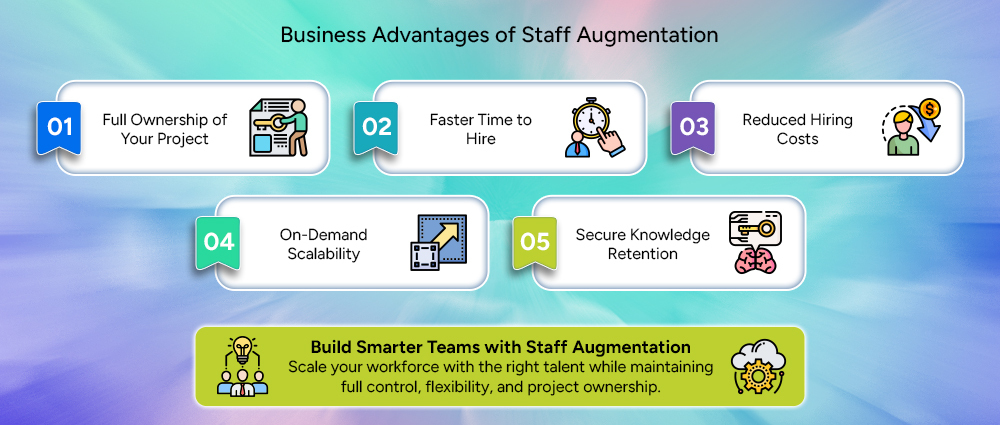
Staff augmentation is a flexible outsourcing model where businesses hire skilled external professionals on a temporary or project basis to supplement their existing workforce. These professionals integrate directly into your team, follow your processes, and report to your internal managers; they are simply not on your permanent payroll.
In practical terms, Staff Augmentation goes beyond just hiring contractors. It’s a deliberate strategy for scaling your team’s capability without scaling your headcount permanently. The augmented professionals become a working extension of your internal team; attending standups, following your sprint cycles, and contributing to your codebase or systems as if they were full-time employees, just without the long-term cost and commitment that comes with permanent hiring.
When it comes to talking about staff augmentation vs managed services, Staff augmentation means when businesses need to move fast on a technical challenge, bringing in external technology professionals, developers, DevOps engineers, QA testers, cloud architects, cybersecurity specialists, and more to fill gaps within your existing IT team. Businesses typically turn to IT staff augmentation services when they have a surge in workload, a specialized project requirement, or a skill that isn’t available internally.
For example, a company migrating to the cloud may not have in-house cloud engineers but doesn’t want to go through the lengthy process of hiring full-time employees. An IT staff augmentation service provider supplies qualified engineers who join the team seamlessly and get to work immediately under the client’s direction, using the client’s tools, aligned with the client’s goals. See how this kind of targeted technical placement drove results in Arpatech’s seamless data integration with blockchain-backed data engine case study.
Software development staff augmentation is a more targeted version of the model, focused entirely on adding development talent to your existing product or engineering teams. If you want to see how businesses practically leverage this approach in real projects, you can explore this detailed guide on how to take advantage of staff augmentation in software development.
The key distinction from outsourcing an entire project is that your internal team retains full technical ownership. Augmented developers follow your codebase standards, attend your standups, and report to your CTO or tech leads. You get the speed and skills of external hiring without losing project visibility or control.
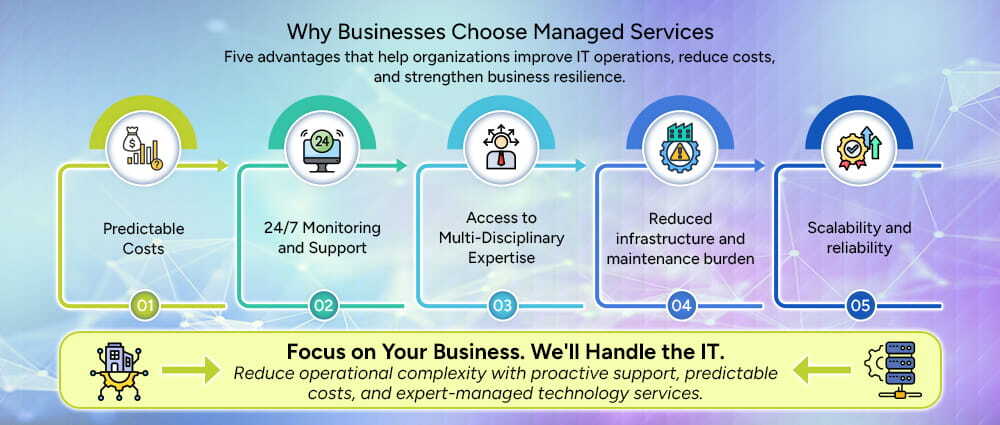
Sometimes people can get confused between staff augmentation vs managed services, so it is important to know what Managed Services are. A model where a business entrusts specific IT functions or operations to an external provider called a Managed Service Provider (MSP). While staff augmentation extends your team under your management, managed services go a step further. The provider takes full ownership of the function, the people, and the outcomes.
Examples of managed services include managed cloud services (where a provider handles your cloud infrastructure, monitoring, and optimization), managed cybersecurity, managed helpdesk support, managed DevOps, and more. Cloud managed services, in particular, have seen enormous growth as businesses shift workloads to AWS, Azure, and GCP and need expert management without building in-house cloud teams. See how this played out in Arpatech’s automating Azure virtual desktops case study, where managed cloud delivery kept operations running without adding internal headcount.
The relationship with an MSP is typically governed by a Service Level Agreement (SLA), which defines what the provider will deliver, the response times expected, and the performance metrics they are responsible for.
| Factor | Staff Augmentation | Managed Services |
| Control | Client retains full control | Provider takes operational ownership |
| Responsibility | Client is responsible for outcomes | Provider is accountable for results |
| Engagement Type | Project-based or temporary | Ongoing, long-term relationship |
| Pricing Model | Hourly, daily, or monthly per resource | Fixed monthly fee or subscription |
| Team Management | Managed by the client | Managed entirely by the provider |
| Flexibility | High-scale individual roles as needed | Moderate is defined within the service scope |
| Best For | Specific skill gaps, project bursts | Continuous operations, full IT functions |
| Knowledge Ownership | Stays with the client | Can remain with the provider unless mitigated |
Staff augmentation is the right model when your business has a clear internal direction but needs extra hands or niche skills to execute it. If you want to understand some of the common myths about staff augmentation. Here are the scenarios where it shines:
Managed services are the better choice when you need consistent, reliable delivery of a function over time and you’d rather focus your internal resources elsewhere. These are the indicators:
Deciding between these two models isn’t about which is objectively better; it’s about which is right for your business right now. Here’s a practical framework:
Are you trying to build something (product, feature, system)? Staff augmentation. Are you trying to operate something reliably ongoing (infrastructure, security, support)? Managed services.
The strength of your existing technical leadership plays a major role in this decision. If you have experienced managers who can direct and oversee external contributors, staff augmentation is a natural fit. If your business lacks that internal technical management layer, managed services is the better choice as it removes that dependency entirely and places accountability with the provider.
The duration of your need is a strong indicator of which model fits best. For short-term projects or workload surges, staff augmentation gives you the flexibility to bring in talent quickly and release them when the work is done. For ongoing operational needs, managed services deliver the long-term stability and SLA-backed accountability your business requires.
If your spending is tied to specific projects and naturally varies over time, staff augmentation pricing gives you the flexibility to pay for what you need when you need it. If you require a fixed, consistent budget line for IT operations, managed it services pricing offers predictable monthly pricing that makes financial planning significantly easier.
If your business requires guaranteed uptime, SLA-backed security, or regulatory compliance assurance, managed services is the stronger choice as it formally transfers that operational risk to the provider. If your internal team is well-equipped to manage and mitigate risk on its own, staff augmentation keeps control and accountability where you are most comfortable, within your organization.
Growing tech teams rarely fit neatly into one model. Most start with IT staff augmentation to move fast on product development, pulling in the specialized talent they need without committing to permanent hires. Over time, as operational workloads across cloud infrastructure, security, and support become too consistent and demanding to handle flexibly, managed services step in to cover those functions reliably and continuously.
Consider a product startup that uses software development staff augmentation to build its MVP while relying on managed cloud services to oversee DevOps and infrastructure. Engineers remain focused on building the product, operations run smoothly in the background, and leadership has confidence in delivery on both sides. For growing teams, the most important takeaway is to be proactive. Map out which functions require internal ownership and which can be handed off, and make that resourcing decision before capacity becomes a crisis.
Both staff augmentation and managed services address the same core challenge of accessing expertise that does not exist internally, but they approach it in very different ways. Staff augmentation keeps control in your hands, extends your existing team, and delivers the flexibility needed for project-specific or skill-specific demands. Managed services transfers operational responsibility to a dedicated provider, ensures continuous and reliable delivery, and allows your internal team to direct their energy toward the goals and initiatives that matter most to your business.
Neither model is inherently better than the other in the staff augmentation vs managed services debate. The right choice is shaped by your goals, internal capacity, budget preferences, and the type of work involved. As your business scales, your needs will evolve, and so will the way you leverage both models to drive growth and operational efficiency.
For businesses looking to bridge skill gaps and move faster on delivery, IT staff augmentation with Arpatech is the lever that makes it possible without the overhead of permanent hiring
Ready to build a team that moves as fast as your business? Contact Arpatech today, and let’s get started.
Staff augmentation adds skilled external professionals to your existing team who work directly under your management, follow your processes, and contribute to your projects just like an internal hire would, without the permanent headcount commitment. The client retains full control over direction, workflow, and outcomes at every stage of the engagement.
Managed services, on the other hand, outsource an entire IT function to a third-party provider who takes full ownership of delivering defined outcomes. The core difference in the staff augmentation vs managed services comparison comes down to control and accountability — with staff augmentation you retain both, and with managed services you transfer them to a provider who is contractually bound to deliver results.
Companies should use staff augmentation when they have a specific short-term project, a skill gap on their existing team, a temporary capacity need, or when they want to retain direct management over technical work while still accessing external talent quickly.
It depends on your specific goals and priorities. Staff augmentation is a form of outsourcing that keeps management control firmly in your hands, allowing you to direct the work while still accessing external talent. Traditional project outsourcing transfers both the execution and the management responsibility to the provider. For businesses where control, flexibility, and retaining institutional knowledge are critical, staff augmentation has a clear advantage. For those seeking a hands-off, outcome-focused engagement, broader outsourcing or managed services is worth considering.
Absolutely. IT staff augmentation is particularly well-suited to startups because it provides access to senior technical talent without the cost and commitment of permanent hires. Startups can bring in experienced engineers to build an MVP, then scale down or pivot the team as needs evolve, maintaining agility while accessing enterprise-level skills.
Through staff augmentation, businesses can access a wide variety of technical roles depending on their project needs. Commonly hired roles include frontend, backend, and full-stack developers, mobile app developers, DevOps engineers, cloud architects, QA testers, cybersecurity specialists, data engineers, UI/UX designers, and project managers, among others. IT staff augmentation services make it possible to fill almost any role on demand without permanent hiring.


Before we begin, please solve this quick math check to confirm you're human, and you'll be all set to start chatting with our AI assistant.
Stay connected with us to receive the latest information, updates, and insights from our world of innovation.
By entering your email address you will receive promotional updates.


© 2026 ARPATECH (ADVANCED RESEARCH PROJECTS & TECHNOLOGY)