If you run a healthcare technology company in the US, you’ve probably heard both of these terms thrown around in the same breath: SOC 2 and HIPAA. Maybe a hospital client asked for your HIPAA compliance documents. Maybe a venture-backed buyer asked for your SOC 2 report before signing a contract. Maybe both happened in the same week, and now you’re wondering if you need one, the other, or both.
You’re not alone. This is one of the most common points of confusion for healthcare SaaS founders, CTOs, and compliance leads. SOC 2 and HIPAA both deal with protecting sensitive data, but they come from completely different places, serve different audiences, and carry very different consequences if you get them wrong.
This guide breaks down SOC 2 vs HIPAA compliance. We’ll cover:
We’ll also look at how working with the right HIPAA compliance consulting and SOC 2 compliance automation partner, and a dedicated Governance, Risk, and Compliance service built for exactly this kind of decision, can save you months of confusion and rework.
SOC 2 stands for System and Organization Controls 2. It’s a framework created by the American Institute of Certified Public Accountants (AICPA) that helps service organizations show their customers and partners that they take data security seriously.
Think of SOC 2 as a third-party seal of approval. An independent auditor examines your company’s internal controls, things like access management, data encryption, system monitoring, and incident response, and then issues a report confirming whether those controls are designed properly and, in the case of a SOC 2 Type 2 compliance audit, whether they actually worked as intended over a period of time (usually three to twelve months).
SOC 2 is built around five Trust Services Criteria:
Here’s something important: SOC 2 is not a pass-or-fail certification. There’s no “SOC 2 certified” badge you slap on your website. Instead, you get a detailed report that customers, investors, and partners can review to understand exactly how your security program works and how well it performed.
You’ll see people mention “SOC 2 Type 1” and “SOC 2 Type 2 compliance” like they’re interchangeable, but they’re not.
SOC 2 wasn’t built specifically for healthcare. It applies to any service organization that stores, processes, or transmits customer data, whether that’s a fintech app, a marketing platform, a cloud storage provider, or a healthcare SaaS company. Its purpose is to give customers confidence that a vendor has real, working security controls in place.
The scope of a SOC 2 audit is something your organization defines. You choose which Trust Services Criteria apply to your business and which systems, products, or services fall “in scope.” A small startup might scope their audit narrowly around a single product. A larger healthcare technology company might scope it around their entire infrastructure, including subprocessors and third-party vendors.
Because SOC 2 is principles-based rather than prescriptive, you get flexibility in how you meet each criterion. The tradeoff is that your auditor still has to agree your chosen controls genuinely satisfy the criteria, so vague or weak controls won’t pass review just because you wrote a policy about them.
You might be thinking, “We already have HIPAA, why would we need SOC 2 too?” Here’s why SOC 2 compliance still matters even in a healthcare context:
For healthcare technology companies specifically, SOC 2 compliance automation tools have made this process far less painful than it used to be. Instead of manually collecting evidence for every control, automated platforms continuously monitor your systems and pull evidence in real time, which cuts audit prep from months down to weeks in many cases.
HIPAA stands for the Health Insurance Portability and Accountability Act. It was signed into law in 1996, and unlike SOC 2, it’s not optional. HIPAA was signed in 1996, with the parts that matter most for modern software companies arriving later through the Privacy Rule in 2003 and the Security Rule in 2005, which was last substantively updated in 2013.
Healthcare organizations face some of the highest cybersecurity stakes, with the average cost of a healthcare data breach reaching $7.42 million, while more than 167 million Americans had their healthcare information exposed in 2023 alone. These figures underscore why healthcare organizations need both strong regulatory compliance through HIPAA and robust security controls that frameworks like SOC 2 help demonstrate and validate.
In simple terms, HIPAA is the federal law that protects patient health information. If your organization creates, receives, stores, or transmits anything that counts as protected health information, or PHI, you are very likely subject to HIPAA, whether you’re a hospital, an insurance company, a billing service, or a software vendor that touches patient data in any way.
PHI is any health information that can identify an individual, and HHS defines 18 specific identifiers that, when combined with health information, make that information PHI. This includes things like names, dates of birth, medical record numbers, and even IP addresses when tied to health data.
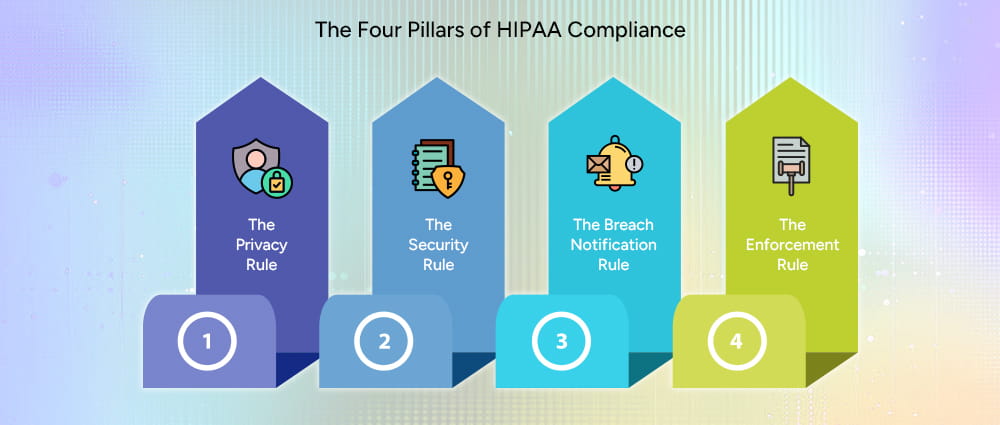
HIPAA is built around four core rules:
Unlike SOC 2, there’s no such thing as being “HIPAA certified.” You’re either compliant or you’re not, and you prove that compliance through documented policies, risk assessments, signed agreements, and audit-ready evidence rather than a single attestation report.
HIPAA exists to protect one of the most sensitive categories of personal data there is: a person’s health information. Before HIPAA, there were no consistent national standards for how that information had to be protected, which left patients vulnerable to having their medical history exposed, misused, or sold without any real accountability.
HIPAA’s scope is defined by who touches PHI, not by industry alone. Two types of organizations fall under its umbrella:
If your company is a business associate, HIPAA requires you to sign a Business Associate Agreement, or BAA, with every covered entity you work with. This agreement spells out exactly how you’ll protect PHI, what you’re allowed to do with it, and what happens if something goes wrong. There’s no equivalent requirement in SOC 2. This is one of the clearest dividing lines between the two frameworks.
One development worth watching closely if you’re building or scaling a healthcare software product: regulators have proposed tightening the HIPAA Security Rule considerably, removing the current distinction between “addressable” and “required” safeguards so that nearly everything becomes mandatory rather than optional. The proposed rule would also require AI tools to be included in risk analysis and risk management activities, which is a notable development for health AI startups. If finalized, this would raise the bar for HIPAA compliance for software development teams building AI-powered healthcare tools.
HIPAA isn’t just a regulatory checkbox. It directly impacts patient trust, legal exposure, and a healthcare technology company’s ability to operate at all.
This is exactly why so many healthcare technology companies turn to HIPAA compliance solutions and outside HIPAA compliance consulting early on, rather than trying to piece together a compliance program after they’ve already signed their first hospital client.
Let’s put the two side by side. Understanding these distinctions is the foundation of the entire SOC 2 vs HIPAA conversation.
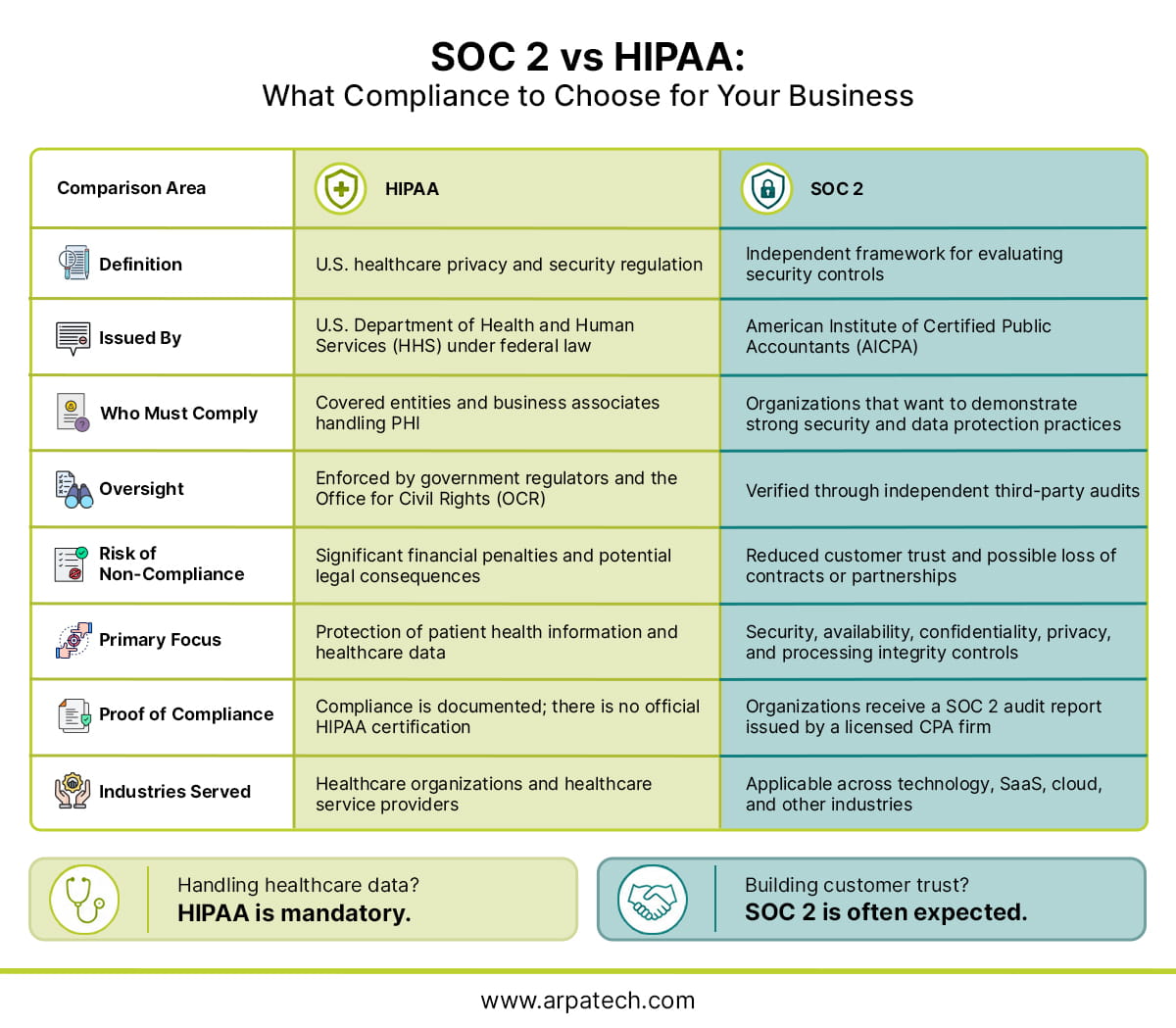
Despite their different origins, SOC 2 vs HIPAA aim at a lot of the same underlying goals, and that overlap is exactly why combining them is more efficient than handling them separately.
Both frameworks care about:
Both frameworks also exist for the same fundamental reason: to give other people (whether that’s patients, business partners, or customers) confidence that an organization is handling sensitive data responsibly. Neither one is a static, one-time achievement. Both require ongoing monitoring, regular reassessment, and continuous evidence collection to stay valid over time, which is exactly the kind of work that HIPAA Compliance Automation and SOC 2 compliance automation platforms are designed to support.
For a lot of healthcare technology companies, the honest answer is yes. Here’s a simple way to think it through.
Ask yourself two questions:
If you answered yes to the first question, HIPAA compliance isn’t optional. It’s a legal requirement, and skipping it puts your company at serious financial and operational risk. If you answered yes to the second question, you’ll need SOC 2 to keep deals moving forward, regardless of whether you’re in healthcare or not.
If both apply, and for many healthcare SaaS companies, telehealth platforms, EHR systems, and patient engagement tools, both absolutely do apply, then you need both frameworks running side by side. The “good” news, if there is any, is that you’re not starting from zero twice. Because so many controls overlap between the two (access management, encryption, audit logs, risk assessments), building both programs together is significantly less work than building them one after the other.
Some companies genuinely only need one or the other:
It’s easy to think of compliance as a cost center, something you do because you have to, not because it helps you. But pursuing SOC 2 and HIPAA compliance together can actually become a genuine competitive advantage for a healthcare technology company.
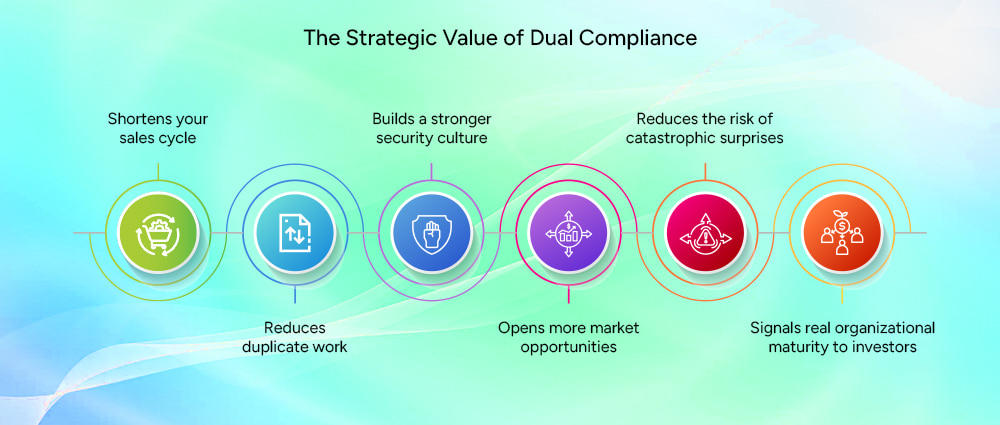
Here’s what dual compliance can do for your business:
The strategic upside is real, but only if the work is done thoughtfully. A rushed, checkbox-driven approach to either framework can leave you with a report or a policy binder that looks good on paper but falls apart the moment a real audit, breach, or regulator shows up.
So how do you actually decide what your company needs and how to get there? Here’s a practical way to approach it.
Start by mapping your data flows: Identify exactly where PHI enters, moves through, and exits your systems. If you can’t answer this clearly, that’s your first project, not your compliance audit.
Identify your regulatory obligations first, then your commercial pressures: HIPAA isn’t negotiable if you’re touching PHI. Figure that piece out before worrying about whether a prospect wants a SOC 2 report.
Decide on your SOC 2 scope carefully: Don’t just default to all five Trust Services Criteria. Most healthcare technology companies scope their SOC 2 around Security, with Confidentiality and Availability frequently added, and sometimes Privacy, depending on the nature of their product.
Build a control framework that serves both standards at once: Rather than building separate SOC 2 vs HIPAA programs, map your access controls, encryption standards, audit logging, incident response plans, and training programs so they satisfy both frameworks simultaneously wherever possible.
Decide between Type 1 and Type 2 for your SOC 2 report: If you’re early-stage and need something quickly to unblock a deal, Type 1 can work as a starting point. But most healthcare and enterprise buyers will eventually want to see Type 2, so plan your roadmap with that in mind from day one.
Invest in the right tools early: HIPAA Compliance Software and SOC 2 compliance automation platforms can dramatically reduce the manual burden of evidence collection, risk assessments, and continuous monitoring. Manually managing both frameworks with spreadsheets and shared drives becomes unsustainable fast, especially as your customer base and infrastructure grow.
Bring in outside expertise where it counts: A good HIPAA compliance consultant or GRC advisory partner can help you avoid the most common (and most expensive) mistakes: scoping your SOC 2 audit incorrectly, missing required BAAs with subcontractors, or building HIPAA policies that look complete but don’t hold up to real scrutiny from the Office for Civil Rights.
Treat compliance as continuous, not a one-time project: Both HIPAA and SOC 2 require ongoing maintenance. Controls need to be monitored, evidence needs to be refreshed, and your risk assessments need to evolve as your product, infrastructure, and customer base change.
This is especially important if your product involves AI in any way. Regulators are increasingly focused on how AI tools interact with PHI, and getting HIPAA compliance for software development right from the design phase, rather than retrofitting it later, will save you enormous pain down the road.
Figuring out the right path by differentiating between SOC 2 vs HIPAA doesn’t have to be something your team tackles alone, especially while you’re also trying to build and scale your actual product.
Arpatech’s Governance, Risk and Compliance Services are built specifically to help healthcare technology companies navigate exactly this kind of decision. Rather than treating compliance as an afterthought bolted onto your engineering roadmap, Arpatech’s GRCS advisory and consultation services help you build governance, risk management, and compliance into your business strategy from the ground up.
Here’s how that support typically plays out for healthcare technology companies:
If your healthcare technology company is trying to figure out whether you need SOC 2, HIPAA, or both, and you’d rather get expert guidance than guess your way through it, Arpatech’s Governance, Risk, and Compliance Services are built to help you make that call with confidence and build a compliance strategy that actually supports your growth instead of slowing it down.
As a SOC 2 Type 2 compliant organization, Arpatech understands firsthand what it takes to implement and maintain robust security controls, helping businesses navigate complex compliance requirements while strengthening trust and operational resilience.
SOC 2 vs HIPAA might get mentioned in the same sentence constantly, but they’re solving different problems. HIPAA is the law that protects patient health information and applies whether you like it or not, if you’re touching PHI. SOC 2 is the voluntary security attestation that proves to customers and partners that your broader security program is solid, tested, and trustworthy.
For a lot of healthcare technology companies operating in the US today, the real question isn’t SOC 2 vs HIPAA as an either-or choice. It’s how to build both into one coherent, efficient compliance strategy that protects patient data, satisfies your legal obligations, and keeps your sales pipeline moving. The overlap between the two frameworks means you don’t have to build everything twice, but you do need a clear strategy, the right HIPAA compliance solutions and SOC 2 compliance automation tools, and ideally, an experienced compliance partner who can help you avoid costly missteps along the way.
Getting this right isn’t just about avoiding penalties or checking a box for your next enterprise deal. It’s about building the kind of trust that lets healthcare organizations, patients, and partners feel confident handing you their most sensitive data. That trust, once you’ve earned it the right way, becomes one of the strongest assets your healthcare technology company has.
You don’t have to map out your SOC 2 vs HIPAA strategy on your own. If you want an expert second opinion on where your healthcare technology company actually stands, or you’re ready to build a compliance roadmap that won’t slow your growth down, reach out to Arpatech for a one-on-one consultation. Their Governance, Risk, and Compliance team can walk through your specific product, data flows, and customer requirements, and help you figure out exactly what SOC 2 and HIPAA compliance should look like for your business, before a deal or an audit forces the question for you.
Let’s get your SOC 2 vs HIPAA compliance straight!

Before we begin, please solve this quick math check to confirm you're human, and you'll be all set to start chatting with our AI assistant.
Stay connected with us to receive the latest information, updates, and insights from our world of innovation.
By entering your email address you will receive promotional updates.


© 2026 ARPATECH (ADVANCED RESEARCH PROJECTS & TECHNOLOGY)